
Gutter Company in Coral Springs, FL
Coral Springs was built almost entirely as a single master-planned city starting in 1963, with an extensive network of engineered lakes for flood control running through nearly every neighborhood. That gives the city a drainage profile distinct from the canal-basin or preserve-buffer conditions we see elsewhere in Broward. Add near-universal HOA architectural review requirements and construction waves concentrated in fairly distinct decades, and the right gutter recommendation depends on knowing exactly which of these applies to your property.
Internal Lake-Lot Properties
Homes fronting Coral Springs’ engineered lake network. Weir-managed levels stay predictable most of the year but can rise measurably during major storms, since the lakes function as neighborhood retention basins.
Original 1970s–80s Tract Core
Ramblewood, Forest Hills, and the Riverside area — the city’s earliest development waves, with hardware sized to specifications that predate current HVHZ code.
Newer HOA-Governed Communities
Eagle Trace, Turtle Run, and Heron Bay — 1990s–2000s construction with hip-roof valley overflow potential and universal architectural review requirements for exterior work.
Why Coral Springs’ Engineered Lakes Drain Differently Than a Canal or Preserve Buffer
Coral Springs was master planned beginning in 1963 with an interconnected network of lakes designed specifically for stormwater management and flood control. Unlike natural lakes or regional canal systems, these man-made retention lakes are engineered to collect runoff from surrounding neighborhoods and are maintained at controlled elevations through a network of weirs. This system helps reduce localized flooding and provides more consistent water levels throughout much of the year.
During South Florida’s rainy season and after major storm events, however, these lakes temporarily store large volumes of runoff from nearby streets, roofs, and landscaped areas. As water levels rise, the groundwater around lakefront properties also rises, slowing the rate at which soil can absorb downspout discharge. Homes directly bordering the lake system may experience temporary water table increases that allow runoff to remain near the foundation longer than it would under normal conditions, particularly during periods of repeated rainfall.
This effect is generally limited to properties immediately adjacent to the lake network. Homes farther from the lakes typically drain into Coral Springs’ engineered stormwater system without experiencing the same seasonal groundwater influence and are often well served by standard downspout discharge. During every estimate, we evaluate whether a property fronts one of Coral Springs’ retention lakes, along with its elevation and drainage patterns, to determine whether standard discharge or an upgraded drainage solution will provide the best long-term performance.
Why the Same Wind-Load Code Applies Regardless of Lake Proximity
Broward County, including Coral Springs, sits inside Florida’s High-Velocity Hurricane Zone alongside Miami-Dade, requiring product-approval documentation for gutter hangers and fastening systems regardless of a property’s position relative to the internal lake network or distance from the coast. This is a baseline requirement that doesn’t vary by zone the way material and drainage specification does.
We verify HVHZ-approved fastening on every Coral Springs estimate independent of the lake-proximity or construction-era assessment, since it applies uniformly across the city.
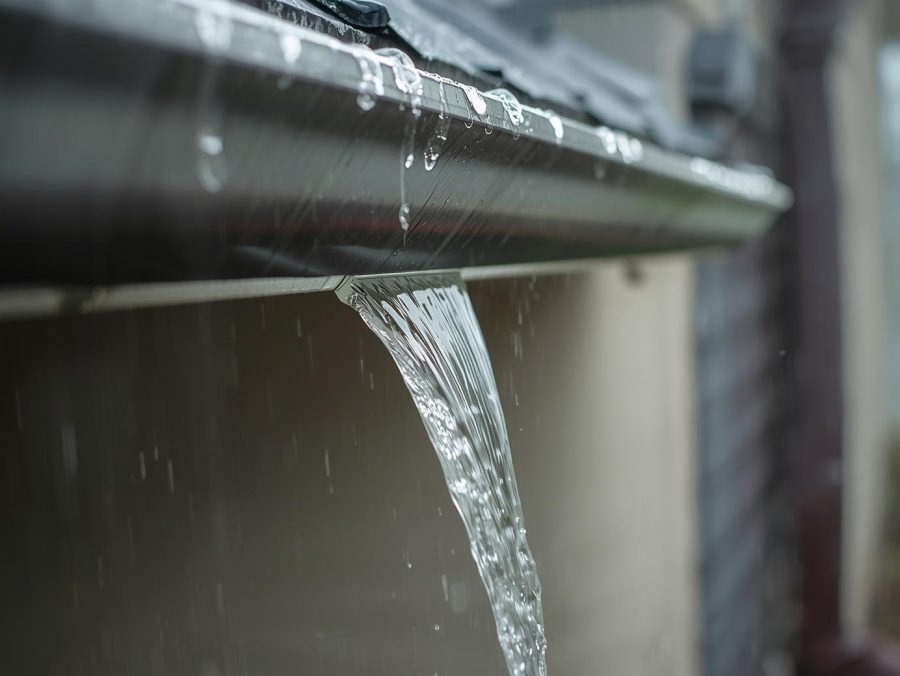
Why Gutter Color and Material Approval Is a Real Scheduling Factor Here
Coral Springs was developed almost entirely as deed-restricted, HOA-governed communities from its earliest planning stages, which makes architectural review approval a practical consideration on nearly every project in the city rather than an occasional exception. Most communities require gutter color — and in some cases material — to be approved by an architectural review committee before installation, a step that doesn’t exist the same way in cities with a more mixed governance history.
We factor typical HOA review timelines into the installation schedule and provide the documentation most architectural review committees ask for, so this step doesn’t become a surprise delay partway through a project.
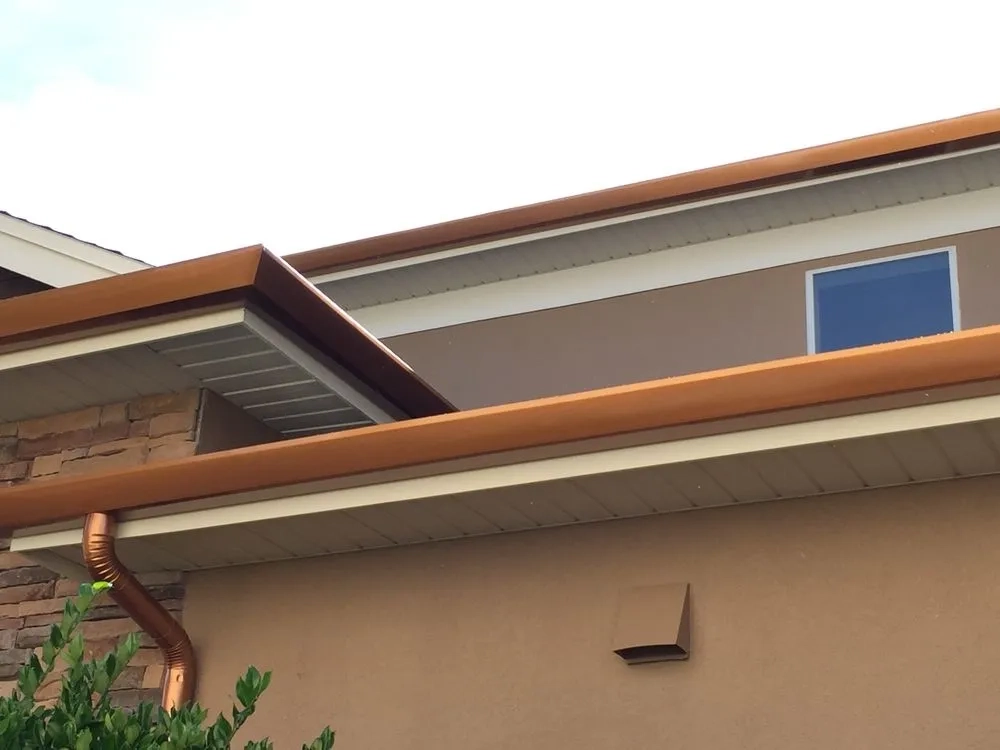
Why Hardware Vintage Is More Predictable Here Than in Most Cities
Because Coral Springs developed in fairly distinct waves rather than continuously over many decades, hardware vintage tends to correlate more predictably with neighborhood here than in cities with scattered infill construction. The original 1970s and 1980s tract neighborhoods — Ramblewood, Forest Hills, and the Riverside area — carry hardware from that era’s specifications, predating current HVHZ code. Neighborhoods built in the 1990s and 2000s, including Eagle Trace, Turtle Run, and Heron Bay, meet current code but often have hip-roof valley convergence points that builder-grade gutters weren’t sized for.
This predictability helps at the estimate stage — knowing a property’s neighborhood gives a strong initial read on likely hardware vintage before the technician even arrives, though we still verify condition on-site rather than relying on the neighborhood alone.
Four Failure Patterns Most Common on Coral Springs Property Assessments
The internal lake network, near-universal HOA governance, decade-correlated construction waves, and HVHZ compliance gaps each produce specific and identifiable conditions. These four account for the large majority of what we find on initial property assessments across the city.
Lake-Lot Storm-Surge Saturation
Properties fronting the internal lake network experiencing temporary water table elevation during and after major storms, when the lakes are actively functioning as retention basins.
Original Tract Aging Hardware
1970s-80s homes in Ramblewood, Forest Hills, and the Riverside area showing loosened hangers and undersized downspouts from hardware that predates current HVHZ code.
Newer Community Valley Overflow
Hip-roof homes in Eagle Trace, Turtle Run, and Heron Bay overflowing specifically at valley convergence points where builder-grade gutters weren’t sized for combined roof-plane flow.
Unpermitted Color/Material Changes
Gutter replacements or repairs completed without HOA architectural review approval, creating compliance issues for the homeowner after the fact.
Gutter and Drainage Services for Coral Springs and Broward County
Each service addresses conditions specific to Coral Springs’ internal lake network, HOA governance requirements, decade-correlated construction waves, or HVHZ compliance. We identify which apply to your property during the free estimate.
Coral Springs Neighborhoods and Broward County Communities We Serve
Lake proximity, HOA governance, and construction era vary predictably across Coral Springs. Knowing which zone a property sits in is the first step of every estimate visit.
Schedule a Coral Springs Estimate
We serve all Coral Springs neighborhoods and Broward County communities. Every estimate begins with zone identification — lake-lot, original tract, or newer HOA community — because the correct discharge and hardware recommendation differs meaningfully across the city’s development waves. This assessment is included in the free estimate at no additional charge.
South Florida Office:
3625 NW 19th St, Lauderdale Lakes FL 33311
(954) 563-9384
How We Work in Coral Springs and Broward County
Zone and HOA Requirements Assessed Together, Not as an Afterthought
Coral Springs’ history as a single master-planned city gives it a more predictable structure than most places we work — construction era correlates closely with neighborhood, and HOA governance is close to universal. We use that predictability to our advantage at the estimate stage, while still verifying actual hardware condition and lake proximity on-site rather than assuming based on neighborhood name alone.
For lake-lot properties, we assess proximity to the internal lake network and plan discharge around the storm-driven water table fluctuation that’s specific to this city’s retention-basin design. For older tract neighborhoods, we check hardware vintage against current HVHZ standards. And because HOA architectural review applies in nearly every Coral Springs community, we build typical approval timelines into the project schedule from the outset rather than treating it as a surprise mid-project delay.
We fabricate seamless gutters on-site from continuous coil stock — no pre-cut section joints — with HVHZ-approved fastening and HOA-compliant color and material selection.
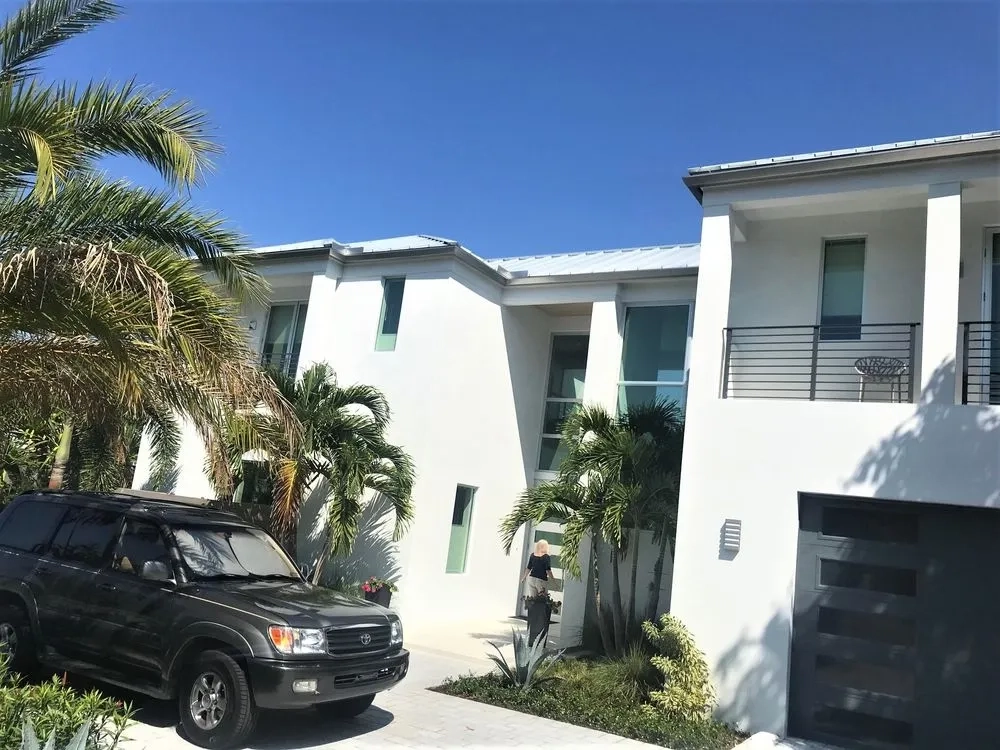
How We Work
From Estimate to Installation
Five steps between your free estimate and a correctly specified gutter system for your Coral Springs property.
Zone & HOA Assessment
Lake proximity, construction era, and HOA architectural review requirements determined first.
Roofline & Hardware Analysis
Catchment area per run, hip-roof valley convergence point identification, hardware vintage review for original-tract properties.
Sizing, Color & Discharge Spec
Gutter profile, HOA-compliant color, valley outlet additions, and discharge routing based on zone.
On-site Fabrication
Seamless gutters formed from continuous coil stock to your exact roofline dimensions — no pre-cut section joints.
Install & Flow Test
Gutters hung at calculated pitch with HVHZ-approved fastening, downspouts connected as specified, flow tested before the crew leaves.
Why an Eagle Trace Lakefront Lot Needs a Different Plan Than an Interior Lot
On a Coral Springs property away from the internal lake network, downspout discharge deposited at grade percolates away from the foundation efficiently under normal conditions, since there’s no adjacent retention basin affecting the local water table. Standard grade-level discharge is typically adequate here year-round.
On a property fronting the lake network, the lake’s function as a storm retention basin means the adjacent water table can rise temporarily during and after major rain events, reducing how much capacity the ground has to absorb additional gutter discharge during exactly the periods when demand is highest. For these properties, we plan discharge routing that accounts for this storm-driven fluctuation rather than assuming the lake’s typical weir-controlled level applies during every condition.
This is why we assess lake proximity during every Coral Springs estimate rather than assuming based on subdivision name. See our underground drainage page for system configuration detail.
Lake-Lot Discharge Routing
Drainage systems designed around storm-driven water table fluctuation for properties fronting Coral Springs’ internal lake network.
Original Tract Hanger Replacement
Full hanger replacement at HVHZ-compliant spacing for Ramblewood, Forest Hills, and other 1970s-80s tract neighborhoods.
Valley Outlet Additions
Additional downspout outlets at hip-roof valley convergence points in Eagle Trace, Turtle Run, and Heron Bay.
HOA-Compliant Color & Material Selection
Gutter specification matched to each community’s architectural review requirements, with documentation provided for approval submission.
Lake-Lot, Original Tract, and Commercial Gutter Systems in Coral Springs
Internal Lake-Lot Residential
Properties fronting Coral Springs’ engineered lake network — assessed for storm-driven water table fluctuation and hip-roof valley overflow.
Original 1970s-80s Tract Core
Ramblewood, Forest Hills, and the Riverside area — the city’s earliest development wave, assessed for aging-hardware conditions.
Commercial & Corridor Properties
University Drive, Sample Road, and Coral Springs City Center commercial and mixed-use buildings.
What Coral Springs and Broward County Customers Say
Professionalism
The first home repair team in a long time that did what they promised and on time. I would recommend Hank’s. We had a whole house gutter and downspout replacement after the March hail storm in 2023.

Highly Recommended!
Dealt with Precision Gutters on a complex custom project, fixing an issue caused by a bad contractor. They worked tirelessly with me and went over every detail to help me come up with the best solution.
Premium Quality
Very professional and on time installation highly recommend thank you for your service!
Knowledgeable
I contracted Precision Gutters LLC to do the drainage for the gutters. They are professional, punctual, great attitude, knowledgeable, respectful personally.
I highly recommend Precision Gutters LLC as a company & their skills workers. Every message I sent to the Sales Representative Marc Marchand was answered in a timely manner & to the point.
Gutter Installation, Repair, Cleaning, and Drainage in Coral Springs
Frequently Asked Questions — Coral Springs Gutter Services
Why do properties on Coral Springs’ internal lakes have different drainage needs?
Coral Springs’ lakes were engineered for flood control and function as retention basins during storms. Levels are weir-managed most of the year but can rise measurably during major storm events, temporarily elevating the water table for lake-fronting properties and affecting grade-level discharge capacity.
Do I need HOA approval before installing gutters in Coral Springs?
In most Coral Springs neighborhoods, yes. The city was developed almost entirely as deed-restricted communities, and gutter color — and sometimes material — typically needs architectural review committee approval before installation. We build this into the project timeline and provide the needed documentation.
Does Coral Springs fall under the same HVHZ code as Miami and Fort Lauderdale?
Yes. Broward County, including Coral Springs, follows HVHZ provisions alongside Miami-Dade. Gutter hangers need product approval documentation regardless of lake proximity or construction era.
Why does my gutter only overflow at one point on the roofline?
That’s typically a valley convergence problem, common in hip-roof floor plans throughout Coral Springs’ 1990s and 2000s communities like Eagle Trace and Heron Bay. A standard 5-inch section is sized for a single roof plane, and a valley receives combined flow from two — exceeding capacity during peak storms. The correction is upsizing that section and adding a dedicated outlet.
How does older Coral Springs construction differ from newer communities?
Original 1970s-80s tract construction in Ramblewood and Forest Hills has hardware predating current HVHZ code. Newer 1990s-2000s communities like Eagle Trace and Heron Bay meet current code but often have hip-roof valley convergence points builder-grade gutters weren’t sized for. Construction era correlates closely with neighborhood here.
How often should gutters be cleaned in Coral Springs?
Most properties benefit from cleaning twice annually — before hurricane season in May and again in late fall. Lake-adjacent and heavily landscaped properties may need a third mid-summer cleaning.
What’s the difference between gutter repair and full replacement?
Repair addresses isolated issues on an otherwise sound system. Replacement is typically more cost-effective when multiple failure points appear concurrently, more common in Coral Springs’ original 1970s-80s tract neighborhoods than in the city’s newer communities.
Do you serve commercial properties in Coral Springs?
Yes. Commercial buildings along the University Drive and Sample Road corridors are assessed individually for roof catchment area and HVHZ product approval requirements rather than scaled up from a residential specification.
Other Cities We Serve Near Coral Springs
Precision Gutters serves communities throughout Broward County and the broader South Florida region. Each has distinct lake, canal, and housing stock conditions that shape the correct gutter specification.
Stop Water Problems Before They Reach the Foundation
Coral Springs’ internal lake network, near-universal HOA governance, and decade-correlated construction waves each demand a different piece of the specification. A lake-lot property needs storm-aware discharge planning. An Eagle Trace or Heron Bay home needs valley overflow correction. A Ramblewood property needs aging-hardware assessment. Every project needs HOA-compliant color and HVHZ-approved fastening.
Free estimates include all of these assessments before we recommend anything.
Other Florida Locations