
Gutter Company In Tampa, FL
Tampa averages 47 inches of rain per year — most of it arriving in intense wet-season events that overload undersized or deteriorating gutter systems. We install seamless gutters sized for Gulf Coast rainfall volumes, fascia and soffit conditions, and Hillsborough County soil drainage patterns.
Gutter Installation and Drainage Solutions Throughout Tampa
Tampa’s housing stock spans a wide range of roofline types, ages, and configurations that each present distinct drainage engineering requirements. South Tampa neighborhoods — Palma Ceia, Bayshore Beautiful, Hyde Park, Davis Islands — feature Craftsman bungalows, Spanish Mission homes, and brick colonials built from the 1920s through 1950s. These homes typically have shallow-pitched rooflines with original rafter-tail construction, wood fascia boards that have cycled through decades of Florida humidity, and inadequate downspout spacing relative to modern rainfall intensity standards.
Newer construction in Westchase, New Tampa, and Carrollwood runs toward Mediterranean revival and contemporary ranch styles with larger footprints, complex hip and valley configurations, and wider roof catchment areas requiring higher-capacity gutter profiles. A 6-inch K-style gutter that works correctly on a 1,500-square-foot bungalow in Seminole Heights may be undersized on a 3,000-square-foot hip-roof home in Westchase if downspout spacing and pitch are not recalculated for the actual catchment area.
Ybor City and Tampa Heights present a third category — historic masonry and stucco construction where fascia integration requires different anchoring approaches and where salt-influenced air from Tampa Bay creates accelerated oxidation conditions even on properties several miles inland from the water.
Why Flat Terrain Makes Discharge Location Critical
Tampa’s average elevation of roughly 10 feet above sea level means gutter systems cannot rely on gravity alone to move water away from foundations at speed. On flat lots — common throughout South Tampa, Carrollwood, and the New Tampa subdivisions — water discharged at grade level from a downspout has minimal natural slope to carry it away from the slab or stem wall edge.
Sandy soils in elevated Tampa neighborhoods percolate reasonably well, but clay-rich soils in low-lying areas near Hillsborough Bay, the Sulphur Springs corridor, and sections of East Tampa resist absorption and cause surface pooling within minutes of high-volume discharge. Properties in these zones need downspout extensions and, in many cases, underground drainage systems with catch basins or French drains that route water to a proper discharge point past clay layers.
The combination of flat terrain, clay soil pockets, and the proximity of much of Tampa to tidal water features means that gutter discharge planning is a property-specific calculation — not a default downspout-to-grade installation that works in higher-elevation Florida markets.
Why Gulf-Front Storms Expose Gutter Problems Faster Than Inland Markets
Tampa sits at the convergence of two moisture sources — Gulf of Mexico sea breezes from the west and Atlantic moisture transported inland from the east — making Hillsborough County one of the highest-lightning-density counties in the United States and producing storm cells that deliver rainfall faster and in greater volume than the state average. During active tropical systems, Tampa can receive 10 or more inches over a 24-hour period, testing gutter capacity well beyond typical summer storm thresholds.
Gulf-proximate properties — Davis Islands, Ballast Point, Bayshore, the Westshore waterfront — also experience salt-air exposure that accelerates surface oxidation on aluminum gutters at a rate approximately 1.5 to 2 times higher than inland locations. This doesn’t disqualify aluminum as a material; it requires appropriate gauge selection, factory-applied paint adhesion, and in some cases material alternatives such as Galvalume or copper for homes immediately adjacent to Old Tampa Bay or Hillsborough Bay.
How Rainfall Intensity Determines Gutter Profile Selection
The standard residential gutter calculation for Tampa uses a rainfall intensity rate between 5 and 7 inches per hour for the 100-year storm event rather than the average annual figure. Applied to a typical roofline catchment area, this calculation frequently results in a minimum 5-inch K-style gutter recommendation — and 6-inch profiles for larger roof surfaces, steep pitches that increase runoff velocity, or hip-roof configurations with multiple valley convergence points.
The downspout sizing equation follows the gutter profile selection: a single 2×3 downspout that was standard installation practice in the 1980s and 1990s is undersized for a 6-inch gutter on a Tampa home by current drainage capacity standards. We calculate the correct 3×4 or round downspout size per gutter run, number of outlets, and roof pitch during the estimate, not as a post-installation add-on. Service coverage throughout Tampa includes Hillsborough County and immediate surrounding communities.
Water That Has Nowhere to Go Finds Its Own Path — Usually Through Your Foundation
When a Tampa gutter system fails to manage wet-season volumes, the consequences are structural rather than cosmetic. Gulf-front storms don’t allow time for incremental damage. Four failure patterns account for most of the water damage we see on Tampa properties.
Fascia and Soffit Rot
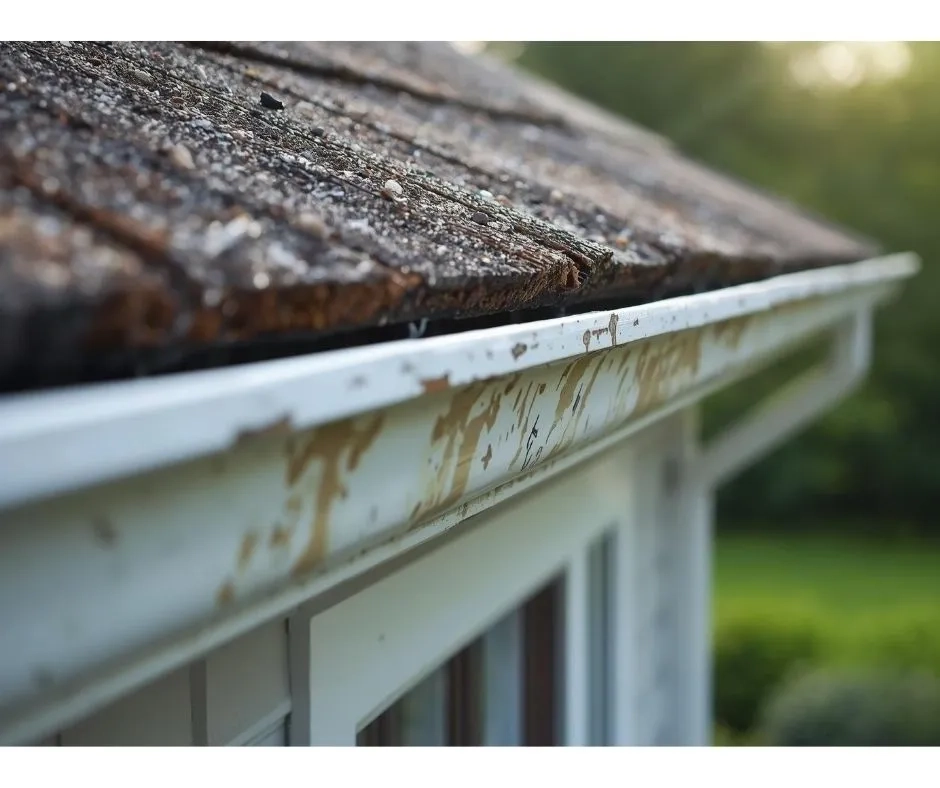
Gutters that overflow against the fascia board introduce standing moisture into wood fiber that Florida humidity cannot dry between storm cycles. Fascia rot typically progresses 12–18 inches in each direction from the overflow point before it becomes visually apparent. By the time the fascia board deflects, the rafter tails and roof deck edge are already compromised.
Slab Edge Saturation
Tampa homes on slab foundations are particularly vulnerable to concentrated discharge near the foundation perimeter. Clay soil layers prevent rapid percolation, and hydrostatic pressure against the slab edge causes the soil-to-concrete interface to shift over time. Hairline cracking at interior floor seams and door frame movement are common indicators of long-term slab saturation from discharge pooling.
Salt-Air Gutter Corrosion
Properties within one to two miles of Tampa Bay and Old Tampa Bay experience chloride-accelerated surface oxidation on aluminum gutters that shows as white chalking at seams and joints before progressing to perforation. Gulf-proximate homes need material specification and gauge selection calibrated to actual salt-air exposure levels — not the standard residential spec applied uniformly across all locations.
Landscape Erosion and Pooling
Uncontrolled downspout discharge on flat Tampa lots creates concentrated flow channels through planting beds, washout along driveways, and pooling at grade level adjacent to walkways and patios. Beyond property appearance, consistent soil movement from high-volume discharge causes settling around utility penetrations and, on clay-rich lots, foundation moisture cycling that accelerates concrete joint separation.
Gutter Services Across the Tampa and Hillsborough County
Each service listed below addresses a specific drainage condition common to Tampa rooflines, soil types, and Gulf-proximate environments. We assess which services apply to your property during the estimate rather than recommending a standard package.
Schedule a Tampa Estimate
We serve all Tampa neighborhoods and surrounding Hillsborough County communities. Estimates are free, include a fascia condition assessment, and typically schedule within the same week.
Orlando Office:
4677 LB McLeod Rd, Ste. B, Orlando FL 32811
(407) 203-1144
Tampa Neighborhoods We Serve
Each Tampa neighborhood presents distinct roofline ages, tree canopy conditions, soil types, and Bay proximity that affect gutter sizing, material selection, and drainage design. We work throughout the city and Hillsborough County.
A Gutter Company That Accounts for Gulf-Front Conditions
Tampa’s gutter installation market includes a broad range of providers who apply a standard residential spec — 5-inch K-style aluminum, stock downspouts, and spike-and-ferrule hangers — uniformly across all property types. That spec may perform adequately in lower-rainfall inland Florida markets. It does not address the Gulf storm intensity, flat terrain drainage limitations, salt-air material degradation, and housing-stock variation that define Tampa’s installation environment.
We operate with a truck-mounted seamless gutter fabrication machine that forms gutters to your specific roofline dimensions on-site rather than cutting pre-sectioned stock. Slope is calculated for each run individually based on your fascia pitch — not set to a standard ¼-inch-per-10-feet default. Fascia condition is assessed before installation begins. Material selection — aluminum gauge, Galvalume, or copper — is determined by your property’s distance from tidal water and measured salt-air exposure, not by a single-spec estimate applied uniformly across all addresses.
We do not separate the estimator role from the installation crew. The person who evaluates your property communicates the drainage analysis directly to the crew performing the work — without a handoff that loses project-specific details between the measurement and the installation day.
Residential and Commercial Gutter Systems in Tampa
Residential Gutter Installation
Single-family homes, townhomes, and villas throughout Tampa and Hillsborough County. Material and sizing determined by roofline, Bay proximity, and drainage conditions.
Commercial Gutter Installation
Retail, multi-family, warehouse, and mixed-use structures in Tampa and Hillsborough County. Commercial rooflines require individual drainage calculation, not residential spec applied at scale.
How We Work
From Estimate to Installation
Five steps between your free estimate and a fully functioning gutter system designed for your specific Tampa property conditions.
01 Property Assessment
Roofline measurement, fascia condition inspection, downspout spacing review, drainage pattern evaluation, and Bay-proximity salt-air exposure rating.
02 Material Specification
Material selected based on proximity to tidal water — standard aluminum for inland properties, Galvalume or copper for Bay-adjacent and Gulf-proximate rooflines.
03 Slope & Sizing Calculation
Gutter profile (5″ or 6″ K-style), downspout size, and outlet spacing calculated against your specific roof catchment area and Tampa rainfall intensity rates.
04 On-site Fabrication
Seamless gutters formed from continuous coil stock on the truck-mounted machine to your exact roofline dimensions — no pre-cut sections spliced to fit.
05 Installation & Testing
Gutters hung at calculated pitch, secured with hidden hanger hardware, downspouts connected to discharge points, and water-flow tested before the crew leaves.
Controlling Where Water Goes After It Leaves the Downspout
A correctly sized gutter system moves water off your roof efficiently. What happens at grade level determines whether that water threatens your foundation. On many Tampa properties — particularly flat lots in South Tampa, Carrollwood, and New Tampa — standard grade-level downspout discharge deposits water within 5 to 10 feet of the slab edge, where flat terrain and occasional clay soil layers prevent it from moving away quickly enough to avoid foundation saturation.
Underground drainage systems route water from the downspout outlet through buried pipe to a pop-up emitter, catch basin, or discharge point positioned at sufficient distance from the foundation to prevent hydrostatic pressure buildup. French drains address subsurface water movement on low-lying lots where the water table rises during wet season. Catch basins collect surface runoff from driveway and patio areas where sheet flow would otherwise concentrate against the structure perimeter.
We assess both the gutter system and the ground-level discharge conditions during the estimate. Internal links to our underground drainage service page and downspout installation page have additional technical detail on system configurations.
Catch Basins
Surface-mounted collection points that capture concentrated discharge from downspouts and surface sheet flow before connecting to buried drainage pipe.
Pop-up Emitters
Pressure-activated discharge outlets positioned at the termination point of underground drain runs — closed at rest, open only during active flow to prevent rodent entry.
French Drains
Perforated pipe systems surrounded by drainage aggregate that intercept and redirect subsurface water movement on low-lying Tampa lots with elevated wet-season water tables.
Downspout Extensions
The minimum intervention for flat lots where discharge distance is inadequate — surface extensions that move water 5–8 feet further from the foundation at lower cost than buried systems.
What Tampa Homeowners Say
Professionalism
The first home repair team in a long time that did what they promised and on time. I would recommend Hank’s. We had a whole house gutter and downspout replacement after the March hail storm in 2023.

Highly Recommended!
Dealt with Precision Gutters on a complex custom project, fixing an issue caused by a bad contractor. They worked tirelessly with me and went over every detail to help me come up with the best solution.
Premium Quality
Very professional and on time installation highly recommend thank you for your service!
Knowledgeable
I contracted Precision Gutters LLC to do the drainage for the gutters. They are professional, punctual, great attitude, knowledgeable, respectful personally.
I highly recommend Precision Gutters LLC as a company & their skills workers. Every message I sent to the Sales Representative Marc Marchand was answered in a timely manner & to the point.
Tampa Gutter Installation, Repair, Cleaning, and Drainage
Frequently Asked Questions — Tampa Gutter Services
What gutter size is correct for Tampa’s rainfall volumes?
Tampa averages roughly 47 inches of annual rainfall concentrated into a May–October wet season, with Gulf-front storm events delivering 2–4 inches per hour during peak cells. Most Tampa rooflines require 5-inch or 6-inch K-style gutters with 3×4 downspouts spaced no more than 30–35 feet apart. Rooflines with steep pitches, large catchment areas, or hip configurations may need 6-inch profiles to prevent overflow during high-intensity events.
Does salt air from Tampa Bay affect aluminum gutters?
Homes within approximately 1–2 miles of Tampa Bay, Old Tampa Bay, or the Gulf shoreline experience elevated chloride concentrations in the air that accelerate oxidation on untreated aluminum. We address this with thicker gauge material, proper paint adhesion, and for homes immediately adjacent to the water, Galvalume gutters or copper as alternatives. Properties in inland neighborhoods like Temple Terrace or Seminole Heights are less affected and standard aluminum performs well with appropriate maintenance.
How does Tampa’s soil type affect gutter and drainage design?
Much of Tampa sits on sandy soils with relatively good percolation, but areas near Hillsborough Bay, low-lying sections of South Tampa, and the Sulphur Springs corridor have higher clay content that resists absorption. Where clay layers prevent rapid percolation, uncontrolled gutter discharge causes surface pooling within 10–15 minutes of heavy rain. Underground drainage systems direct runoff past clay layers to appropriate discharge points.
How often should Tampa gutters be cleaned?
Most Tampa properties need cleaning twice per year — once before wet season (April–May) and once after the primary oak and palm drop in late fall. Properties in neighborhoods with heavy tree canopy, such as Hyde Park, Palma Ceia, or Seminole Heights, may need three cleanings annually. Oak tassels and palm fronds compact inside gutters faster than typical leaf debris and can block downspout inlets with relatively little accumulated volume.
What neighborhoods in Tampa does Precision Gutters serve?
We serve all Tampa neighborhoods including Hyde Park, Palma Ceia, South Tampa, Davis Islands, Seminole Heights, Tampa Heights, Ybor City, Westchase, Carrollwood, New Tampa, Channelside, Ballast Point, Bayshore Beautiful, Temple Terrace, and surrounding Hillsborough County communities including Brandon, Plant City, Riverview, and Lutz.
Are leaf guards worth it for Tampa homes?
Leaf guard performance in Tampa depends on the debris type. Live oak and water oak produce fine tassels and small leaves that penetrate lower-grade screen guards easily. Micro-mesh systems with a 50-micron or finer opening handle fine debris better than standard aluminum screen. For most Tampa properties with mature oak canopy, a quality micro-mesh system reduces cleaning frequency from twice to once per year and prevents the downspout blockages most common after oak tassel season in March–April.
Does Precision Gutters handle commercial gutter systems in Tampa?
Yes. We install commercial gutter systems on retail buildings, multi-family properties, warehouses, and mixed-use structures throughout Tampa and Hillsborough County. Commercial installations typically involve box gutters or larger K-style profiles, roof-level scupper integration, and internal drain tie-ins depending on the roof type. We assess each commercial roofline individually for catchment area, pitch, and discharge requirements.
What causes gutters to pull away from the fascia on Tampa homes?
Fascia separation in Tampa is usually caused by one of three conditions: wood rot behind the fascia board where moisture has penetrated over time, hanger spacing set too wide for the gutter weight during high-volume events, or original installation into rafter tails rather than structural fascia. Florida’s heat and humidity cycles accelerate wood fiber breakdown, so homes older than 15–20 years frequently show fascia deterioration that standard spike-and-ferrule installations cannot hold. We assess fascia condition before installation and replace deteriorated sections as part of the project.
Stop Water Problems Before They Reach the Foundation
A correctly designed Tampa gutter system accounts for Gulf rainfall intensity, Bay-proximity salt air, your roofline configuration, and the drainage conditions at grade level. Free estimates include a fascia condition assessment and a drainage pattern evaluation — not just a linear-foot gutter quote.