
Gutter Company in Pembroke Pines, FL
Pembroke Pines follows High-Velocity Hurricane Zone (HVHZ) wind-load requirements, but its drainage conditions differ from coastal South Florida. Built largely on reclaimed Everglades land, western communities such as Chapel Trail, Pembroke Falls, and Pembroke Isles lie within the C-11 canal basin, where a managed water table influences drainage and discharge planning. Meanwhile, many homes in the city’s older eastern neighborhoods, developed beginning in the 1960s, still have aging gutter systems that predate current building standards. We evaluate each property’s location, age, and drainage conditions before recommending the right solution.
Eastern Established Core
Areas near the Hollywood and Miramar borders, developed since the 1960s and 1970s. Original hardware predates current HVHZ code — loosened hangers, undersized downspouts, and open joints are the typical concurrent-failure pattern.
Western Canal & Lake Communities
Chapel Trail, Silver Lakes, Pembroke Falls, Pembroke Isles, and Century Village. Built on reclaimed Everglades land within the C-11 canal basin, where SFWMD control structures maintain a managed water table. Hip-roof valley overflow is common in these HOA-planned communities.
Central & Pines Boulevard Corridor
Mixed residential and commercial along the city’s central spine. No canal-adjacency water table concern, but HVHZ fastening still governs hanger spacing and product approval throughout.
Why Pembroke Pines Carries Miami’s Code Requirements Without Miami’s Salt-Air Conditions
Pembroke Pines is located within Florida’s High-Velocity Hurricane Zone (HVHZ), meaning it follows the same wind-load requirements as Miami-Dade County for exterior building components, including gutter systems. Every gutter installation must use approved fastening methods and products that comply with HVHZ standards, regardless of how far the property is from the Atlantic Ocean. While many homeowners associate these requirements with coastal cities, they apply equally to inland communities throughout Broward County.
The key difference is that Pembroke Pines does not experience the same level of salt-air exposure as coastal Miami. Located roughly ten miles inland, the city is largely protected from the constant chloride-rich ocean spray that accelerates corrosion along the Atlantic coastline. As a result, most Pembroke Pines homes do not require the Galvalume or copper gutter systems often recommended for oceanfront properties. In most neighborhoods, high-quality seamless aluminum gutters provide the right balance of durability, performance, and value when installed with HVHZ-approved fastening systems.
For every Pembroke Pines installation, we evaluate both the property’s location and its structural requirements. Homes in neighborhoods such as Chapel Trail, Pembroke Falls, SilverLakes, and Pembroke Isles still require hurricane-rated attachment methods, even though they do not face the same corrosion risks as coastal South Florida. By separating wind-load requirements from material selection, we specify gutter systems that meet Broward County’s building code while avoiding unnecessary upgrades that are intended for much harsher coastal environments.
Why Western Pembroke Pines Has a Water Table Condition Unlike Anywhere Else in the Network
Much of western Pembroke Pines — including Chapel Trail, Silver Lakes, Pembroke Falls, and Pembroke Isles — was developed on reclaimed Everglades land within the C-11 canal basin. The South Florida Water Management District maintains water levels in this basin through control structures rather than letting them fluctuate with rainfall alone, which keeps the water table in canal-adjacent properties consistently closer to the surface than in areas without managed canal control.
This is a different mechanism than a seasonal lake level rise or a king tide event — it’s a baseline condition maintained year-round by the water management district, though it does intensify during wet season when the managed system is carrying more volume overall. Properties backing directly onto a canal or community lake have less percolation capacity available for gutter discharge than the same property would have without canal adjacency, which is why we assess proximity to controlled waterways specifically during the estimate.

Why Hip-Roof Homes in Pembroke Falls and Chapel Trail Overflow at One Specific Point
Pembroke Falls, Pembroke Isles, Chapel Trail, and other western HOA-planned communities were built to current code, but builder-grade gutter specification is sized for an average roof plane — not the hip-roof valley convergence points common in these communities’ floor plans. At a valley, a standard 5-inch gutter section receives the combined flow of two roof planes rather than the single-plane volume it was sized to carry, and during peak-intensity South Florida storms, that combined volume exceeds capacity.
Homeowners typically describe this as overflow “at one spot” rather than a general system failure — the diagnostic marker of a valley capacity issue. The correction is targeted: upsizing the section at the valley to 6 inches and adding a dedicated outlet directly beneath the convergence point, rather than replacing runs that aren’t actually the problem.
Why Pembroke Pines’ Established Neighborhoods Show Multiple Failures at Once
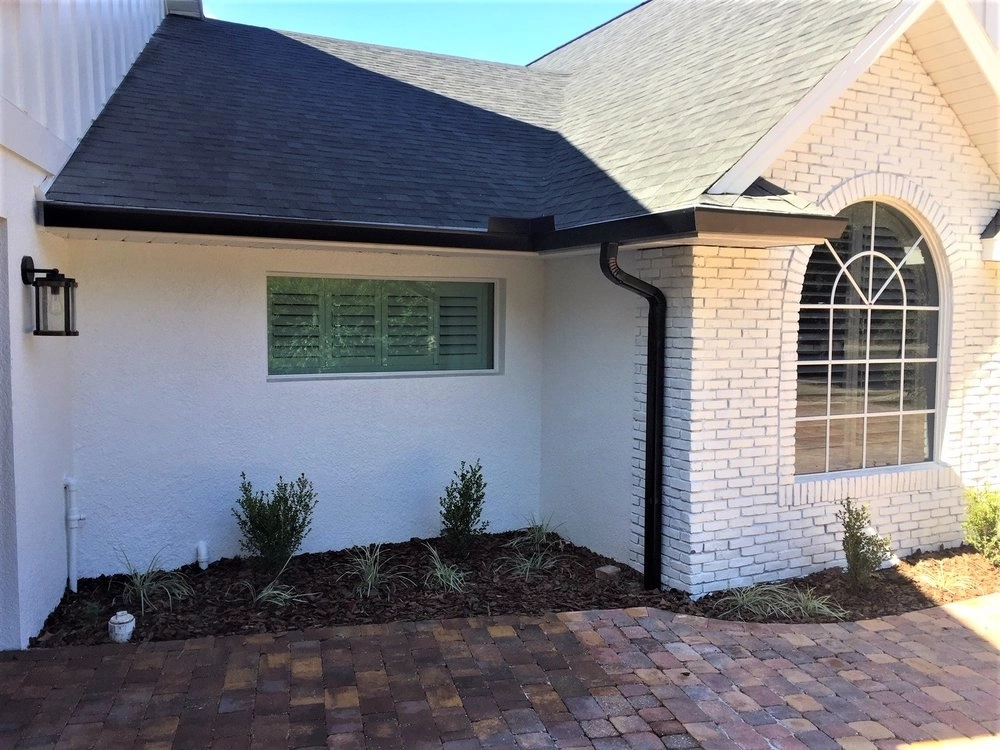
Areas near the Hollywood and Miramar borders, developed since the 1960s and 1970s, contain the city’s oldest gutter installations — hardware sized to standards that predate both current HVHZ code and current wind-load provisions. Three components typically degrade on a similar timeline: original hanger spacing loosens after decades of thermal cycling, original downspouts run at or near capacity against rainfall data that current figures have since exceeded, and sectional joints separate as the metal is worked by repeated expansion and contraction.
When a technician finds all three on the same property — common on homes from this era — seamless replacement with HVHZ-compliant fastening is typically more cost-effective than sequential repairs, since the labor to correct each issue separately usually exceeds the cost of a single seamless installation done right.
Four Failure Patterns Most Common on Pembroke Pines Property Assessments
HVHZ code requirements, the C-11 canal basin’s managed water table, western HOA-community roofline geometry, and the eastern core’s aging hardware each produce specific and identifiable conditions. These four account for the large majority of what we find on initial property assessments across the city.
Canal-Adjacent Foundation Saturation
Properties backing onto C-11 basin canals or community lakes in Chapel Trail, Silver Lakes, and Pembroke Isles experiencing reduced percolation capacity due to the managed water table maintained by SFWMD control structures.
Western HOA Valley Overflow
Hip-roof homes in Pembroke Falls, Pembroke Isles, and Chapel Trail with builder-grade 5-inch sections overflowing specifically at valley convergence points where combined roof-plane flow exceeds single-plane capacity.
Eastern Core Triple-Failure Hardware
1960s–1970s homes near the Hollywood and Miramar borders showing loosened original hangers, undersized original downspouts, and open sectional joints concurrently — the pattern that typically makes seamless replacement more cost-effective than sequential repair.
Non-HVHZ Fastening on Existing Systems
Gutter systems installed with hanger spacing and fasteners that don’t carry Broward County HVHZ product approval — a compliance gap that can exist on any property in the city regardless of construction era.
Gutter and Drainage Services for Pembroke Pines and Broward County
Each service addresses conditions specific to Pembroke Pines’ HVHZ code requirements, C-11 canal basin water table, western HOA-community roofline geometry, or eastern core aging hardware. We identify which apply to your property during the free estimate.
Pembroke Pines Neighborhoods and Broward County Communities We Serve
Canal proximity, construction era, and roofline geometry vary across Pembroke Pines. Knowing which zone a property sits in is the first step of every estimate visit.
Schedule a Pembroke Pines Estimate
We serve all Pembroke Pines neighborhoods and Broward County communities. Every estimate begins with canal-proximity and construction-era identification, because the correct hardware and discharge recommendation differs meaningfully between a Chapel Trail canal-adjacent property and an eastern-core home near Hollywood. This assessment is included in the free estimate at no additional charge.
South Florida Office:
3625 NW 19th St, Lauderdale Lakes FL 33311
(954) 563-9384
How We Work in Pembroke Pines and Broward County
HVHZ Compliance and Canal Proximity — Assessed Together, Not Separately
Pembroke Pines requires the same HVHZ wind-load compliance as our Miami-Dade properties, without the salt-air material consideration that comes with coastal exposure. We verify HVHZ-approved hardware on every estimate regardless of where in the city a property sits, since that requirement doesn’t vary by zone the way material selection does.
What does vary by zone is canal proximity. For western communities within the C-11 basin — Chapel Trail, Silver Lakes, Pembroke Falls, and Pembroke Isles — we assess distance to the nearest managed waterway, since that determines whether standard discharge is adequate or whether the property needs a plan that accounts for a persistently elevated water table. For the eastern established core, we assess hardware vintage and condition, since aging installations from the 1960s and 1970s often show multiple concurrent failure points that make seamless replacement more cost-effective than piecemeal repair.
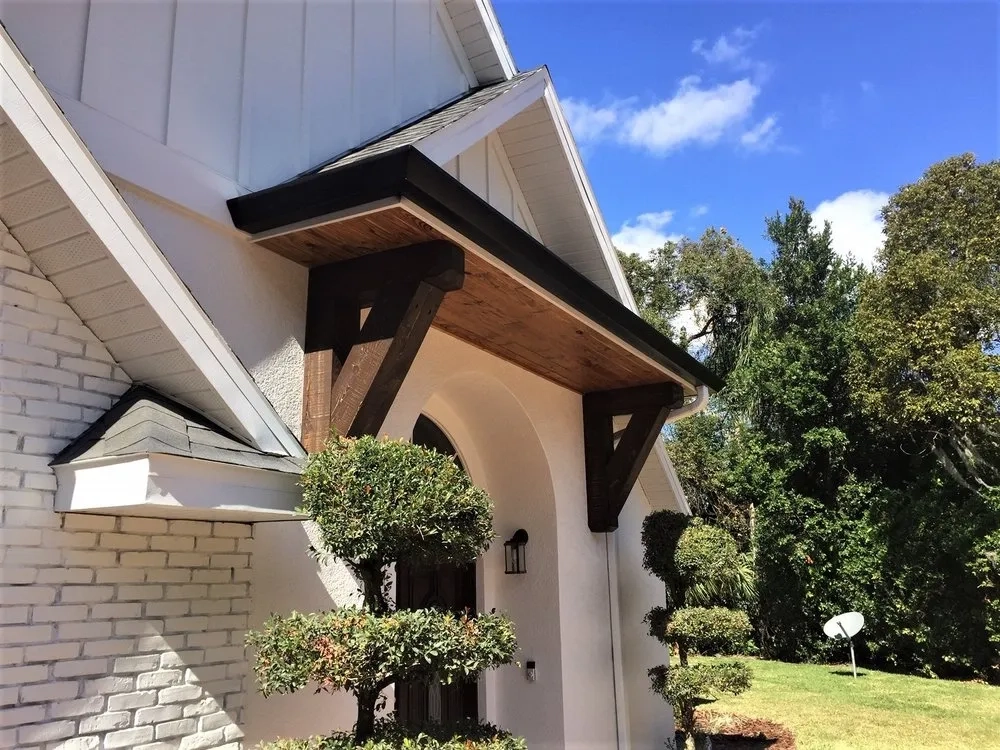
We fabricate seamless gutters on-site from continuous aluminum coil stock — no pre-cut section joints — paired with HVHZ-approved hangers and fasteners rated for Broward County wind-load requirements.
How We Work
From Estimate to Installation
Five steps between your free estimate and a correctly specified, HVHZ-compliant gutter system for your Pembroke Pines property.
HVHZ & Canal Assessment
Wind-load compliance and canal-basin proximity determined first — these shape the discharge and fastening recommendation.
Roofline & Hardware Analysis
Catchment area per run, hip-roof valley convergence point identification, hardware vintage review for eastern-core properties.
Sizing & Discharge Spec
Gutter profile, downspout sizing, valley outlet additions, and discharge routing based on canal proximity and construction era.
On-site Fabrication
Seamless gutters formed from continuous aluminum coil stock to your exact roofline dimensions — no pre-cut section joints.
Install & Flow Test
Gutters hung at calculated pitch with HVHZ-approved fastening, downspouts connected as specified, flow tested before the crew leaves.
Why a Chapel Trail Canal Lot Needs a Different Drainage Plan Than a Pines Boulevard Property
On a property along the Pines Boulevard corridor or elsewhere without canal adjacency, downspout discharge deposited at grade percolates away from the foundation efficiently, since the local water table isn’t affected by the C-11 basin’s managed control structures at that distance. Installing underground drainage on this property adds cost without adding meaningful protection.
On a property backing directly onto a canal or community lake in Chapel Trail, Silver Lakes, or Pembroke Isles, the SFWMD-maintained water table sits consistently closer to the surface, which reduces how much capacity the ground has to absorb additional discharge — a condition that’s present year-round but intensifies during wet season when the managed system carries more volume. For these properties, we typically recommend discharge planning that routes water toward a point less affected by the baseline canal water level, rather than relying on grade-level discharge calibrated to a water table that doesn’t actually apply on that lot.
This is why we assess canal and lake proximity during every Pembroke Pines estimate rather than assuming based on subdivision name. See our underground drainage page for system configuration detail.
Canal-Adjacent Discharge Routing
Drainage systems designed around the C-11 basin’s managed water table for properties backing onto canals or community lakes in western Pembroke Pines.
Eastern Core Hanger Replacement
Full hanger replacement at correct HVHZ-compliant spacing for established Pembroke Pines properties where original hardware has loosened.
Valley Outlet Additions
Additional downspout outlets at hip-roof valley convergence points on western HOA-community homes — the primary correction for builder-spec overflow.
HVHZ Fastening Retrofits
Upgrading existing systems to HVHZ-approved hanger and fastener documentation, regardless of construction era or canal proximity.
Canal-Adjacent, Established, and Commercial Gutter Systems in Pembroke Pines
Western Canal & Lake Communities
Chapel Trail, Silver Lakes, Pembroke Falls, and Pembroke Isles — assessed for managed water table conditions and hip-roof valley overflow before installation.
Eastern Established Core
Areas near the Hollywood and Miramar borders, developed since the 1960s and 1970s — assessed for aging-stock triple-failure pattern.
Commercial & Pines Blvd Corridor
Central commercial corridor and mixed-use properties throughout Pembroke Pines and Broward County.
What Pembroke Pines and Broward County Customers Say
Professionalism
The first home repair team in a long time that did what they promised and on time. I would recommend Hank’s. We had a whole house gutter and downspout replacement after the March hail storm in 2023.

Highly Recommended!
Dealt with Precision Gutters on a complex custom project, fixing an issue caused by a bad contractor. They worked tirelessly with me and went over every detail to help me come up with the best solution.
Premium Quality
Very professional and on time installation highly recommend thank you for your service!
Knowledgeable
I contracted Precision Gutters LLC to do the drainage for the gutters. They are professional, punctual, great attitude, knowledgeable, respectful personally.
I highly recommend Precision Gutters LLC as a company & their skills workers. Every message I sent to the Sales Representative Marc Marchand was answered in a timely manner & to the point.
Gutter Installation, Repair, Cleaning, and Drainage in Pembroke Pines
What Pembroke Pines Homeowners Ask About Gutter Services
Does Pembroke Pines fall under Miami’s HVHZ building code even though it’s not coastal?
Yes. Broward County, including Pembroke Pines, is governed by HVHZ provisions alongside Miami-Dade, regardless of distance from the coast. The difference from Miami is that Pembroke Pines doesn’t have the salt-air corrosion factor that changes material selection near the coast — the code requirement is present without the material consideration.
Why do properties near canals in western Pembroke Pines have different drainage needs?
Much of western Pembroke Pines was developed within the C-11 canal basin, where SFWMD maintains water levels through control structures rather than letting them fluctuate naturally. This keeps the water table in canal-adjacent properties consistently closer to the surface, limiting percolation capacity for gutter discharge, especially during wet season.
Why does my gutter only overflow at one point on the roofline?
That’s the diagnostic signature of a valley convergence problem, common in the hip-roof floor plans throughout western HOA communities like Pembroke Falls and Chapel Trail. A standard 5-inch gutter section is sized for a single roof plane, and a valley receives combined flow from two planes — exceeding capacity during peak-intensity storms. The correction is upsizing that section to 6 inches and adding a dedicated outlet.
How does older eastern Pembroke Pines differ from newer western communities?
Eastern Pembroke Pines, established since the 1960s, has aging hardware that predates current HVHZ code. Western Pembroke Pines, built in the 1990s and 2000s within the C-11 canal basin, meets current code but has hip-roof valley overflow issues plus the managed canal water table condition. One zone has an aging-hardware problem; the other has a roofline-geometry and water-table problem.
How often should gutters be cleaned in Pembroke Pines?
Most properties benefit from cleaning twice annually — before hurricane season in May and again in late fall. Canal-adjacent properties with heavy landscaping in western HOA communities may need a third mid-summer cleaning.
Are builder-installed gutters in Pembroke Falls, Pembroke Isles, or Chapel Trail adequate?
They meet minimum code but are calculated for an average roof plane, not hip-roof valley convergence points common in these communities’ floor plans. Overflow typically shows up specifically at valley points — a targeted, correctable geometry issue rather than defective materials.
What’s the difference between gutter repair and full replacement?
Repair addresses isolated issues on an otherwise sound system. Replacement is typically more cost-effective when multiple failure points appear concurrently, which is common on eastern Pembroke Pines properties where original 1960s-70s hardware tends to degrade in several places around the same time.
Do you serve commercial properties along Pines Boulevard and the central corridor?
Yes. Commercial buildings along Pines Boulevard and Pembroke Pines’ central commercial corridor are assessed individually for roof catchment area and HVHZ product approval requirements rather than scaled up from a residential specification.
Other Cities We Serve Near Pembroke Pines
Precision Gutters serves communities throughout Broward County and the broader South Florida region. Each has distinct canal-basin, salt-air, and housing stock conditions that shape the correct gutter specification.
Stop Water Problems Before They Reach the Foundation
Pembroke Pines carries Miami’s HVHZ code requirements without Miami’s coastal salt-air conditions, and its western canal-basin communities face a managed water table unlike anywhere else in our network. Chapel Trail and Pembroke Falls properties need canal-aware discharge planning. Eastern-core homes need aging-hardware assessment. Every property needs HVHZ-compliant fastening.
Free estimates include all of these assessments before we recommend anything.
Other Florida Locations