
Gutter Company in Sanford, FL
Sanford sits at the origin of the St. Johns River on the shores of Lake Monroe — giving the city a near-lake drainage character that separates it from the rest of the Orlando metro. Historic downtown properties on the lakefront face elevated wet-season water tables and preservation-grade fascia conditions. Heathrow and Markham Woods corridor homes have large-roofline valley overflow from builder-spec systems. And the flat former agricultural land east toward Lake Jesup has some of the lowest-permeability soils in Seminole County. We account for all three before specifying anything.
Historic Downtown — Fascia Assessment Priority
Sanford’s Historic District along Magnolia Avenue, Oak Avenue, and French Avenue contains 1880s–1930s construction with original wood fascia that requires condition assessment before any new gutter hardware is mounted. Lake Monroe proximity adds seasonal water table elevation that affects discharge planning for downtown lakefront lots.
Heathrow & Growth Corridors — Valley Overflow Assessment
Large-footprint homes in Heathrow, Markham Woods, and the SR-417 corridor have builder-installed 5-inch sectional systems with valley overflow at hip-roof convergence points. Established 1970s–90s suburban neighborhoods need hanger system and downspout sizing assessment on aging stock.
Lake Monroe, the St. Johns River Headwaters, and What That Means for Downtown Sanford Drainage
Sanford occupies a unique position at the southern end of Lake Monroe, where the St. Johns River begins its northward journey to the Atlantic. Since the city’s founding in the 1870s, the lakefront has shaped both Sanford’s historic character and its drainage conditions. During the June through October wet season, rising Lake Monroe levels elevate the surrounding water table, particularly in the lakefront, Magnolia Square, and Marina Island neighborhoods. On low-elevation lots, water discharged from downspouts can remain against the slab edge far longer than during the dry season, increasing the risk of foundation moisture problems. For many lake-adjacent properties, underground drainage systems are the most effective solution for moving runoff away from the foundation.
Downtown Sanford’s Historic District, listed on the National Register of Historic Places, includes Victorian and early Craftsman homes built between the 1880s and 1930s along Magnolia Avenue, Oak Avenue, and Elm Avenue. Many retain their original wood fascia boards and exposed rafter tails, leaving structural components with decades of weather exposure. Because aging fascia directly affects gutter performance and fastening strength, a thorough fascia condition assessment should be completed before recommending or installing a new gutter system.
Heathrow, Lake Forest, and the Seminole County Suburban Housing Stock
North and west of Sanford along the SR-417 Central Florida Greeneway, neighborhoods such as Heathrow, Markham Woods, and other master-planned communities feature 3,000 to 6,000 square foot homes with Mediterranean and transitional rooflines, complex hip roofs, and multiple valley convergence points. Many were built with standard 5-inch sectional gutters sized to meet minimum code requirements rather than the actual runoff generated during Central Florida’s intense wet-season storms. Overflow commonly occurs at roof valleys, sending water onto paver driveways, entry walkways, and landscaped front yards where drainage problems are immediately visible.
The established suburban neighborhoods of Lake Forest, Countryside, Bentley, Kingswood, and communities east of US-17/92, built primarily between the 1970s and 1990s, represent Sanford’s largest residential gutter market. Many still have original spike-and-ferrule hangers, undersized 2×3 downspouts, and aging sectional gutters that have separated after decades of thermal expansion and contraction. Because these homes vary significantly in fascia condition and system wear, a complete inspection is the best way to determine whether repair, replacement, or a targeted upgrade will provide the most effective long-term solution.
Why the Celery Fields Legacy Creates the Lowest-Permeability Soils in Seminole County
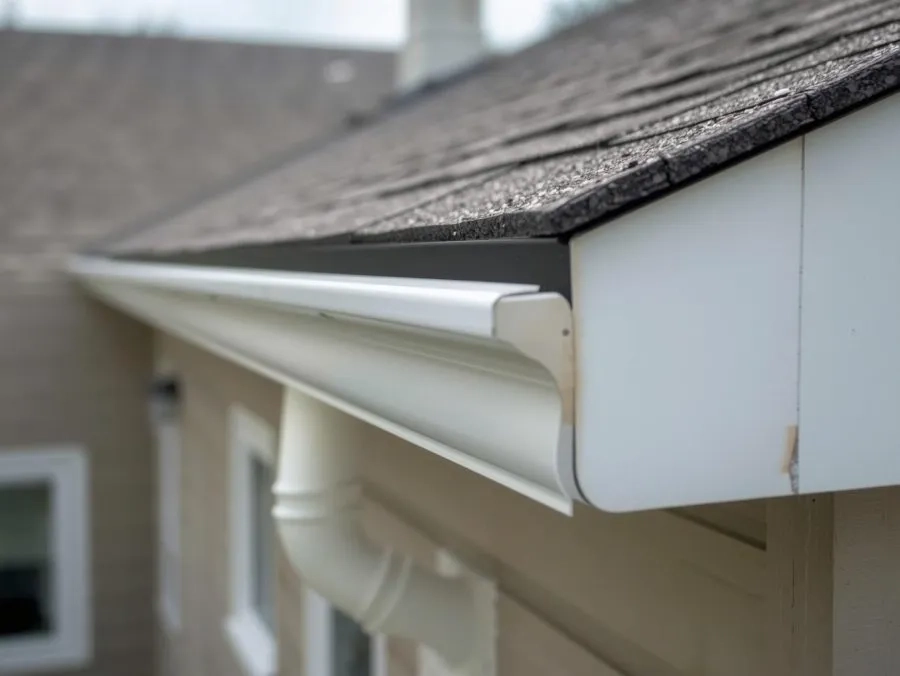
Sanford’s history as the former Celery Capital of the World continues to influence drainage conditions across neighborhoods east of downtown toward Lake Jesup. The flat agricultural land that once supported celery farming, including the Midway corridor, Geneva, and the Lake Jesup basin, contains muck and clay-rich soils that retain water instead of allowing it to drain quickly. Unlike the sandy soils found in other parts of Seminole County, these low-permeability soils cause downspout discharge to remain near the foundation during the wet season. For homes in these areas, underground drainage systems with pop-up emitters or connections to the community stormwater network provide a far more effective solution than simply extending downspouts across the same saturated ground.
Lake Jesup further compounds the problem by raising the seasonal water table in nearby neighborhoods. Properties close to the lake often experience both slow-draining muck soils and elevated groundwater during the rainy season, creating conditions where surface discharge alone cannot adequately move water away from the home. In many of these east Sanford properties, properly designed underground drainage is not simply an upgrade but the most reliable long-term solution for protecting foundations and managing runoff.
Sanford’s Commercial and Logistics Corridor Along SR-46 and the I-4 Interchange
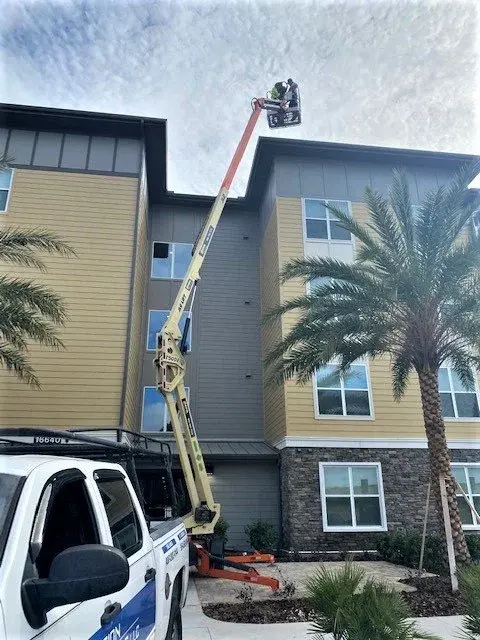
Sanford’s location at the intersection of I-4, SR-417, and SR-46 has made it a major logistics and commercial hub for the north Orlando metro. The SR-46 corridor, Rinehart Road, US-17/92, and Colonial Town Park are home to warehouses, distribution centers, retail developments, and light industrial facilities with roof drainage demands far greater than those of residential properties. Large commercial roofs require gutter systems engineered for their actual catchment area, roof pitch, and discharge requirements rather than scaled-up residential installations.
Historic commercial buildings along First Street present a different challenge. Their older brick and masonry construction requires gutter systems that protect the structure while preserving the architectural character of downtown Sanford. For both modern commercial facilities and historic buildings, evaluating roof size, drainage patterns, and building design is essential to selecting a gutter system that delivers long-term performance and complements the property.
Four Failure Patterns Most Common on Sanford and Seminole County Property Assessments
Sanford’s dual character — historic lakefront and suburban growth corridor — produces failure conditions that span a wider range than most single-market Florida cities. These four account for the large majority of initial assessment findings.
Near-Lake Foundation Saturation — Downtown
Low-elevation lakefront and near-lakefront properties in the Magnolia Square, Marina Island, and First Street areas experience seasonal water table elevation from Lake Monroe during the June–October wet season. By peak wet season, grade-level discharge on these lots percolates slowly enough that foundation-edge saturation from routine storm discharge becomes a recurring condition. The same dynamics seen in Lakeland’s lake-adjacent neighborhoods and Jacksonville’s St. Johns River corridor apply here.
Fascia Rot on Historic District Properties
Victorian and early Craftsman homes in Sanford’s Historic District often retain original wood fascia and exposed rafter tails with 90 to 140 years of weather exposure. When gutters begin separating from the home, the wood beneath them has often deteriorated beyond what is visible. Installing new gutters on weakened fascia can lead to premature failure within a few storm seasons. A thorough fascia inspection, and replacement where necessary, should always come before installing a new gutter system.
Valley Overflow on Heathrow and Markham Woods Homes
Large homes in Heathrow and Markham Woods often have hip roofs with valley convergence points where runoff from multiple roof planes combines during heavy storms. Many builder-installed 5-inch sectional gutter systems cannot handle this volume, causing water to overflow onto paver driveways and front entry walkways. Upgrading valley sections to 6-inch gutters, adding additional outlets, or replacing aging systems with seamless gutters can significantly improve drainage performance.
Muck-Soil Pooling — East Sanford and Midway
Homes in the Midway corridor and near Lake Jesup are often built on former agricultural land with muck and clay-rich soils that drain very slowly during the wet season. Standard downspout discharge can leave water standing against the foundation for extended periods after rain. For these properties, underground drainage systems with pop-up emitters or connections to community stormwater infrastructure provide the most effective long-term solution.
Gutter and Drainage Services for Sanford and Seminole County
Each service addresses conditions specific to Sanford’s historic properties, lake-proximity drainage, suburban housing stock, or SR-46 commercial corridor. We identify which apply to your property during the free estimate.
Sanford Neighborhoods and Seminole County Communities We Serve
Sanford’s housing stock spans more than a century of construction across dramatically different soil, drainage, and architectural conditions. The dominant concern varies significantly by neighborhood.
Schedule a Sanford Estimate
We serve all Sanford neighborhoods and Seminole County communities including Lake Mary, Longwood, Casselberry, Altamonte Springs, Winter Springs, Oviedo, and Geneva. Estimates include a property character assessment — Historic District fascia condition, lake proximity water table, soil drainage conditions, and roofline valley analysis where applicable.
Orlando Office:
4677 LB McLeod Rd, Ste. B, Orlando FL 32811
(407) 203-1144
How We Work in Sanford and Seminole County
Historic Character, Lake-Proximity Drainage, and Soil Conditions — Before Specifying Anything
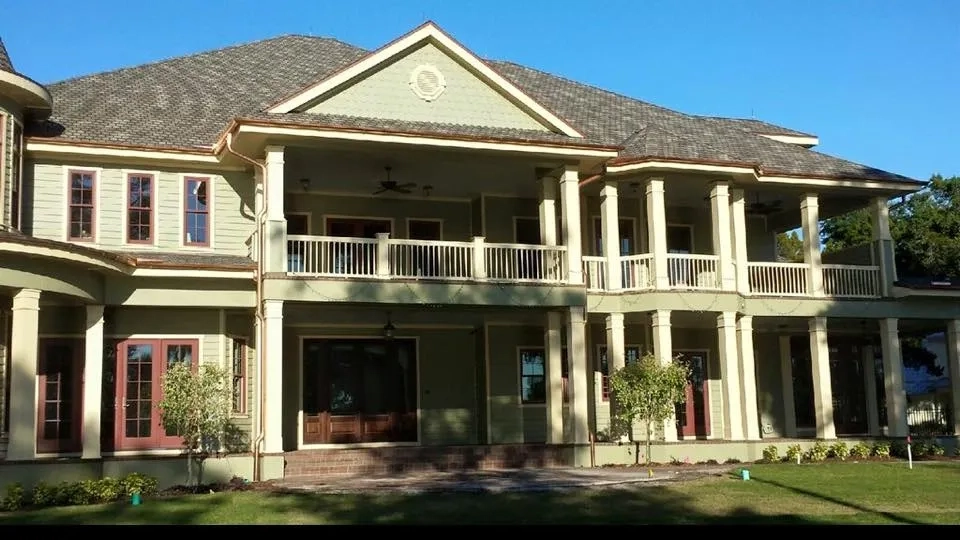
Sanford has one of the most diverse housing stocks in Central Florida. A 1905 Victorian on Magnolia Avenue, a 1970s ranch in Lake Forest, a Mediterranean-style home in Heathrow, and a property on former agricultural land near Midway each require a different approach to gutter design. Historic construction, proximity to Lake Monroe or Lake Jesup, soil conditions, roof complexity, and drainage patterns all influence the right material, sizing, and discharge strategy.
Every Sanford estimate begins with a property-specific assessment. We evaluate whether the home is in the Historic District, near Lake Monroe or Lake Jesup, built on sandy or muck soils, and whether roof valleys require additional outlet capacity. Those findings guide fascia evaluation, gutter sizing, and downspout placement before installation begins.
We fabricate seamless gutters on-site from continuous aluminum coil stock, or copper for qualifying historic homes, to match your roofline precisely. Each run is properly sloped, outlet locations are planned around roof drainage patterns, and the assessment completed during the estimate is carried directly through installation to ensure the finished system is designed specifically for your property.
How We Work
From Estimate to Installation
Five steps between your free estimate and a correctly specified gutter system for your Sanford or Seminole County property.
Property Character Assessment
Historic district, lake-adjacent, established suburban, or flatland muck-soil — determines fascia assessment priority, water table concern, and discharge planning approach before measurement begins.
Fascia & Soil Evaluation
Fascia condition reviewed on all historic and older properties. Soil drainage assessed at discharge locations — sandy ridge vs. muck flatland determines whether underground drainage components are required.
Sizing & Material Spec
Gutter profile (5″ or 6″), downspout sizing, outlet placement, and material finalized. Valley points on Heathrow and Markham Woods homes receive individual outlet analysis. Copper specified for qualifying historic properties.
On-site Fabrication
Seamless gutters formed from continuous coil stock in aluminum or copper to exact roofline dimensions — no pre-cut section joints on long straight runs.
Install & Flow Test
Gutters hung at calculated pitch, downspouts connected to grade-level or underground discharge as specified, flow tested before the crew leaves the property.
Why Sanford Requires Three Different Discharge Approaches Across Its Market Area
Sanford’s combination of changing soil types and seasonal water table conditions means one drainage approach does not fit every property. On the higher sandy soils of Lake Forest, parts of Countryside, and the SR-46 corridor, standard downspout extensions typically provide adequate drainage because water percolates quickly away from the foundation. Near Lake Monroe and downtown Sanford, however, the seasonal rise in the water table slows drainage during the wet season, making underground drainage systems a more effective way to move runoff away from the home.
East of Sanford toward Midway and Lake Jesup, the challenge shifts to muck and clay-rich soils that retain water year-round. In these neighborhoods, extended downspouts alone rarely solve standing water issues. Underground drainage with pop-up emitters or connections to community stormwater systems provides the most effective long-term solution. During every estimate, we evaluate soil conditions, water table influence, and drainage patterns at each downspout location to recommend the right system. Learn more on our underground drainage and downspout installation pages.
Lake-Adjacent Discharge Runs
Buried pipe to pop-up emitter for Lake Monroe and Lake Jesup-adjacent properties — routing discharge away from the foundation perimeter during wet-season water table elevation that reduces grade-level percolation rates.
Valley Outlet Addition
Additional downspout outlets at hip-roof valley convergence points on Heathrow and Markham Woods homes — addressing the overflow that standard builder outlet spacing causes at combined-flow valley locations during peak wet-season storms.
Muck-Soil Drainage Systems
French drains and catch basins for former agricultural flatland properties east of Sanford where clay-muck soils provide almost no percolation capacity — routing water to stormwater connections or controlled discharge emitters.
Downspout Upsizing
Replacing original 2×3 downspouts with 3×4 outlets on established suburban homes where the original sizing is inadequate for current rainfall intensity standards applied to the roofline’s actual catchment area.
Residential, Historic, and Commercial Gutter Systems in Sanford and Seminole County
Residential
From established 1970s–90s Lake Forest and Countryside homes through newer Heathrow and Lake Mary-border construction. Assessment approach determined by property age and location.
Historic Properties
Sanford Historic District Victorian and Craftsman properties — one of Central Florida’s most intact collections of pre-1930 residential construction.
Commercial
SR-46, Rinehart Road, US-17/92 commercial corridors; downtown First Street historic commercial; Colonial Town Park; and industrial properties in the I-4 interchange zone.
What Sanford and Seminole County Customers Say
Professionalism
The first home repair team in a long time that did what they promised and on time. I would recommend Hank’s. We had a whole house gutter and downspout replacement after the March hail storm in 2023.

Highly Recommended!
Dealt with Precision Gutters on a complex custom project, fixing an issue caused by a bad contractor. They worked tirelessly with me and went over every detail to help me come up with the best solution.
Premium Quality
Very professional and on time installation highly recommend thank you for your service!
Knowledgeable
I contracted Precision Gutters LLC to do the drainage for the gutters. They are professional, punctual, great attitude, knowledgeable, respectful personally.
I highly recommend Precision Gutters LLC as a company & their skills workers. Every message I sent to the Sales Representative Marc Marchand was answered in a timely manner & to the point.
Gutter Installation, Repair, Cleaning, and Drainage in Sanford
Frequently Asked Questions — Sanford Gutter Services
How does Lake Monroe affect drainage for downtown Sanford properties?
Lake Monroe forms the northern boundary of downtown Sanford and marks the origin of the St. Johns River. During the June through October wet season, the lake level rises with rainfall accumulation, and the water table in adjacent neighborhoods rises with it. Properties in the lakefront, Magnolia Square, and Marina Island areas within approximately two to three blocks of the lake experience elevated wet-season water tables that slow grade-level downspout discharge percolation. By peak wet season in August and September, discharge that percolated from a foundation edge in 20 minutes in June can sit in contact with the slab for an hour or more. Underground drainage systems that route discharge away from the foundation perimeter are the technically correct solution for low-elevation lake-adjacent Sanford properties.
Do historic homes in Sanford’s downtown district need special assessment?
Yes. Sanford’s Historic District contains Victorian and early Craftsman homes built from the 1880s through the 1930s along Magnolia Avenue, Oak Avenue, Elm Avenue, and French Avenue. These properties have original wood rafter-tail framing and wood fascia boards exposed to Seminole County’s humidity for 90 to 140 years. By the time gutters on homes of this age are visibly separating from the fascia, the wood substrate behind them has typically deteriorated over a span wider than the visible failure point. We assess fascia condition as a prerequisite to any installation recommendation. For properties listed on the National Register or subject to Sanford’s historic preservation guidelines, gutter profile and color must be compatible with the architectural period. Copper half-round profiles are available for properties where period-appropriate materials are required.
What drainage conditions apply to Lake Jesup-adjacent properties in Midway and Geneva?
Lake Jesup stretches across eastern Seminole County through the Geneva and Midway areas. Properties adjacent to or within approximately two to three blocks of Lake Jesup face seasonal water table elevation during the June through October wet season as the lake level rises. The former agricultural muck and clay soils that characterize much of the Lake Jesup basin also have substantially lower percolation rates than the sandy soils of Sanford’s higher ground. On Lake Jesup-adjacent properties, the combination of elevated wet-season water table and clay-muck soil means grade-level downspout discharge has almost no percolation capacity during peak wet season. Underground drainage is the appropriate specification for most properties in this zone.
Do newer homes in Heathrow and Markham Woods need gutter assessments?
Builder-installed gutter systems in Heathrow, Markham Woods, and the upscale planned communities along the SR-417 and Markham Road corridors are typically 5-inch sectional aluminum at minimum code specification. These communities contain homes in the 3,000 to 6,000 square foot range with complex rooflines featuring multiple hip-roof planes, extended overhangs, and valley convergence points where combined flow during peak storm events substantially exceeds what a single-plane 5-inch profile can handle. Valley overflow on these properties discharges onto paver driveways and front entry walks visible from the street. We assess valley point sizing, sectional joint condition, and downspout spacing before recommending repair or replacement.
How does the former celery field land east of Sanford affect drainage?
Sanford’s history as the Celery Capital of the World explains the drainage conditions on a significant portion of land east of the city center toward Lake Jesup. Celery cultivation thrived because the flat, low-elevation terrain held water — properties on former agricultural flatland in the Midway corridor and Lake Jesup basin have muck and clay-muck soil profiles that retain water rather than percolating it. On residential lots developed on this former agricultural flatland, grade-level downspout discharge faces a percolation environment unlike the sandy soils of Sanford’s higher ground. Water deposited near the foundation does not move laterally or percolate vertically at meaningful speed during wet season. Underground discharge runs — pop-up emitters in the turf zone or connections to the community’s stormwater infrastructure — are the correct solution.
What gutter conditions are typical in Lake Forest, Countryside, and Bentley?
Lake Forest, Countryside, Bentley, and Kingswood represent the largest segment of Sanford’s established suburban housing stock — concrete block and frame construction from the 1970s through the 1990s. Homes in this age range typically have original spike-and-ferrule hanger installations that have loosened through 30 to 50 years of Florida’s heat cycling, original 2×3 downspout sizing undersized for current rainfall intensity standards, and sectional aluminum gutter systems with joint separations developed through age and thermal movement. We assess whether targeted hanger replacement and downspout upsizing is adequate, or whether the combination of joint failures and fascia deterioration makes full replacement more cost-effective over a 10-year horizon.
How often should Sanford homes with live oak and pine canopy be cleaned?
Most Sanford residential properties need gutter cleaning at least twice per year — once pre-wet-season in April or May and once post-fall in November. Properties with significant live oak canopy in the historic district, Lake Forest, and the established neighborhoods along Magnolia Avenue and Oak Avenue may need three annual cleanings. Live oak sheds fine tassels and acorn caps year-round rather than in a single seasonal drop, and these small debris types accumulate at downspout inlets faster than standard leaf debris. The pre-wet-season cleaning is the most critical interval — entering June with partially blocked downspout inlets means the first significant storm of the season tests the system at reduced capacity.
Does Precision Gutters serve commercial properties along SR-46 and Rinehart Road?
Yes. We install commercial gutter systems on retail and office properties throughout Sanford’s commercial corridors — SR-46, Rinehart Road, the US-17/92 strip, and the Colonial Town Park area — as well as on warehouse and light industrial properties in the SR-46 east corridor and the I-4 interchange industrial zones. We also serve historic commercial buildings in downtown Sanford’s First Street district where exterior appearance and drainage performance must both be addressed, and multifamily properties throughout Sanford and the Lake Mary/Sanford border area. Each commercial property is assessed individually for catchment area, roof drainage plan, and discharge requirements.
Stop Water Problems Before They Reach the Foundation
Sanford’s historic lakefront district, established suburban ring, Heathrow corridor growth homes, and former agricultural flatland east toward Lake Jesup all require gutter systems specified for the actual property conditions — not the generic Central Florida residential template the live page applied uniformly. Free estimates include a property character assessment, fascia condition review on older and historic properties, lake proximity water table evaluation, and soil drainage analysis at downspout discharge locations.
Other Florida Locations