
Gutter Company in Kissimmee, FL
Kissimmee hosts one of the highest concentrations of short-term rental vacation villas in North America — purpose-built 4 to 8 bedroom properties with complex hip-roof configurations, pool decks, and hardscaped lanai areas that create drainage conditions not seen in standard residential markets. We size systems for villa rooflines, plan discharge around pool deck and hardscape constraints, and serve property managers and owner-operators across Osceola County’s STR communities.
Vacation Villa Rooflines Generate Drainage Loads That Standard Residential Spec Doesn’t Account For
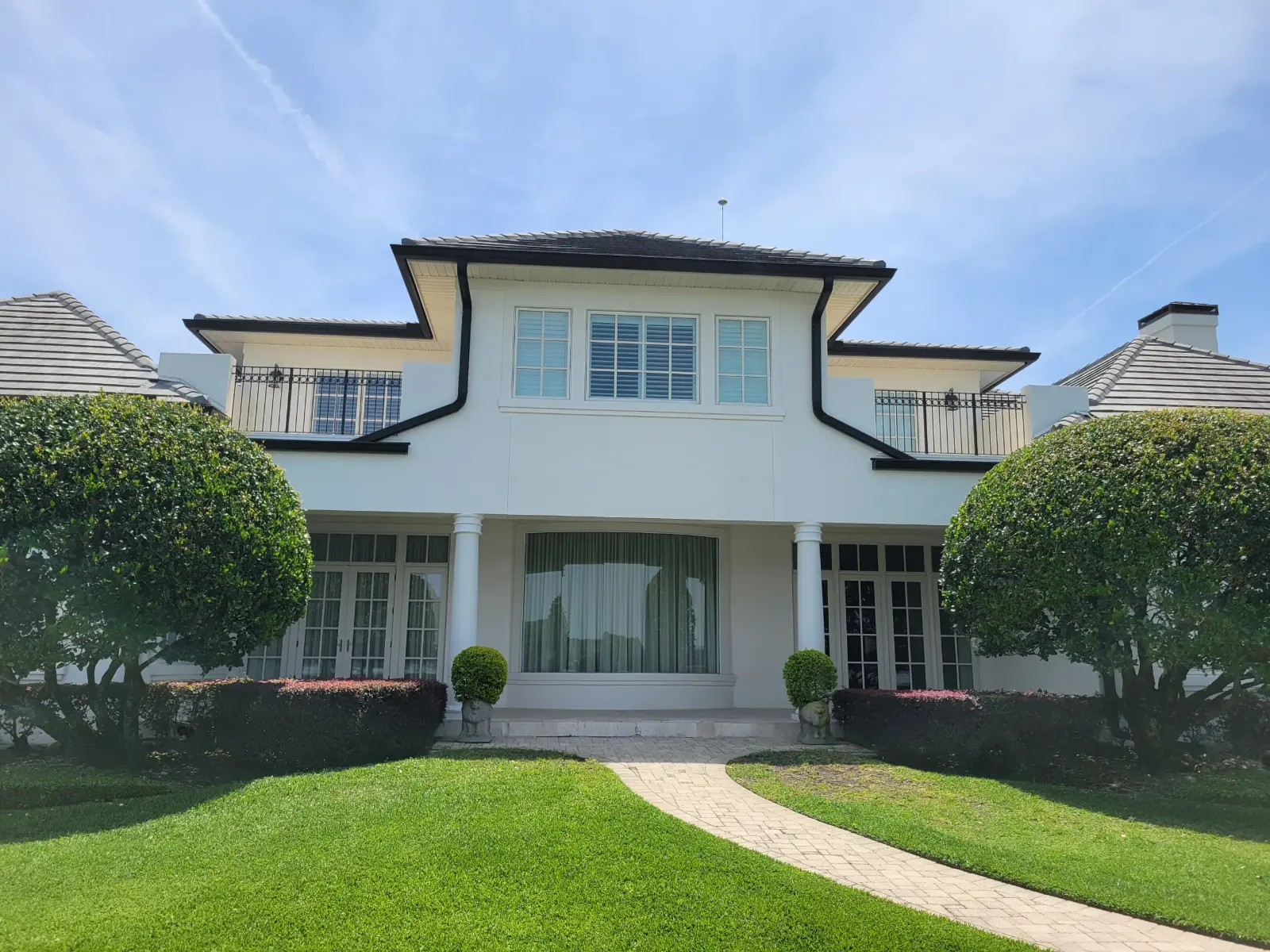
A 6-bedroom vacation villa in Windsor Hills or Reunion has roofline complexity — multiple hip-roof planes, valley convergence points, extended overhangs over pool screen enclosures — that generates higher combined flow rates than a standard single-family home of equivalent square footage. Builder-installed 5-inch sectional systems on these villas routinely overflow at valley points during wet-season storms, discharging onto pool decks where guests see and photograph it. Correct valley sizing and pool deck discharge planning are the two most impactful installation differences for STR properties in this market.
Why Kissimmee’s Vacation Villa Market Creates Gutter Conditions Unlike Any Other Florida City
Kissimmee and the surrounding Osceola County theme park corridor contain one of the highest concentrations of short-term rental vacation villas in North America. The US 192 corridor and the planned vacation communities that line it — Windsor Hills, Windsor at Westside, Windsor Palms, Reunion, ChampionsGate, Solara, Solterra, Storey Lake, and dozens of others — were purpose-built for the tourism economy surrounding Walt Disney World, Universal, and the greater Orlando attraction market. These communities contain tens of thousands of vacation villas managed through Airbnb, VRBO, and dedicated STR property management companies, with annual occupancy rates running 40 to 52 weeks on most well-managed properties.
The drainage significance of this market concentration is specific. Vacation villas are not standard residential homes. A 6-bedroom, 3,500-square-foot villa in Windsor Hills typically has a significantly more complex roofline than a similarly sized single-family home in a traditional residential subdivision — multiple hip-roof planes with several valley convergence points, extended overhangs over screened pool enclosures, and roofline configurations that generate combined flow rates at valley points substantially above what a single-plane 5-inch gutter calculation assumes. Builder-installed 5-inch sectional systems on these villas were sized for permit approval, not for the actual hydraulic load they receive during a peak Central Florida wet-season event.
The consequence of overflow at a villa valley point is different from the consequence at a standard owner-occupied home. When a vacation villa valley gutter overflows during a guest’s stay, it discharges water directly onto the pool deck or the lanai paver area — both of which are photographed by guests, featured in listing photos, and subject to review comments. An owner-occupant has time to assess and repair before the next storm. A property manager has a guest checking in Thursday whether or not the gutter issue was resolved after Tuesday’s storm.
How Impermeable Surfaces Around Vacation Villas Change the Discharge Planning Equation
The typical Kissimmee vacation villa has significantly more impermeable surface coverage than a standard owner-occupied home of equivalent lot size. Pool decks, lanai screen enclosure foundations, extended paver patios around the pool and outdoor dining area, driveway and parking pad, and front entry walks together cover a large portion of the lot with surfaces through which downspout discharge cannot percolate. This hardscape concentration creates a specific discharge planning challenge: water from the downspout that lands adjacent to a pool deck or screen enclosure has nowhere to go except along the impermeable edge until it reaches a turf or planting bed.
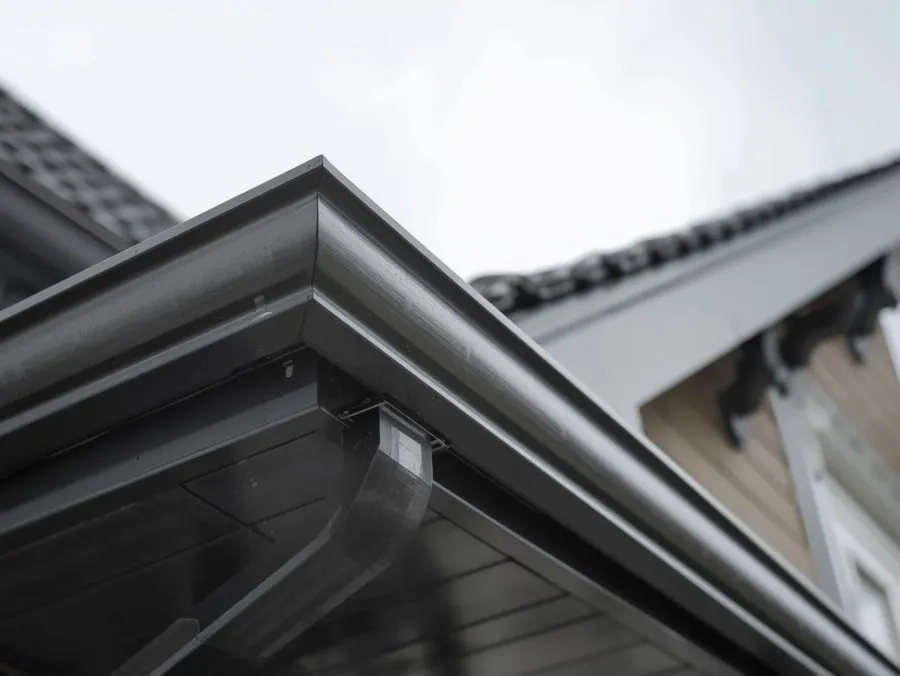
On villa properties where the pool deck and screen enclosure extend close to the structure, downspout elbows that discharge at grade level deposit water against the screen enclosure foundation or pool deck edge — where it can undermine the paver or concrete slab, introduce moisture behind the screen frame, or pool in the area immediately outside the lanai door. Underground drainage runs that carry downspout discharge away from the pool deck and enclosure to a pop-up emitter in the turf or landscape zone are the standard solution on larger vacation villa properties. The emitter placement must be far enough from the pool deck and property line to discharge into an appropriate landscape zone without causing erosion or violation of community drainage guidelines.
How STR Property Managers Should Think About Gutter Maintenance Scheduling
The vacation villa property management industry in Kissimmee operates on a continuous occupancy model — properties booked most weeks of the year with turnover cleaning and inspection between each stay. In this model, proactive exterior maintenance scheduling is not a nice-to-have; it is the difference between finding a problem before a guest checks in and discovering it through a guest complaint or a negative review that affects the property’s booking performance.
Pre-wet-season gutter cleaning in late April or May is the single highest-value maintenance visit for vacation villa properties in the Kissimmee STR market. A villa entering June with accumulated palm frond debris, fine organic material, and any downspout inlet restriction is running its drainage system at reduced capacity through the highest-intensity storm period of the year. The first significant June storm tests the system at its weakest point. Post-wet-season cleaning in October or November addresses debris accumulated through storm season. Properties with pool screen enclosures adjacent to significant palm canopy — common on many villa lots — may need mid-season clearing in July or August when palm frond drop peaks.
Leaf guard installation reduces the cleaning frequency on villa properties from two or three visits annually to typically one — the annual pre-wet-season visit to clear any material that has accumulated on the guard surface. For property managers coordinating maintenance across multiple villas, guards that reduce the number of required service visits per property meaningfully reduce the coordination and cost burden across a portfolio.
Owner-Occupied Residential, Poinciana, and the Downtown Lake Toho Corridor
Kissimmee’s residential market extends well beyond the vacation villa communities. Poinciana, one of Florida’s largest master-planned communities spanning the Osceola-Polk county line, contains over 30,000 homes ranging from 1980s concrete block ranch construction with original spike-and-ferrule hanger installations to newer homes with builder-spec 5-inch sectional systems. The aging 1980s stock has original 2×3 downspouts undersized for current rainfall intensity standards applied to their actual catchment areas; the newer stock has the valley overflow problem common to hip-roof construction throughout Central Florida.
Downtown Kissimmee’s Lakefront, Edgewater, and older residential neighborhoods adjacent to Lake Tohopekaliga face seasonal water table elevation from the lake — the same near-lake drainage dynamic that affects Lakeland’s residential stock near its named lakes. Properties within approximately two to three blocks of Lake Toho see the water table rise progressively through the June through October wet season as lake levels increase with rainfall accumulation. Grade-level downspout discharge on these lots percolates more slowly as the wet season advances, and underground drainage components are the technically correct solution for properties where foundation-edge saturation becomes a recurring issue.
Four Failure Patterns Most Common on Kissimmee Property Assessments
Kissimmee’s STR villa market, Lake Toho proximity, and Osceola County new construction produce distinct failure conditions. These four account for most of what we diagnose on initial property assessments across the market.
Valley Overflow on Vacation Villas
Purpose-built vacation villas in Windsor Hills, Reunion, ChampionsGate, and similar communities have hip-roof configurations with multiple valley convergence points where builder-installed 5-inch sectional systems overflow during peak wet-season events. Overflow discharges onto pool decks or lanai paver areas — where it is visible to guests, photographed, and subject to review comments. Correct valley sizing (6-inch profile at convergence points) and additional outlets prevent this failure on villas where it recurs each wet season.
Pool Deck and Screen Enclosure Saturation
Downspout elbows discharging adjacent to pool decks, screen enclosure foundations, or lanai paver areas deposit water against impermeable surfaces where it moves laterally rather than percolating. Repeated saturation of the pool deck edge and screen frame foundation causes paver settlement adjacent to the enclosure, moisture intrusion behind the screen frame bottom rail, and pooling in the outdoor area visible to arriving guests. Underground drainage routing to landscape zone emitters eliminates this pattern.
Near-Lake Foundation Saturation — Downtown Kissimmee
Properties within two to three blocks of Lake Tohopekaliga in the Lakefront, Edgewater, and downtown Kissimmee residential areas experience seasonal water table elevation during the June–October wet season. Grade-level downspout discharge on low-elevation lake-adjacent lots percolates progressively more slowly as the wet season advances, creating foundation-edge saturation from routine storm discharge by peak wet season. The same near-lake discharge planning approach used in Lakeland applies to these properties.
Aging Systems in Poinciana’s 1980s Housing Stock
Poinciana’s older housing stock — 1980s and early 1990s concrete block ranch construction — has original spike-and-ferrule hanger installations that have cycled through 35 to 45 years of thermal expansion and contraction in Florida’s heat environment. By this age, hangers have typically loosened, allowing gutters to pitch backward and pond standing water against the fascia face rather than draining to the downspout. Original 2×3 downspouts are undersized for the catchment area by current rainfall intensity standards. Both conditions accumulate before they become visible from the ground.
Gutter and Drainage Services for Kissimmee and Osceola County
Each service below addresses conditions specific to Kissimmee’s STR villa market, lake proximity, aging Poinciana housing stock, or new Osceola County construction. We assess which apply during the free estimate.
Vacation Villa Communities, Residential Neighborhoods, and Osceola County Properties
STR villa communities have different primary concerns than owner-occupied residential neighborhoods. Each entry notes the dominant drainage condition and gutter issue for that community or area.
Schedule a Kissimmee Estimate=
We serve all Kissimmee neighborhoods and Osceola County communities including St. Cloud, Celebration, Poinciana, Harmony, and all US 192 corridor vacation villa communities. Estimates include a property-type assessment — STR villa roofline complexity, pool deck discharge planning, HOA color requirements, or standard residential — before any sizing recommendation.
Orlando Office:
4677 LB McLeod Rd, Ste. B, Orlando FL 32811
(407) 203-1144
How We Work in Kissimmee and Osceola County
STR Villa Rooflines, Pool Deck Constraints, and HOA Color Standards — Before We Fabricate Anything
The Kissimmee vacation villa market requires pre-installation assessment questions that don’t apply in most residential gutter markets. Before we specify anything on a vacation villa property, we need to know: how many valley convergence points does the roofline have, and where does flow concentrate during a peak storm event? Where does each downspout currently discharge relative to the pool deck, screen enclosure, and paver areas? Does the property HOA have a gutter color or profile covenant that constrains material selection? Is the property near Lake Toho or another water feature that affects the wet-season water table at discharge locations?
These questions are answered during the free estimate visit — not as separate engineering consultations. For property managers coordinating multiple villa properties, we can assess multiple units in a single community during a scheduled visit and provide per-property recommendations without requiring separate estimate scheduling for each unit. For Celebration homeowners, we coordinate color selection against the approved exterior palette before fabricating — not after.
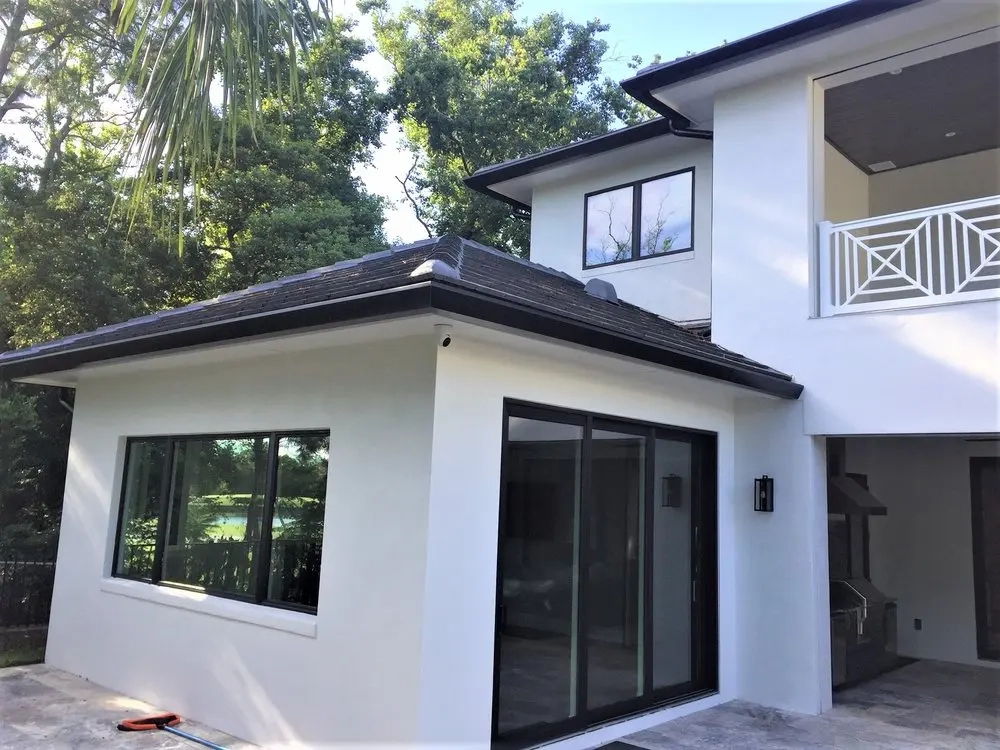
We fabricate seamless gutters on-site from continuous aluminum coil stock to the exact roofline dimensions of your property. No pre-cut section joints on long straight runs. Slope calculated per run. Valley outlets placed at convergence points based on the actual roofline analysis, not uniform spacing. The crew performing the installation works from the assessment conducted during the estimate.
How We Work
From Estimate to Installation
Five steps between your free estimate and a correctly specified, fabricated, and installed gutter system for your Kissimmee or Osceola County property.
Property Type Assessment
STR villa vs. owner-occupied vs. commercial. Valley convergence points identified, pool deck and hardscape discharge constraints mapped, HOA color requirements confirmed.
Roofline & Valley Analysis
Catchment area calculated per run, valley convergence points identified for outlet placement, fascia condition inspected — especially on older Poinciana and Buenaventura Lakes homes.
Sizing & Color Spec
Gutter profile, downspout sizing, outlet count, and aluminum color finalized. Valley convergence points receive additional outlets or 6″ sections as required. HOA color matched before fabrication.
On-site Fabrication
Seamless gutters formed from continuous aluminum coil stock to exact roofline dimensions on the truck-mounted machine — in the specified color, no pre-cut section joints.
Install & Flow Test
Gutters hung at calculated pitch, downspouts connected to discharge points (grade-level or underground), flow tested before the crew leaves to confirm valley points clear as intended.
Routing Downspout Water Away from Pool Decks, Screen Enclosures, and Paver Areas
Most Kissimmee vacation villas have the gutter system and the pool deck in close proximity — the screened pool enclosure typically runs along the rear and at least one side of the structure, with downspout locations determined by the roofline configuration rather than by deck proximity. When a downspout elbow discharges adjacent to a screen enclosure foundation or pool deck edge, water moves along the impermeable surface rather than percolating — which means it finds the path of least resistance, typically under the pool deck paver, around the screen enclosure bottom rail, or through any low point in the paver joint pattern.
Underground drainage runs from downspout outlets to pop-up emitters in the turf or landscape zone are the standard solution for vacation villa pool deck discharge problems. The emitter is positioned in a turf area or planting bed far enough from the pool deck and enclosure that discharge moves through soil rather than along impermeable surfaces. Catch basins at the transition point between the pool paver and the turf zone can intercept water moving along the deck edge before it reaches the enclosure foundation. More detail on system configurations is on our underground drainage page and downspout installation page.
Pop-up Emitter Runs
Buried pipe from downspout outlet to a turf-zone emitter — routing discharge away from pool decks and screen enclosure foundations to landscape areas where water percolates without pooling against impermeable surfaces.
Valley Outlet Addition
Additional downspout outlets at hip-roof valley convergence points — the primary correction for villa rooflines where builder outlet spacing causes overflow at valley locations that land on pool decks during peak storms.
Deck-Edge Catch Basins
Surface collection points at the pool deck perimeter or in the turf zone adjacent to the screen enclosure — intercepting water moving along the deck edge and routing it to a buried discharge line.
Near-Lake Discharge Runs
Underground discharge for properties near Lake Tohopekaliga — routing water away from the foundation perimeter during the wet-season water table elevation that affects low-elevation lake-adjacent lots.
Owner-Occupied, Vacation Villa, and Commercial Gutter Systems in Osceola County
Owner-Occupied Residential
Standard residential homes in Kissimmee neighborhoods, Celebration, Poinciana, Harmony, St. Cloud, and the broader Osceola County residential market.
Vacation Villa & STR Properties
Purpose-built vacation villas in Windsor Hills, Reunion, ChampionsGate, Solara, Solterra, Storey Lake, Windsor Palms, and all US 192 corridor STR communities.
Commercial & Hospitality
Resort amenity centers, hotel properties, retail and restaurant along US 192, and multifamily buildings throughout Osceola County.
What Kissimmee and Osceola County Customers Say
Professionalism
The first home repair team in a long time that did what they promised and on time. I would recommend Hank’s. We had a whole house gutter and downspout replacement after the March hail storm in 2023.

Highly Recommended!
Dealt with Precision Gutters on a complex custom project, fixing an issue caused by a bad contractor. They worked tirelessly with me and went over every detail to help me come up with the best solution.
Premium Quality
Very professional and on time installation highly recommend thank you for your service!
Knowledgeable
I contracted Precision Gutters LLC to do the drainage for the gutters. They are professional, punctual, great attitude, knowledgeable, respectful personally.
I highly recommend Precision Gutters LLC as a company & their skills workers. Every message I sent to the Sales Representative Marc Marchand was answered in a timely manner & to the point.
Gutter Installation, Repair, Cleaning, and Drainage in Kissimmee
Frequently Asked Questions — Kissimmee Gutter Services
How do vacation villa rooflines differ from standard residential gutter requirements?
Purpose-built vacation villas in Kissimmee’s STR communities — Windsor Hills, Windsor at Westside, Reunion, ChampionsGate, Solara, Solterra, and Storey Lake — typically have rooflines significantly more complex than standard Osceola County single-family homes. Hip-roof configurations with multiple valley convergence points are standard, and the combined flow rate at each valley point during peak Central Florida storm events substantially exceeds what a single-plane 5-inch gutter calculation assumes. Builder-installed 5-inch sectional systems on these villas routinely overflow at valley locations during wet-season storms. Overflow discharges onto pool decks or lanai areas — visible to guests and problematic for property review scores. Correct valley sizing and pool deck discharge planning are the two most impactful installation differences for STR properties.
How should STR property managers schedule gutter maintenance?
Vacation villa property managers face a maintenance calculus that differs from residential ownership. Pre-wet-season cleaning in late April or May is the highest-value single maintenance visit — ensuring the system enters the June through September peak with cleared downspout inlets. Post-wet-season cleaning in October or November addresses storm-season accumulation. Properties with pool screen enclosures adjacent to significant palm canopy may need mid-season clearing in July or August. Leaf guard installation reduces this to typically one annual visit — the pre-wet-season clearing. For property managers maintaining multiple villas, portfolio-wide seasonal cleaning contracts that cover multiple properties in a single community visit reduce coordination cost significantly.
How does pool deck and hardscape concentration affect downspout discharge planning?
Most Kissimmee vacation villas have pool decks, lanai paver areas, and screen enclosure foundations covering a significant portion of the lot — surfaces through which downspout discharge cannot percolate. A downspout elbow that discharges adjacent to a pool deck deposits water against the impermeable surface edge, where it moves laterally along the deck until it reaches turf or a paver joint. Underground drainage runs that carry discharge away from the pool deck and enclosure to a pop-up emitter in the turf or landscape zone route water appropriately without pooling adjacent to the enclosure foundation or guest areas.
Does Celebration’s HOA affect gutter installation choices?
Celebration’s community association has exterior appearance covenants that address gutter color and profile. Homeowners cannot install gutters in colors or profiles that don’t match the approved palette for their home’s exterior treatment. This means color selection must be coordinated with existing soffit, fascia, and trim colors before fabrication — the requirement is stricter than in a standard residential context where the homeowner makes the final aesthetic call. We assess the existing exterior treatment and coordinate color selection before fabricating gutters for Celebration properties, and we can confirm compliance with community standards as part of the estimate process.
Do properties near Lake Toho face elevated water table conditions?
Yes. Lake Tohopekaliga is one of Florida’s larger interior lakes, and properties in the Lakefront, Edgewater, and downtown Kissimmee residential areas within approximately two to three blocks of the lake shoreline experience seasonal water table elevation as lake levels rise during the June through October wet season. In this condition, grade-level downspout discharge on low-elevation lake-adjacent lots percolates more slowly than on inland Osceola County properties. Properties within the Lake Toho influence zone benefit from discharge planning that routes water away from both the foundation edge and the lake shoreline — the same near-lake drainage approach used in Lakeland’s lake-adjacent residential neighborhoods.
What gutter conditions are typical in Poinciana?
Poinciana is one of Florida’s largest master-planned communities, with housing stock ranging from 1980s concrete block ranch construction to newer homes built in the 2010s and 2020s. The 1980s homes typically have original spike-and-ferrule hanger installations that have loosened through 40 years of thermal cycling, original 2×3 downspouts undersized for current rainfall intensity standards, and fascia boards that may have absorbed moisture behind gutters pitching backward. Newer Poinciana homes have the valley overflow problem common to hip-roof construction. We assess both conditions during the estimate and recommend repair or replacement based on actual system condition.
Do new homes in Harmony or the St. Cloud corridor need gutter assessments?
Builder-installed gutter systems in Harmony, the St. Cloud growth corridor, and newer Osceola County communities follow the same minimum-code-specification pattern seen throughout Central Florida’s new construction market — 5-inch sectional aluminum adequate for permit inspection, not necessarily sized for the roofline’s actual catchment area. These communities’ larger family homes have hip-roof configurations with valley convergence points where combined flow from two planes during a peak wet-season event exceeds the single-plane 5-inch capacity. We assess valley sizing, sectional joint condition, and downspout spacing before recommending targeted valley correction or full replacement.
Does Precision Gutters serve commercial and hospitality properties along US 192?
Yes. The US 192 corridor from Celebration east to St. Cloud contains significant concentrations of hospitality properties — hotels, resort complexes, vacation villa communities with shared amenity centers, restaurants, and retail serving the theme park tourism market. Commercial gutter installations on these properties require sizing for large roof catchment areas, coordination with existing drainage infrastructure on developed resort sites, and material selection consistent with the property’s exterior finish. We assess each commercial property individually for catchment area, roof drainage plan, and discharge requirements — residential gutter specifications applied to commercial-scale buildings undersize the system by a factor proportional to the roof area difference.
Stop Water Problems Before They Reach the Foundation — or the Pool Deck
Kissimmee’s vacation villa market, Lake Toho-adjacent residential stock, aging Poinciana housing, and newer Osceola County master-planned communities each require gutter systems specified for the actual property conditions — not a standard Florida residential spec applied uniformly. Free estimates include a property-type assessment, valley convergence analysis on villa rooflines, pool deck discharge planning, and HOA color coordination where required.
Other Florida Locations