
Gutter Company In Daytona Beach, FL
Daytona Beach’s barrier island sits in direct Atlantic exposure — salt-laden easterlies, windblown sand, and 54 inches of annual rainfall concentrated into June–September storm season. Material selection, sizing, and discharge planning all vary by where a property sits relative to the Halifax River. We account for that geography before specifying anything.
Why the Halifax River Changes the Gutter Specification on Either Side of It
Daytona Beach is not a single drainage environment. The Halifax River, which separates the barrier island from the mainland, functions as a rough boundary line between three distinct material and drainage specification zones for gutter installation. Understanding which zone a property sits in determines the correct aluminum gauge, whether Galvalume or copper is appropriate, how many cleanings per year the system needs, and whether underground drainage components are necessary at the downspout discharge point.
East of the Halifax River, on the barrier island between A1A and the Atlantic, properties are in the highest-exposure zone in the Daytona market. Atlantic easterlies carry salt aerosol from the surf zone inland continuously, and windblown sand from the beach infiltrates open gutter channels at a rate that has no equivalent in inland or Gulf Coast markets. Beach cottages from the 1950s and 1960s on the barrier island, particularly in the Seabreeze, Beverly Beach, and beachside residential blocks, typically have original wood fascia boards, spike-and-ferrule gutter hangers, and 4-inch or undersized 5-inch gutter profiles that were installed before current rainfall intensity standards were established. This combination of material exposure and system age creates accelerated failure conditions.
The Intracoastal-adjacent zone between the Halifax River and US-1, including the North Halifax, Daytona Beach Shores, and riverside Ormond Beach corridor, sits at low elevation with high wet-season water tables. Properties here receive less direct salt-air exposure than beachside locations but face a different drainage challenge. Flat terrain and subsurface saturation during the wet season mean that standard grade-level downspout discharge frequently pools against the foundation perimeter rather than draining away at an adequate speed.
Port Orange, Ormond Beach, and the Western Subdivision Corridor
West of US-1 and into the Port Orange, South Daytona, Holly Hill, and Ormond Beach suburban corridors, the salt-air and sand variables that define beachside installation specifications become less critical. Standard aluminum performs reliably throughout this zone with appropriate gauge and installation quality. The drainage challenge in inland Volusia shifts from material corrosion to sizing adequacy on the newer large-footprint homes that dominate communities like Spruce Creek, Venetian Bay, and the LPGA International area.
These homes, built primarily from the 1990s through the 2010s in Mediterranean-revival and contemporary ranch plans, have rooflines of 2,500 to 4,500 square feet with hip-roof configurations and multiple valley convergence points. Builder-installed 5-inch sectional gutter systems on these homes were sized for minimum code compliance, not for the actual catchment area and Daytona’s 54-inch annual rainfall intensity. Hip-roof valleys are the first overflow point: two roof planes combine their flow at the valley point, generating load rates that the 5-inch profile cannot handle during peak wet-season events.
The Midtown Daytona and US-1 corridor communities, primarily mid-century CBS ranch construction from the 1960s and 1970s, present a third condition: aging systems with original hanger hardware that has loosened, downspout sizing (2×3 outlets) inadequate for current drainage standards, and fascia boards that require condition assessment before any new gutter installation will anchor correctly.
Why Atlantic-Track Storms Expose Daytona Beach Gutter Failures Faster Than Inland Markets
Daytona Beach sits on Florida’s northeast Atlantic coast in the direct approach path for tropical systems that form in the Atlantic basin and track westward toward the Florida peninsula. Unlike Gulf Coast markets where storms must travel over land before reaching inland communities, Atlantic-track tropical systems make landfall directly on or near the Daytona Beach barrier island, delivering wind-driven rainfall against the oceanward face of structures at sustained high rates that are qualitatively different from the convective thunderstorm cells that characterize Central Florida’s wet season.
Wind-driven Atlantic rain enters gutter systems at angles that standard gutter sizing calculations, based on vertical rainfall intensity, do not fully account for. A gutter profile adequate for 3 inches of vertical rainfall per hour can be overwhelmed when the same volume arrives at a 30-degree wind angle, driving water over the back edge of the gutter before it reaches the downspout. Reinforced hanger systems that hold gutters tight against the fascia at the appropriate pitch are the technical response, not simply increasing gutter size, though sizing for the actual catchment area is also necessary.
How Atlantic Exposure Accelerates Gutter System Wear in the Beachside Zone
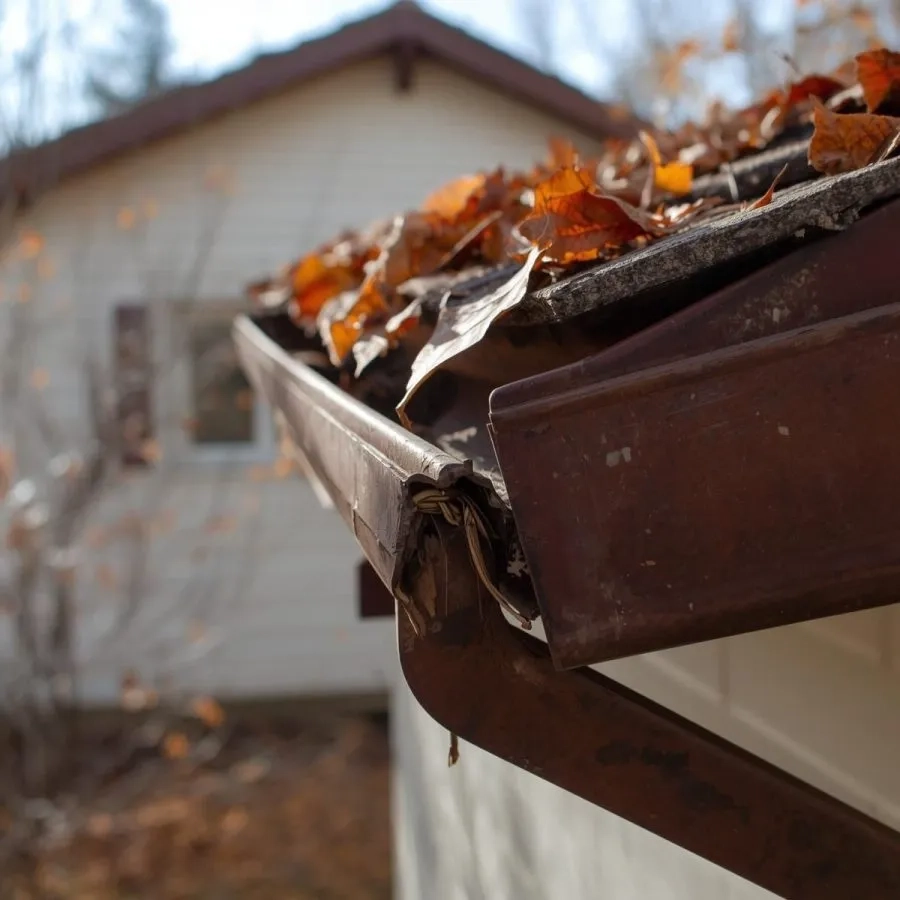
Salt aerosol from Atlantic wave action is carried inland by prevailing easterlies year-round, not only during storm events. On beachside properties east of A1A, this continuous chloride exposure attacks aluminum gutter surfaces at the joint points, where sealant failure exposes bare metal, and at any location where paint adhesion has been compromised by UV cycling or installation damage. The visible manifestation — white chalking at seams, brown staining on fascia below joint points — typically appears within three to five years on standard aluminum in the highest-exposure zone, well ahead of the 15-to-20-year service life expectation in inland markets.
Windblown sand compounds this effect. Sand that enters gutter channels acts as an abrasive that accelerates paint surface wear wherever water moves it against aluminum — particularly on the downspout inlet collar, the gutter floor at the outlet, and any location where debris accumulation creates a damp sand-and-organic mat in contact with the metal surface. The correct material response for beachside Daytona properties is Galvalume — steel with an aluminum-zinc alloy coating that provides meaningfully better chloride resistance than standard aluminum — or copper for properties where long-term performance and patina are preferred over initial cost.
Four Ways Daytona Beach’s Coastal Environment Turns a Gutter System Failure Into a Structural Problem
Atlantic coastal conditions accelerate the transition from gutter system underperformance to property damage faster than most Florida inland markets. These are the failure patterns we see most frequently across Volusia County.
Corrosion Failure on Beachside Aluminum
Standard aluminum in the beachside zone east of A1A develops joint corrosion, paint chalking, and perforation failures significantly ahead of the expected material service life. The failure progression runs from surface oxidation at sealant-compromised joints, to galvanic staining on the fascia below, to joint separation and water infiltration behind the gutter — where it contacts wood fascia directly and accelerates rot faster than any other gutter failure mode.
Sand and Debris Downspout Blockage
Windblown Atlantic sand accumulates in gutter channels continuously and combines with palm frond debris and organic material at downspout inlets to form a dense, abrasive plug that standard cleaning intervals cannot keep pace with on beachside properties. A fully blocked downspout on a beachside home during a tropical band rainfall event converts the gutter to an open overflow trough — directing concentrated discharge against the fascia at the inlet location for the duration of the event.
Foundation Saturation in the Intracoastal Zone
Halifax River-adjacent properties in the Intracoastal corridor sit at very low elevation with wet-season water tables that can rise within 24 to 36 inches of the surface during sustained June–September wet periods. In this condition, standard grade-level downspout discharge does not percolate laterally away from the foundation fast enough to prevent hydrostatic pressure against the slab edge. Foundation joint cracking and interior moisture intrusion in Intracoastal-zone Daytona homes is frequently traced to chronic downspout discharge saturation rather than roof or wall penetration.
Valley Overflow on Inland Hip-Roof Homes
Port Orange, Ormond Beach, and LPGA-area homes with hip-roof configurations experience valley overflow during peak wet-season events because builder-installed 5-inch systems are sized for single-plane catchment — not the combined flow from two roof planes converging at each valley point. The overflow discharges against the fascia at the valley location, which is also a penetration point in the roofline where moisture intrusion risk is highest. Correction requires replacing or supplementing the valley-adjacent gutter section with a 6-inch profile and adding an outlet specifically at the high-flow valley point.
Gutter and Drainage Services for Daytona Beach and Volusia County
Service specifications vary by exposure zone — beachside, Intracoastal-adjacent, and inland Volusia County each require different material and sizing decisions. We assess zone and property conditions during the estimate before recommending anything.
Neighborhoods and Communities Throughout Volusia County
Material spec, gutter sizing, and cleaning interval all vary by location within the Daytona market. The three-zone framework — beachside, Intracoastal, inland — determines the starting point for each property assessment.
Schedule an Daytona Beach Estimate
We serve all Volusia County communities — beachside barrier island, Intracoastal corridor, Port Orange, Ormond Beach, Holly Hill, DeLand, and Deltona. Estimates include a material zone assessment and a discharge location evaluation specific to your property’s position relative to the Halifax River and the Atlantic coast.
Orlando Office:
4677 LB McLeod Rd, Ste. B, Orlando FL 32811
(407) 203-1144
How We Work in Volusia County
A Gutter Company That Accounts for the Atlantic Exposure Gradient
The Daytona Beach market has a material specification problem that does not exist in most Florida inland markets: a property’s distance from the Atlantic Ocean directly determines whether standard aluminum is the correct material or whether Galvalume or copper is appropriate — and that distance varies from block to block across the barrier island and Intracoastal zones. Applying a uniform aluminum specification across all Volusia County properties produces correct installations on inland properties and accelerated failures on beachside ones.
We assess each property’s position relative to the Halifax River and the Atlantic shoreline as part of the estimate — not as a separate engineering consultation. The three-zone framework we use to determine material specification is built into our evaluation process: beachside east of A1A, Intracoastal-adjacent between the Halifax and US-1, and inland west of US-1. Within each zone, the specific roofline configuration, fascia condition, and drainage pattern at grade level determine the remaining installation decisions.
We fabricate seamless gutters on-site from continuous coil stock in the appropriate material for your zone — aluminum, Galvalume, or copper — to your exact roofline dimensions. Slope is calculated per run based on your actual fascia pitch. Fascia condition is assessed before we mount anything. The crew performing the installation receives the property-specific analysis from the estimate, not a generic work order that loses the drainage reasoning in translation.
How We Work
From Estimate to Installation
Five steps between your free estimate and a correctly specified, installed, and tested gutter system for your Daytona Beach or Volusia County property.
01 Zone Assessment
Property location relative to Atlantic shoreline and Halifax River determines material zone — beachside, Intracoastal-adjacent, or inland standard aluminum.
02 Roofline & Fascia Evaluation
Catchment area measurement per run, fascia condition inspection, valley convergence identification, and downspout spacing review.
03 Sizing & Material Spec
Gutter profile (5″ or 6″), downspout size, outlet count, and material (aluminum, Galvalume, or copper) finalized based on zone and roofline data.
04 On-site Fabrication
Seamless gutters formed from continuous coil stock on the truck-mounted machine to your exact roofline dimensions — no pre-cut section joints.
05 Install & Flow Test
Gutters hung at calculated pitch with reinforced hangers, downspouts connected to discharge points, flow-tested before the crew leaves the property.
Why Downspout Discharge Location Matters in Daytona’s Low-Elevation Zones
The barrier island and Intracoastal corridor in Daytona Beach sit at elevations of 5 to 10 feet above sea level with wet-season water tables that can rise to within 18 to 30 inches of the surface during sustained June–September rainfall periods. At this water table proximity, the soil profile between the surface and the saturation zone is thin — grade-level downspout discharge that would percolate away from the foundation in 15 minutes on an inland Volusia property may pool for an hour or more in the Intracoastal zone during peak wet-season conditions.
Repeated saturation and drying cycles at the slab edge in these conditions create the hydrostatic pressure differentials that cause foundation joint separation and interior moisture intrusion over time. Underground drainage systems route water from the downspout outlet through buried pipe to an emitter positioned well away from the structure — past the zone of slab-edge influence. On beachside properties, discharge placement also requires consideration of how water moves across sand and shell substrate in the beach zone rather than into landscaping or drainage features that do not exist on many barrier island lots. More detail on system configurations is available on our underground drainage page and downspout installation page.
Underground Discharge Runs
Buried pipe from downspout outlet to pop-up emitter positioned away from the foundation — the correct solution for Intracoastal-zone properties where grade-level discharge pools rather than percolates.
Catch Basins
Surface collection points for high-volume discharge — particularly useful on beachside properties where multiple downspouts from large cottage rooflines discharge into limited landscaping space.
Reinforced Hanger Systems
Hidden hanger hardware spaced for Atlantic wind-uplift resistance — not the spike-and-ferrule or standard residential spacing used in inland markets where wind load on gutter systems is lower.
Valley Outlet Addition
Additional downspout outlets placed specifically at hip-roof valley convergence points on Port Orange and LPGA-area homes — addressing the overflow condition that standard outlet spacing does not resolve.
Residential and Commercial Gutter Systems in Daytona Beach and Volusia County
Residential
Barrier island cottages through inland Volusia subdivision homes — material and sizing determined by Atlantic exposure zone, roofline configuration, and fascia condition.
Commercial
A1A oceanfront hospitality, ISB corridor retail, multi-family in South Daytona and Port Orange, and office properties throughout Volusia County — zone-appropriate material specification on all commercial projects.
What Daytona Beach and Volusia County Customers Say
Professionalism
The first home repair team in a long time that did what they promised and on time. I would recommend Hank’s. We had a whole house gutter and downspout replacement after the March hail storm in 2023.

Highly Recommended!
Dealt with Precision Gutters on a complex custom project, fixing an issue caused by a bad contractor. They worked tirelessly with me and went over every detail to help me come up with the best solution.
Premium Quality
Very professional and on time installation highly recommend thank you for your service!
Knowledgeable
I contracted Precision Gutters LLC to do the drainage for the gutters. They are professional, punctual, great attitude, knowledgeable, respectful personally.
I highly recommend Precision Gutters LLC as a company & their skills workers. Every message I sent to the Sales Representative Marc Marchand was answered in a timely manner & to the point.
Gutter Installation, Repair, Cleaning, and Drainage in Daytona Beach
Frequently Asked Questions — Daytona Beach Gutter Services
How does beachside salt-air exposure affect gutter material selection?
Properties east of the Halifax River — on the barrier island along A1A, Ocean Avenue, and the beachside residential blocks — are in the highest salt-air concentration zone for Volusia County. Prevailing Atlantic easterlies carry aerosol chloride from the surf zone directly onto rooflines and gutter surfaces. Standard aluminum oxidizes measurably faster in this environment than it does in inland Volusia County locations. For beachside homes within approximately one mile of the ocean, we specify Galvalume gutters or copper as primary material options. For properties west of the Halifax River in Daytona proper, Holly Hill, and South Daytona, standard aluminum with appropriate gauge and paint adhesion performs adequately. The Halifax River itself functions as a rough demarcation line — east of it, material selection requires coastal spec; west of it, standard residential aluminum is correct.
How often should homes on the Daytona Beach barrier island be cleaned?
Beachside properties on the barrier island typically need cleaning three times per year rather than the standard twice-annual interval. Atlantic easterlies deposit windblown sand continuously into open gutter channels — sand accumulates in the gutter base and at downspout inlets, where it combines with palm debris and organic material to form a dense plug that restricts flow faster than typical debris buildup. Pre-wet-season cleaning in April or May is the critical interval: entering June with significant sand and debris accumulation means the first major storm of the season runs through a restricted system. Properties west of the Halifax River in less direct Atlantic exposure can typically maintain a twice-annual schedule.
Do mid-century beach cottages on the barrier island need replacement or repair?
The 1950s–1970s beach cottages on the barrier island present a specific combination of challenges: original wood fascia boards that have absorbed decades of salt-laden Atlantic moisture, spike-and-ferrule hanger installations that loosened long ago, and gutter profiles often undersized for the catchment area of homes with flat or low-pitch Florida rooflines. By the time these gutters are visibly pulling away from the fascia or showing corrosion through the paint, the wood behind them is typically deteriorated well past the visible failure point. We assess fascia condition before recommending repair or replacement. On barrier island properties with original 1960s or 1970s gutter systems, full replacement with Galvalume or appropriate-gauge aluminum is usually the more cost-effective path than attempting to repair into deteriorated mounting surfaces.
What gutter size is appropriate for Midtown Daytona’s mid-century ranch homes?
The Midtown neighborhood and the areas west of US-1 near the International Speedway Boulevard corridor are primarily mid-century CBS ranch homes with flat or low-pitch rooflines and original gutter sizing from the 1960s and 1970s. Standard 4-inch and early 5-inch systems installed in that era were sized against lower rainfall intensity assumptions than current Florida gutter design standards use. Daytona Beach receives approximately 54 inches of rain annually, concentrated into June–September wet-season events that routinely deliver 2–3 inches per hour. A 5-inch K-style system at minimum, with properly sized 3×4 downspouts and outlets spaced for actual catchment area, is the correct specification for these rooflines — not the 4-inch sectional systems still found on many Midtown properties.
Are gutter guards effective for beachside properties with windblown sand?
Micro-mesh guards reduce palm debris and organic material loading effectively on beachside properties. Their effectiveness against windblown sand is more limited — fine sand particles pass through most micro-mesh openings and accumulate in the gutter base regardless of guard type. For beachside Daytona Beach properties, guards are still worth installing because they address the palm frond and large debris component of the cleaning problem, which reduces the volume and density of the accumulation that combines with sand in the downspout inlet area. Guards do not eliminate the need for annual cleaning on beachside properties; they reduce it from three visits to typically two — one pre-wet-season and one post-season — by eliminating the mid-season call that is primarily driven by debris accumulation rather than sand.
How does the Halifax River affect drainage conditions for homes in the Intracoastal corridor?
Properties in the Intracoastal-adjacent zone between the Halifax River and US-1 sit at low elevation and have limited drainage fall from the structure toward the street or rear yard. Flat terrain combined with the high water table that parallels the Halifax in these areas means downspout discharge planning is critical. Grade-level discharge that pools within 5 to 10 feet of the foundation does not percolate rapidly in Intracoastal-adjacent soils during the wet season, when the water table rises close to the surface. Underground drainage systems — catch basins or French drains to a pop-up emitter positioned away from the structure — address this condition more reliably than extended downspout elbows alone.
Do newer Port Orange or LPGA International homes need gutter upgrades?
Builder-installed gutter systems in Port Orange subdivisions, Ormond Beach master-planned communities, and the LPGA International area are typically 5-inch sectional aluminum installed at minimum code specification. These communities contain homes with larger Mediterranean-revival and contemporary plan footprints — 2,500 to 4,500 square feet — with hip-roof configurations and multiple valley convergence points where two roof planes meet and combine their flow. At a valley convergence point, a 5-inch gutter sized for one roof plane receives the combined flow from two planes simultaneously, which exceeds its design capacity during peak-intensity events. We assess whether existing systems are undersized at valley points, whether sectional joints are opening, and whether downspout spacing needs correction before recommending repair versus replacement.
Does Precision Gutters serve commercial properties in Daytona Beach and Volusia County?
Yes. We install commercial gutter systems on retail, hospitality, multi-family, and mixed-use properties throughout Daytona Beach and the broader Volusia County market — including ISB corridor commercial properties, oceanfront hospitality buildings along A1A, multi-family properties in South Daytona and Port Orange, and office and retail in the Beville Road and Nova Road commercial zones. Oceanfront commercial buildings in the A1A corridor require material specification for direct Atlantic exposure — Galvalume or copper rather than standard aluminum. Inland commercial properties in Port Orange and Ormond Beach can use standard commercial aluminum profiles sized for the specific catchment area and roof drainage plan.
Stop Water Problems Before They Reach the Foundation
Daytona Beach’s gutter installation market spans three distinct exposure zones — beachside Atlantic, Intracoastal corridor, and inland Volusia — each requiring different material spec, sizing decisions, and discharge planning. Free estimates include an exposure zone assessment, a fascia condition review, and a discharge location evaluation. Not just a linear-foot quote.
Other Florida Locations
View Orlando Metro Hub →