
Gutter Company In West Palm Beach, FL
West Palm Beach is outside Florida’s High-Velocity Hurricane Zone (HVHZ), but it still presents unique gutter and drainage challenges. Properties near the Intracoastal Waterway, including El Cid and the South End, face increased salt-air corrosion, while the historic Mizner-era neighborhoods feature barrel tile rooflines that require specialized installation methods. Many homes also predate Florida’s 2002 statewide building code update. Before making any recommendation, we evaluate the property’s location, age, roof design, and exposure to determine the most appropriate gutter system.
Intracoastal & Waterway-Adjacent Corridor
El Cid, SoSo, and the South End within a few blocks of the Intracoastal Waterway. Consistent salt-laden air accelerates standard aluminum corrosion. Galvalume or copper typically specified for properties in this zone.
Mizner-Era Historic Core
El Cid, Flamingo Park, and Old Northwest. 1920s Mediterranean Revival and Spanish eclectic construction with barrel-tile roofs and original attachment points that predate current material and wind-load standards.
Inland Mainland Residential & Commercial
Western and inland West Palm Beach. No salt-air exposure. Standard aluminum spec applies under Florida’s non-HVHZ wind-load provisions for Palm Beach County.
Why West Palm Beach’s Code Requirements Differ From Miami’s — and What Still Matters Here
West Palm Beach follows a different building code path than Miami, even though both cities are exposed to hurricanes. Palm Beach County is not part of Florida’s High-Velocity Hurricane Zone (HVHZ), which applies only to Miami-Dade and Broward counties. As a result, gutter installations in West Palm Beach are governed by the standard Florida Building Code rather than the additional HVHZ product approval requirements for exterior-attached components such as gutter hangers and fastening systems.
The difference is primarily one of code compliance, not storm exposure. West Palm Beach still experiences hurricane-force winds, wind-driven rain, and tropical storms that place significant stress on gutter systems. Proper hanger spacing, fastener selection, and attachment methods remain essential to ensure the system performs reliably during severe weather. The fact that HVHZ documentation is not required does not reduce the importance of designing the system for Palm Beach County’s wind-load requirements.
For every West Palm Beach installation, we specify fastening systems that comply with the building code requirements applicable to Palm Beach County, rather than assuming the stricter Miami-Dade standard or using specifications better suited to inland markets. This property-specific approach ensures the gutter system is engineered for local wind conditions while avoiding unnecessary upgrades that are required only in HVHZ jurisdictions.
Why Proximity to the Intracoastal Changes Material Selection Within the Same City
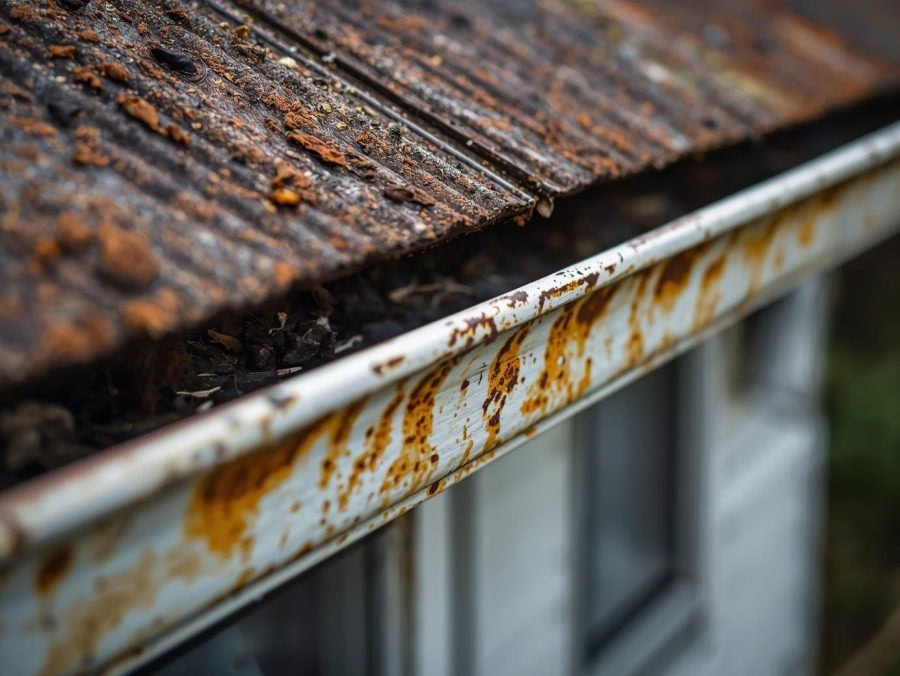
Properties directly on or within a few blocks of the Intracoastal Waterway — much of El Cid, SoSo, and the South End — experience consistent salt-laden air that accelerates standard aluminum corrosion at a rate closer to true oceanfront exposure than most people expect from an inland waterway. This isn’t the same mechanism as direct ocean spray, but the cumulative humidity and salt content in the air produces comparable long-term material degradation.
For properties in this corridor, we typically recommend Galvalume or copper. Properties even a mile or two further west, away from the waterway, don’t face the same exposure and are well served by standard aluminum. Distance from the water — not the city limit line — is what determines the correct material.
Why El Cid and Flamingo Park’s 1920s Architecture Needs Different Gutter Detailing
West Palm Beach’s historic districts — El Cid, Flamingo Park, and Old Northwest — contain Mediterranean Revival and Spanish eclectic homes largely dating to the 1920s, built in the architectural tradition architect Addison Mizner established across Palm Beach County during that decade. These homes typically feature barrel tile roofing and deep eave overhangs, which shed water in a different pattern than the truss-and-shingle roofs common in newer Florida construction.
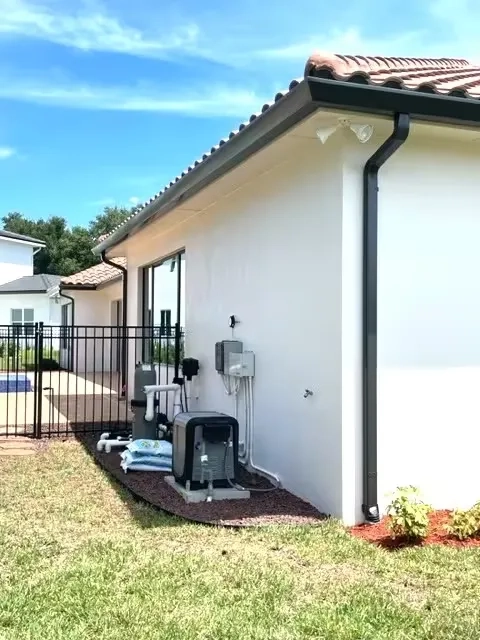
Original gutter attachment points on these homes predate both current wind-load code and current salt-air material standards. Barrel tile roof edges require different gutter-to-roofline attachment detailing than a standard shingle edge, and we assess this specifically before recommending hardware — a generic fascia-mount bracket sized for a shingle roof doesn’t always transfer cleanly to a barrel tile edge condition.
Why a Meaningful Share of West Palm Beach’s Housing Predates Current Wind-Load Standards
Florida unified its statewide building code in 2002 following a series of post-Hurricane-Andrew updates, and homes built before that date — common throughout West Palm Beach’s older neighborhoods beyond just the designated historic districts — were often fitted with gutter hardware specified under standards that current code has since superseded. This is a broader pattern than the Mizner-era homes specifically; it applies to mid-century construction throughout the city as well.
We check hardware vintage and condition as part of every estimate rather than assuming a system meets current wind-load standards simply because it’s been patched or partially repaired at some point. A property with hanger spacing calculated to pre-2002 assumptions can look intact while still underperforming during a sustained wind event.
Four Failure Patterns Most Common on West Palm Beach Property Assessments
Intracoastal salt-air exposure, the Mizner-era historic core’s barrel-tile construction, pre-2002 hardware vintage, and West Palm Beach’s tropical canopy each produce specific and identifiable conditions. These four account for the large majority of what we find on initial property assessments across the city.
Intracoastal-Proximity Salt-Air Corrosion
Standard aluminum installed within a few blocks of the Intracoastal Waterway in El Cid, SoSo, and the South End showing pitting and premature thinning well ahead of the same material installed further inland.
Mizner-Era Barrel-Tile Fascia Degradation
1920s Mediterranean Revival homes in El Cid and Flamingo Park with original barrel-tile roof edge attachment points showing decades of fascia degradation behind gutters never upgraded to current material or fastening standards.
Pre-2002 Hardware Underperformance
Older hanger spacing and fastener specifications throughout the city’s pre-2002 housing stock that look intact on inspection but were calculated to wind-load assumptions current code has since revised upward.
Tropical Canopy Inlet Clogging
Royal palm and banyan tree debris accumulating at downspout inlets throughout the Historic Northwest and El Cid neighborhoods faster than a standard twice-annual cleaning schedule accounts for.
Gutter and Drainage Services for West Palm Beach and Palm Beach County
Each service addresses conditions specific to West Palm Beach’s Intracoastal salt-air exposure, Mizner-era historic core, pre-2002 hardware vintage, or inland mainland properties. We identify which apply to your property during the free estimate.
West Palm Beach Neighborhoods and Palm Beach County Communities We Serve
Salt-air exposure, historic construction era, and hardware vintage vary across West Palm Beach. Knowing which zone a property sits in is the first step of every estimate visit.
Schedule a West Palm Beach Estimate
We serve all West Palm Beach neighborhoods and Palm Beach County communities. Every estimate begins with salt-air exposure and hardware-vintage assessment, because the correct material and attachment recommendation differs meaningfully between an El Cid Intracoastal-adjacent property and an inland western home. This assessment is included in the free estimate at no additional charge.
South Florida Office:
3625 NW 19th St, Lauderdale Lakes FL 33311
(954) 563-9384
How We Work in West Palm Beach and Palm Beach County
Salt-Air Zone and Hardware Vintage First — Before Material Is Chosen
West Palm Beach sits in a different code jurisdiction than our Miami-Dade and Broward markets, and we specify fastening systems accordingly rather than applying a one-size-fits-all Florida spec. But code jurisdiction is only one input. We also assess proximity to the Intracoastal Waterway, since that determines whether standard aluminum, Galvalume, or copper is the correct material — a distinction that matters within a few blocks in neighborhoods like El Cid and SoSo.
For the city’s Mizner-era historic core, we assess barrel-tile roof edge detailing and fascia condition specifically, since original 1920s attachment points don’t translate directly to modern hardware without adjustment. And because a meaningful share of West Palm Beach’s housing predates Florida’s 2002 statewide code update, we check hardware vintage on every estimate rather than assuming a previously repaired system meets current wind-load standards.
We fabricate seamless gutters on-site from continuous coil stock — no pre-cut section joints — with fastening specified to current Florida Building Code requirements for Palm Beach County.
How We Work
From Estimate to Installation
Five steps between your free estimate and a correctly specified gutter system for your West Palm Beach property.
Salt-Air & Vintage Assessment
Intracoastal proximity and hardware age determined first — these shape the material and fastening recommendation.
Roofline & Fascia Analysis
Catchment area per run, barrel-tile or standard roof edge detailing, fascia condition review for historic properties.
Material & Fastening Spec
Aluminum, Galvalume, or copper based on salt-air zone. Hanger and fastener system specified to current Palm Beach County wind-load code.
On-site Fabrication
Seamless gutters formed from continuous coil stock to your exact roofline dimensions — no pre-cut section joints.
Install & Flow Test
Gutters hung at calculated pitch with code-compliant fastening, downspouts connected as specified, flow tested before the crew leaves.
Why the Correct Spec for an Intracoastal Property Is Wrong for an Inland Property
On a property in western or inland West Palm Beach, standard aluminum performs reliably for decades, and grade-level discharge is typically adequate since there’s no salt-air acceleration and no unusual water table condition to plan around. Specifying Galvalume or copper on this property adds cost without adding meaningful benefit.
On a property within a few blocks of the Intracoastal — much of El Cid, SoSo, and the South End — standard aluminum corrodes at a rate that makes it a poor long-term choice, and low-lying lots near the waterway can also benefit from underground drainage that routes discharge further from the foundation than grade-level splash blocks alone provide. Assuming standard aluminum is adequate everywhere in the city, based only on the fact that West Palm Beach isn’t as far south as Miami, misses the specific exposure gradient that actually exists within a few miles of the coast.
This is why we assess Intracoastal proximity during every West Palm Beach estimate rather than assuming based on neighborhood name alone. See our underground drainage page for system configuration detail.
Intracoastal Salt-Air Material Upgrades
Galvalume and copper specification for El Cid, SoSo, and South End properties where standard aluminum corrodes prematurely due to waterway proximity.
Pre-2002 Hardware Replacement
Full hanger and fastener replacement to current Florida Building Code wind-load standards for the city’s older housing stock.
Barrel-Tile Roof Edge Detailing
Attachment specification for Mizner-era Mediterranean Revival homes in El Cid and Flamingo Park with barrel-tile roof edges.
Low-Lying Underground Drainage
Pop-up emitter systems for waterway-adjacent lots where grade-level discharge alone isn’t sufficient to fully clear foundation-edge moisture.
Waterway-Adjacent, Historic, and Inland Gutter Systems in West Palm Beach
Intracoastal-Adjacent Residential
El Cid, SoSo, and South End properties within a few blocks of the waterway — assessed for salt-air material spec and low-lying discharge planning.
Mizner-Era Historic Core
El Cid, Flamingo Park, and Old Northwest — 1920s Mediterranean Revival barrel-tile construction requiring specific fascia and eave assessment.
Inland Residential & Commercial
Western West Palm Beach and downtown commercial corridors — no salt-air exposure, standard aluminum spec.
What West Palm Beach and Palm Beach County Customers Say
Professionalism
The first home repair team in a long time that did what they promised and on time. I would recommend Hank’s. We had a whole house gutter and downspout replacement after the March hail storm in 2023.

Highly Recommended!
Dealt with Precision Gutters on a complex custom project, fixing an issue caused by a bad contractor. They worked tirelessly with me and went over every detail to help me come up with the best solution.
Premium Quality
Very professional and on time installation highly recommend thank you for your service!
Knowledgeable
I contracted Precision Gutters LLC to do the drainage for the gutters. They are professional, punctual, great attitude, knowledgeable, respectful personally.
I highly recommend Precision Gutters LLC as a company & their skills workers. Every message I sent to the Sales Representative Marc Marchand was answered in a timely manner & to the point.
Gutter Installation, Repair, Cleaning, and Drainage in West Palm Beach
Frequently Asked Questions — West Palm Beach Gutter Services
Does West Palm Beach fall under the same hurricane building code as Miami?
No. Palm Beach County is not part of Florida’s High-Velocity Hurricane Zone, which applies only to Miami-Dade and Broward. West Palm Beach follows standard Florida Building Code wind-load provisions instead. Wind load still matters here, but the fastening specification and product documentation differ from Miami’s stricter HVHZ requirements.
What gutter material is correct near the Intracoastal Waterway versus inland West Palm Beach?
It depends on proximity to the waterway, not city limits. Properties within a few blocks of the Intracoastal — much of El Cid, SoSo, and the South End — experience salt-laden air that accelerates standard aluminum corrosion, so we typically recommend Galvalume or copper. Properties further inland are well served by standard aluminum.
Do historic Mizner-era homes need different gutter assessments?
Yes. El Cid, Flamingo Park, and Old Northwest contain 1920s Mediterranean Revival homes with barrel tile roofing and deep eave overhangs that shed water differently than standard shingle roofs. Original attachment points predate current wind-load and material standards, so we assess fascia and eave condition specifically.
Are pre-2002 West Palm Beach homes at higher risk of gutter hardware failure?
Often, yes. Florida unified its statewide building code in 2002, and homes built before then were frequently fitted with hardware that predates current wind-load standards. We check hardware vintage on every estimate rather than assuming a previously repaired system meets current code.
How often should gutters be cleaned in West Palm Beach?
Most properties benefit from cleaning twice annually — before hurricane season in May and again in late fall. Properties with heavy royal palm or banyan tree canopy, common in Historic Northwest and El Cid, typically need a third mid-summer cleaning.
What’s the difference between gutter repair and full replacement?
Repair addresses isolated issues on an otherwise sound system. Replacement is typically more cost-effective when a property shows both pre-2002 hardware age and inadequate salt-air material spec at the same time — common on older aluminum near the Intracoastal never upgraded to Galvalume or copper.
Do you install commercial gutter systems in West Palm Beach?
Yes. Commercial buildings throughout downtown West Palm Beach and the broader Palm Beach County corridor are assessed individually for roof catchment area and salt-air exposure zone rather than scaled up from residential spec.
How long does gutter installation take for a West Palm Beach home?
Seamless gutters are fabricated on-site from continuous coil stock. Most single-family residential installations are completed in a single day, though historic-district homes with barrel-tile roof edges or extensive fascia repair may take longer.
Other Cities We Serve Near West Palm Beach
Precision Gutters serves communities throughout Palm Beach, Broward, and Miami-Dade counties. Each has distinct code jurisdiction, salt-air exposure, and housing stock conditions that shape the correct gutter specification.
Stop Water Problems Before They Reach the Foundation
West Palm Beach’s non-HVHZ wind-load code, Intracoastal salt-air corridor, Mizner-era historic core, and pre-2002 housing stock each demand a different piece of the specification. An El Cid property near the waterway needs Galvalume and possibly underground drainage. A Flamingo Park historic home needs barrel-tile fascia assessment. Every property needs fastening specified to current Palm Beach County code.
Free estimates include all of these assessments before we recommend anything.
Other Florida Locations