
Gutter Company In Apopka, FL
Apopka sits at the boundary of two completely different soil drainage environments — the Wekiva springs karst zone in the northeast with some of the fastest-draining soils in the Orlando metro, and the flatwood clay zones approaching Lake Apopka in the west and south where percolation is poor year-round. The correct gutter discharge plan for an Apopka property depends on which zone it sits in. We determine that before specifying anything.
Northeast Apopka — Wekiva Springs Karst Zone
Rock Springs Ridge, Kelly Park, and Wekiva Springs Road areas sit on limestone karst with some of the fastest-draining soils in the Orlando metro. Standard grade-level downspout discharge typically percolates adequately. Underground drainage is the exception, not the rule, in this zone.
West & South Apopka — Flatwood Clay Zones
The Ponkan Road corridor and areas approaching Lake Apopka sit on agricultural flatwood clay soils with poor percolation. Grade-level discharge can sit against foundation edges for extended periods. Underground drainage is typically required in this zone.
Why Northeastern Apopka Has the Best-Draining Soils in the Orlando Metro — and What That Means for Gutters
Apopka’s northeastern quadrant borders one of Florida’s most ecologically significant spring systems — Wekiwa Springs State Park and the Wekiva River basin, where Rock Springs Run and the Wekiva River flow through a landscape underlain by the same limestone karst platform that produces Ocala’s Silver Springs and Marion County’s spring-fed lakes. Properties in the Rock Springs Ridge, Kelly Park, Wekiva Springs Road, and northwestern Errol Estates areas sit on karst-influenced soils with solution cavities in the limestone that percolate water rapidly — sometimes significantly faster than the sandy soils that characterize most of Central Florida’s suburban market.
For gutter discharge planning on properties in this zone, the rapid percolation typically means that standard grade-level downspout elbows perform adequately — water deposited near the foundation perimeter moves laterally into the soil and downward through the karst structure before it can accumulate to a saturation level that creates foundation-edge pressure. Underground drainage components are the exception rather than the rule in this zone, and are only specified when low-elevation lot conditions adjacent to Rock Springs Run or the Wekiva River itself create seasonal water table elevation conditions that temporarily reduce the natural percolation advantage.
The proximity to the Wekiva State Buffer Conservation Area also constrains development to the east and north, meaning properties in this zone tend to be on larger lots with natural landscape buffers that further assist water dispersal. The combination of rapid karst percolation and larger lot sizes makes the northeast Apopka zone one of the most drainage-favorable environments in the Orlando metro — a condition that is genuinely unusual for a growing Florida suburb.
Why Western and Southern Apopka Near Lake Apopka Has Drainage Conditions That Require a Different Approach
The western and southern portions of Apopka approaching Lake Apopka tell a completely different drainage story. This area — including properties along the Ponkan Road corridor, the agricultural transition zones west of US-441, and the residential areas approaching Lake Apopka’s northern shore — sits on flatwood clay soils that are a direct legacy of the agricultural land use that defined this part of Orange County for generations. The foliage industry that made Apopka the Indoor Foliage Capital of the World thrived here partly because the flat terrain and clay-rich soils retain moisture effectively — characteristics ideal for greenhouse operations and nursery cultivation but challenging for residential drainage.
On residential lots developed on these former agricultural flatwood soils, grade-level downspout discharge faces a percolation environment that differs dramatically from the northeast Apopka karst zone. Water deposited at grade level from a downspout elbow on a flatwood clay lot may sit in contact with the foundation perimeter for 30 to 60 minutes per storm event during wet season rather than percolating away within minutes. Accumulated across the 20 to 30 significant storm events that characterize a typical Apopka wet season, this creates the cyclical foundation-edge saturation that eventually produces slab joint movement and interior moisture signs. Underground drainage — pop-up emitters positioned in turf zones, or catch basins routed to appropriate stormwater features — is the technically correct solution for most lots in the flatwood clay zone.
Why Lake Apopka’s Restoration Status Creates Additional Discharge Constraints for Nearby Properties
Lake Apopka is one of Florida’s largest lakes — historically a premier bass fishing destination that was severely degraded by decades of agricultural runoff from the surrounding muck farms. The ongoing environmental restoration effort, one of Florida’s most significant lake restoration projects, has established strict stormwater management guidelines for the lake’s watershed. Properties on Apopka’s southern boundary near the lake face a discharge constraint analogous to Winter Park’s lake chain and Lakeland’s named lakes: direct routing of concentrated stormwater discharge toward the lake surface can conflict with watershed protection guidelines designed to support the restoration effort.
For lakefront and near-lake properties in this zone, correct discharge planning routes downspout water away from both the foundation edge and the lake shoreline — to an appropriate discharge point that does not contribute additional nutrient-loaded stormwater to the lake. On the flatwood clay soils that characterize the Lake Apopka-adjacent zone, the near-lake wet-season water table elevation adds a foundation saturation concern on top of the environmental discharge constraint — creating the same dual discharge requirement seen at Winter Park’s lake chain properties, where two constraints must be resolved simultaneously on narrow lots.
Why the Western Beltway’s Rapid Growth Creates the Largest New-Construction Valley Overflow Problem in Northwest Orange County
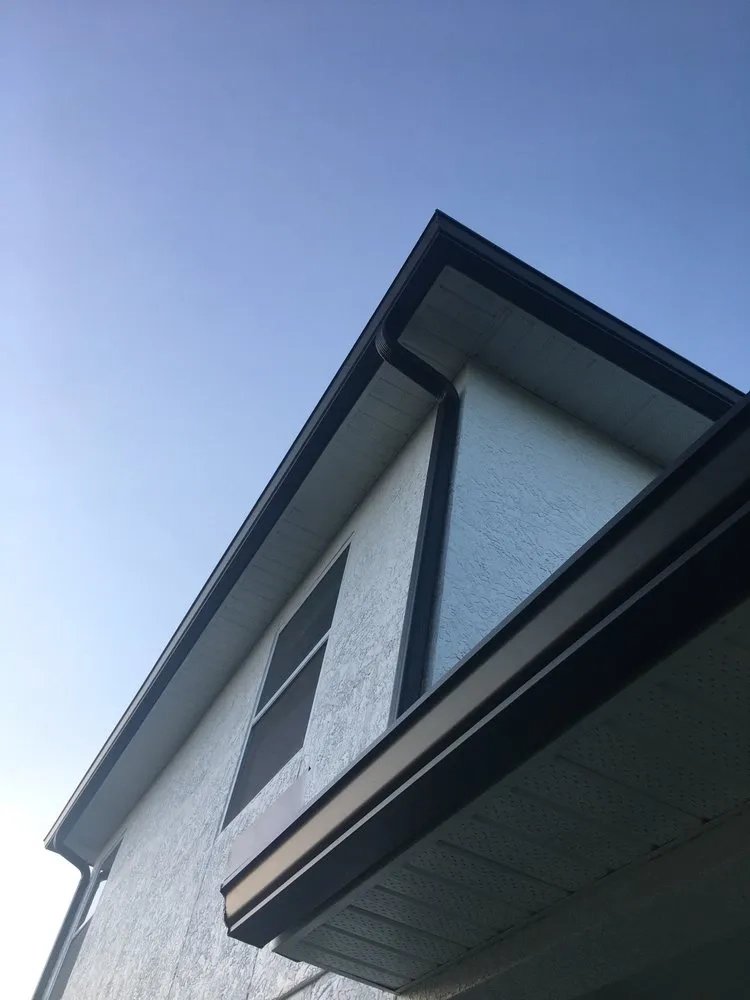
The SR-429 Western Beltway corridor has become one of the Orlando area’s fastest-growing residential markets, with communities such as Rock Springs Ridge, Apopka Landing, Magnolia Park, and the expanding Errol Estates area. Many of these homes feature 2,500 to 5,000 square foot Mediterranean and contemporary designs with hip roofs and multiple valley convergence points. Builder-installed 5-inch sectional gutter systems are often adequate for code compliance but can struggle to handle the concentrated runoff produced during Central Florida’s heaviest storms.
This valley overflow pattern is similar to what we see in communities such as Nocatee, Haile Plantation, and Killearn Estates. During our assessment, we evaluate valley capacity, sectional joint condition, downspout spacing, and roof drainage patterns to determine whether targeted upgrades or full seamless gutter replacement offers the best long-term solution. We also consider local soil conditions, as homes in Rock Springs Ridge often sit on fast-draining karst soils, while properties in Apopka Landing may require different drainage strategies because of flatter, clay-influenced soils.
Four Failure Patterns Most Common on Apopka Property Assessments
Apopka’s dual geology, Lake Apopka environmental constraints, SR-429 corridor new construction, and commercial greenhouse legacy each produce specific drainage failure conditions. These four account for the large majority of what we find on initial property assessments across Northwest Orange County.
Flatwood Clay Foundation Saturation
Properties in western and southern Apopka on clay-influenced agricultural flatwood soils experience grade-level downspout discharge that sits against foundation perimeters rather than percolating rapidly — the same condition seen in southwest Gainesville and the Lake Jesup basin in Sanford. Standard elbows that appear adequate in the dry season create progressive foundation-edge saturation through the wet season, accumulating across 20 to 30 storm events per season.
SR-429 Corridor Valley Overflow
Large-footprint homes in Rock Springs Ridge, Apopka Landing, Errol Estates expansion, and Magnolia Park have hip-roof valley convergence points where builder-installed 5-inch sectional systems overflow during peak wet-season events. The combined flow from two roof planes at each valley point exceeds single-plane capacity, discharging against fascia at the highest moisture-intrusion-risk location on the roofline. Sectional joint separation compounds the problem on installations 5 to 10 years old.
Lake Apopka Environmental Discharge Constraints
Near-lake properties on Apopka’s southern boundary face both the flatwood clay percolation limitation and the environmental discharge constraint from the Lake Apopka restoration watershed guidelines. Standard elbows that deposit water near the lake edge or at the foundation perimeter create problems in both directions simultaneously. Underground drainage that routes water to a regulated discharge point addresses both constraints — the only solution that works for properties in this dual-constraint zone.
Commercial Greenhouse Structure Undersizing
Apopka’s remaining greenhouse and nursery facilities, a legacy of its Foliage Capital history, often feature metal roofs spanning 10,000 to 100,000 square feet. These buildings generate runoff volumes far beyond the capacity of residential or light commercial gutter systems. When gutters are undersized because roof catchment areas were not properly calculated, overflow can cause perimeter erosion, flooding around growing areas, and moisture buildup along the building foundation. Proper commercial gutter sizing begins with an accurate assessment of roof area, drainage patterns, and discharge requirements.
Gutter and Drainage Services for Apopka and Northwest Orange County
Each service addresses conditions specific to Apopka’s dual geology, Lake Apopka environmental context, SR-429 corridor growth communities, or commercial legacy structures. We identify which apply to your property during the free estimate — including which drainage zone you’re in.
Apopka Neighborhoods and Northwest Orange County Communities We Serve
Drainage zone, housing age, proximity to Lake Apopka, and canopy density vary significantly across Apopka. Knowing which geological zone a property sits in is the first step of every estimate visit.
Schedule an Apopka Estimate
We serve all Apopka neighborhoods and Northwest Orange County communities. Every estimate begins with soil zone identification — karst or flatwood clay — because the correct discharge planning approach differs between these zones more than it does between some pairs of different cities. Drainage zone assessment is included in the free estimate at no additional charge.
Orlando Office:
4677 LB McLeod Rd, Ste. B, Orlando FL 32811
(407) 203-1144
How We Work in Apopka and Northwest Orange County
Soil Zone First — Karst or Flatwood Clay — Before Any Other Specification
Apopka is unique within the Precision Gutters service area because soil type is the first factor we evaluate during every estimate. Drainage needs vary dramatically between the fast-draining karst soils of Rock Springs Ridge and the flatter, clay-rich areas near Ponkan Road. A home in the karst zone may only need properly sized gutters and standard downspout extensions, while a property just a few miles away may benefit from underground drainage because of slower soil percolation.
After identifying the soil zone, we evaluate roof design, valley convergence points, and gutter capacity on newer SR-429 corridor homes to determine whether targeted upgrades or full seamless gutter replacement is the best solution. For properties near Lake Apopka, we also consider environmental stormwater requirements alongside local soil conditions when designing the discharge plan. Commercial and agricultural buildings receive individual roof catchment calculations to ensure the gutter system matches the property’s actual drainage demands.
Every seamless gutter system is fabricated on-site from continuous aluminum coil stock with no sectional joints. We calculate the proper slope for each run, and the site assessment, soil analysis, and drainage plan developed during the estimate are carried directly to the installation crew to ensure every system is built specifically for the property.
How We Work
From Estimate to Installation
Five steps between your free estimate and a correctly specified gutter system for your Apopka or Northwest Orange County property.
Soil Zone Assessment
Karst or flatwood clay? This first determination shapes everything that follows — including whether underground drainage is recommended as a standard component or an exception.
Roofline & Valley Analysis
Catchment area per run, hip-roof valley convergence point identification on SR-429 corridor homes, fascia condition review, and downspout spacing assessment.
Sizing & Discharge Spec
Gutter profile (5″ or 6″), downspout sizing (correcting 2×3 undersizing to 3×4 where warranted), outlet spacing, and discharge planning — including underground components for near-lake and near-river properties.
On-site Fabrication
Seamless gutters formed from continuous aluminum coil stock to your exact roofline dimensions — no pre-cut section joints, no default pitch applied uniformly.
Install & Flow Test
Gutters hung at calculated pitch, downspouts connected to grade-level or underground discharge as specified by zone, flow tested before the crew leaves.
Why the Correct Discharge Approach for a Karst Property Is Wrong for a Flatwood Clay Property — and Vice Versa
The difference between Apopka’s two primary soil zones directly affects drainage design. In Rock Springs Ridge and other karst areas, water from a properly positioned downspout typically drains quickly through limestone and well-draining soils, making standard downspout extensions sufficient for most properties. Adding underground drainage in these conditions often provides little additional benefit.
In contrast, homes near Ponkan Road and other flatwood clay areas drain much more slowly. During the wet season, repeated storms can keep the soil saturated, allowing water to remain near the foundation for extended periods. For these properties, underground drainage is often the more effective long-term solution for moving runoff away from the home.
That’s why identifying the property’s soil zone is the first step of every Apopka estimate. The right drainage solution depends on local ground conditions, not a one-size-fits-all approach. See our underground drainage page for system configuration detail.
Flatwood Zone Emitter Runs
Pop-up emitter systems for western and southern Apopka clay-soil properties — routing discharge past the slow-percolating clay layer to an appropriate discharge point away from the foundation perimeter.
Lake Apopka Dual-Constraint Routing
Discharge planning for lake-adjacent lots — routing water away from the foundation edge AND away from the lake surface per watershed restoration guidelines, to a regulated discharge point appropriate for each lot geometry.
Valley Outlet Additions
Additional downspout outlets at hip-roof valley convergence points on SR-429 corridor growth community homes — the primary correction for builder-spec systems where standard outlet spacing produces overflow at high-flow valley locations.
Near-River Drainage
For properties in the lowest-elevation areas adjacent to Rock Springs Run and the Wekiva River itself, seasonal water table elevation during wet season reduces the karst zone’s normally rapid percolation — underground drainage specified where this condition applies.
Residential, Growth Community, and Commercial Gutter Systems in Apopka
Residential
Established Errol Estates, Wekiva corridor, and central Apopka homes through newer SR-429 growth community construction — soil zone identified before any installation or discharge recommendation.
Growth Community — SR-429 Corridor
Rock Springs Ridge, Apopka Landing, Magnolia Park, and Errol Estates expansion — large-footprint hip-roof homes with builder-spec valley overflow and zone-dependent discharge conditions.
Commercial & Agricultural
Foliage industry greenhouse structures, wholesale nursery facilities, US-441 commercial corridor, and multifamily throughout Northwest Orange County.
What Apopka and Northwest Orange County Customers Say
Professionalism
The first home repair team in a long time that did what they promised and on time. I would recommend Hank’s. We had a whole house gutter and downspout replacement after the March hail storm in 2023.

Highly Recommended!
Dealt with Precision Gutters on a complex custom project, fixing an issue caused by a bad contractor. They worked tirelessly with me and went over every detail to help me come up with the best solution.
Premium Quality
Very professional and on time installation highly recommend thank you for your service!
Knowledgeable
I contracted Precision Gutters LLC to do the drainage for the gutters. They are professional, punctual, great attitude, knowledgeable, respectful personally.
I highly recommend Precision Gutters LLC as a company & their skills workers. Every message I sent to the Sales Representative Marc Marchand was answered in a timely manner & to the point.
Gutter Installation, Repair, Cleaning, and Drainage in Apopka
Frequently Asked Questions About Gutter Services in Apopka
How does Apopka’s geology create two different drainage conditions within the same city?
Apopka sits at the boundary of two distinct geological zones. The northeastern portion — the Wekiva River corridor, Rock Springs Ridge, and areas adjacent to Wekiwa Springs State Park — sits on karst limestone that produces rapid percolation through solution cavities. Grade-level downspout discharge on properties in this zone typically moves away from the foundation quickly enough that underground drainage is not routinely necessary. The western and southern portions approaching Lake Apopka sit on heavier flatwood clay soils with substantially lower percolation rates. In these zones, grade-level discharge can sit against the foundation perimeter for extended periods during wet season, and underground drainage is the technically correct solution for most lots. The correct discharge planning approach depends on which zone a property sits in — two properties five miles apart can have completely different drainage requirements.
Why does Lake Apopka’s restoration affect discharge planning for nearby properties?
Lake Apopka is one of Florida’s most significant environmental restoration projects — decades of agricultural runoff severely degraded the lake, and strict stormwater management guidelines now govern the watershed. Lakefront and near-lake properties on Apopka’s southern boundary face a discharge constraint: direct routing of concentrated stormwater discharge toward the lake surface can conflict with watershed protection guidelines. The correct approach routes downspout water away from both the lake edge and the foundation perimeter to an appropriate regulated discharge point. On the flatwood clay soils that characterize this zone, the near-lake wet-season water table elevation adds a foundation saturation concern on top of the environmental constraint — creating a dual requirement that must be addressed simultaneously in the discharge plan.
Do new homes in Rock Springs Ridge or Apopka Landing need gutter assessments?
Builder-installed gutter systems in Rock Springs Ridge, Apopka Landing, Magnolia Park, and the SR-429 corridor growth communities follow the same minimum-code-specification pattern seen throughout Florida’s new construction market — 5-inch sectional aluminum adequate for permit inspection, not necessarily sized for the roofline’s actual catchment area. These communities contain homes with hip-roof configurations and valley convergence points where two roof planes combine their flow during peak storm events, substantially exceeding what the single-plane 5-inch profile was sized to handle. We assess valley sizing, sectional joint condition, and downspout outlet spacing before recommending whether targeted valley correction or full seamless replacement is appropriate. The soil zone the home sits in also affects the discharge planning recommendation.
How does Wekiva River proximity affect drainage for northeast Apopka properties?
Northeastern Apopka’s Wekiva River corridor properties in the Rock Springs Ridge, Kelly Park, and Wekiva Springs Road areas typically have the best-draining soils in the Apopka market — the karst limestone substrate percolates water rapidly. The exception is in the lowest-elevation areas adjacent to Rock Springs Run and the Wekiva River itself, where seasonal water table elevation during the June through September wet season temporarily reduces the karst zone’s naturally rapid percolation. Properties in these lowest-elevation river-adjacent areas benefit from discharge planning that accounts for wet-season water table conditions — similar to the near-river drainage conditions along the Little Wekiva in Altamonte Springs. We assess each property’s specific elevation and river proximity during the estimate to determine whether standard or underground discharge is appropriate.
Does Apopka’s foliage capital history affect commercial drainage requirements?
Apopka’s legacy as the Indoor Foliage Capital of the World left a significant commercial infrastructure legacy — commercial greenhouse operations, wholesale nursery facilities, and agricultural processing buildings with large metal roof spans are present throughout the Apopka commercial corridor. These large metal-roof buildings generate drainage volumes during peak storm events that residential or light commercial gutter specifications cannot handle. A greenhouse facility with 100,000 square feet of roof area generates dozens of gallons of water per second during a 2.5-inch-per-hour Central Florida storm event. We assess each commercial greenhouse or nursery-related building individually for roof area, drainage plan, and discharge requirements rather than applying residential spec to commercial-scale agricultural rooflines.
Are micro-mesh leaf guards worth installing on Apopka homes with live oak canopy?
For properties in Errol Estates, Rock Springs Ridge, and the established residential areas of central Apopka with significant live oak or water oak canopy, micro-mesh guards are a cost-effective preventive measure. Standard screen guards with 1/8-inch openings allow live oak tassels and acorn caps to pass through and accumulate at downspout inlets regardless. Micro-mesh systems with fine enough openings to exclude live oak debris effectively reduce cleaning frequency from twice to once annually on high-canopy properties. For properties in the karst northeast zone where drainage otherwise requires little maintenance, guards that reduce the cleaning frequency provide the only ongoing service cost reduction available.
How often should Apopka homes be cleaned?
Most Apopka residential properties benefit from gutter cleaning at least twice annually — once pre-wet-season in April or May and once post-fall in November. Properties in the established Errol Estates, Rock Springs Ridge, and older central Apopka residential areas with significant live oak or longleaf pine canopy may need three annual cleanings. The pre-wet-season cleaning is the most critical interval: properties entering June with accumulated debris at downspout inlets are running their drainage system at reduced capacity through the highest-intensity storm period of the year. This is true whether the property is in the karst northeast zone (where good drainage makes the system easier to maintain) or the flatwood clay southwest zone (where reduced flow capacity compounds an already more demanding drainage situation).
Does Precision Gutters serve commercial properties in Apopka?
Yes. We install commercial gutter systems on retail and office properties throughout Apopka’s commercial corridors — US-441, SR-436, and the SR-429 interchange area — as well as on commercial greenhouse structures, wholesale nursery facilities, and agricultural-related buildings throughout the Apopka corridor. Large commercial greenhouse and nursery buildings with metal roof spans require individual catchment area assessment and commercial-profile gutter systems rather than residential spec scaled up. We also serve multifamily properties throughout Northwest Orange County and the growing residential communities along the SR-429 corridor.
Stop Water Problems Before They Reach the Foundation
Apopka’s karst-limestone northeast and flatwood-clay southwest require different discharge planning approaches — sometimes for properties just five miles apart within the same city. The SR-429 corridor’s large hip-roof growth community homes have builder-spec valley overflow conditions. Lake Apopka’s restoration watershed creates dual environmental and foundation discharge constraints for nearby properties. Free estimates include soil zone identification, valley analysis for growth community homes, and discharge planning appropriate to each property’s actual conditions.
Other Florida Locations