
Gutter Company in Winter Park, FL
Winter Park has the densest live oak canopy in the Orlando metro, a chain of interconnected lakes that creates seasonal water table conditions on the city’s most valuable lakefront properties, and historic estate-scale homes from the 1910s through the 1940s with original wood fascia and architectural drainage features that require more than a standard residential gutter spec. We account for all three before measuring anything.
Florida’s Most Celebrated Urban Live Oak Canopy — and What It Costs Your Gutters
Winter Park’s 60 to 80-year-old live oaks along Park Avenue, Palmer Avenue, and the lakefront estates shed tassels, leaves, and acorn caps year-round. The pre-wet-season cleaning in April or May is the most critical maintenance interval: properties with heavy canopy that enter June with blocked downspout inlets are testing their drainage system at reduced capacity through the highest-intensity storm period of the year.
The Lake Chain Creates a Regulated Discharge Constraint and a Wet-Season Water Table Condition
Lakes Virginia, Osceola, Maitland, and the Winter Park chain are an interconnected regulated watershed. Lakefront properties cannot discharge directly toward the lake surface. Near-lake properties experience wet-season water table elevation that slows grade-level percolation. Both conditions require underground drainage planning — not standard downspout elbows.
Why the Winter Park Chain of Lakes Changes Drainage Planning for the City’s Most Valuable Properties
Winter Park’s interconnected chain of lakes, including Lakes Virginia, Osceola, Maitland, Killarney, and Berry, defines both the city’s character and its drainage conditions. Lakefront estates along Interlachen Avenue, Palmer Avenue, Palmer’s Edge, and nearby neighborhoods sit in one of the Orlando area’s highest-value residential markets. During the June to October wet season, rising lake levels also raise the surrounding water table. On low-elevation properties, downspout discharge that drains normally in the dry season can remain near the foundation for extended periods as groundwater approaches the surface. Repeated exposure over the wet season increases the risk of foundation-edge saturation and long-term moisture intrusion.
Lakefront properties also require careful stormwater planning because Winter Park’s lakes are part of an interconnected, regulated watershed. Directing concentrated roof runoff toward the shoreline can create drainage and environmental concerns. Effective gutter and underground drainage design moves water away from both the foundation and the lake, protecting the home while supporting proper stormwater management.
Year-Round Debris Loading From the Densest Urban Canopy in the Orlando Metro
Winter Park’s mature live oak canopy is one of the city’s defining features, shading Park Avenue, the Via neighborhoods, and many lakefront estates. It also drives gutter maintenance needs across much of the residential market. Unlike many tree species, live oaks shed year-round, dropping tassels in spring, leaves and acorn caps through summer and fall, and additional foliage into early winter. Because debris accumulates continuously, the typical twice-yearly gutter cleaning schedule is often inadequate for homes beneath heavy oak canopy. A pre-wet-season cleaning in April or May is especially important, ensuring gutters and downspouts are clear before Central Florida’s heaviest rains arrive.
Many Winter Park neighborhoods also have water oaks, laurel oaks, magnolias, and sabal palms, creating a mix of debris that clogs gutters more quickly than any single tree species alone. Large magnolia leaves can bridge across gutter channels, trapping smaller leaves, tassels, and acorn caps behind them and restricting water flow. Homes surrounded by mature tree canopy typically benefit from more frequent gutter cleaning to maintain proper drainage throughout the year.
Tudor, Mediterranean Revival, and Craftsman Homes — and What They Need From a Gutter Installation
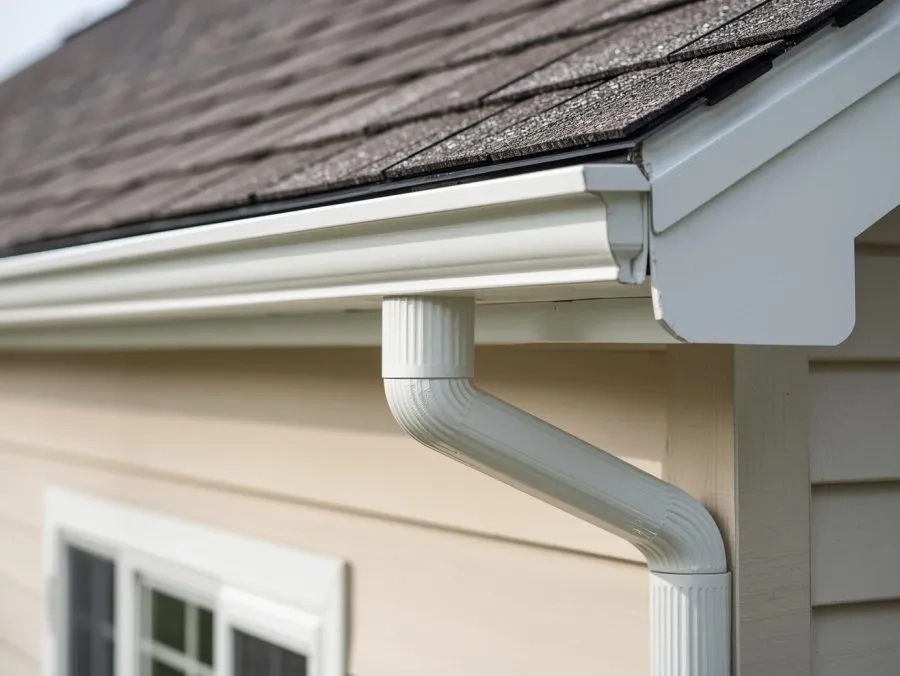
Winter Park’s historic homes are among the most architecturally significant in Central Florida. Lakefront estates along Palmer Avenue, Interlachen Avenue, and the neighborhoods surrounding Rollins College showcase Tudor Revival, Mediterranean Revival, Colonial Georgian, and Spanish Colonial architecture built between the 1910s and 1940s. On these homes, gutter profile, material, and color are part of the property’s architectural design, not simply functional components.
Many of these homes retain original wood fascia boards and exposed rafter tails that have endured decades of Central Florida’s humidity and seasonal rainfall. Even on well-maintained properties, hidden moisture damage behind existing gutters is common. Combined with elevated water tables near the chain of lakes and year-round debris from mature live oaks, these conditions create unique installation challenges. For every Winter Park home built before 1960, we begin with a thorough fascia assessment to guide gutter sizing, material selection, and drainage planning before installation.
When Copper Is the Technically and Aesthetically Correct Specification
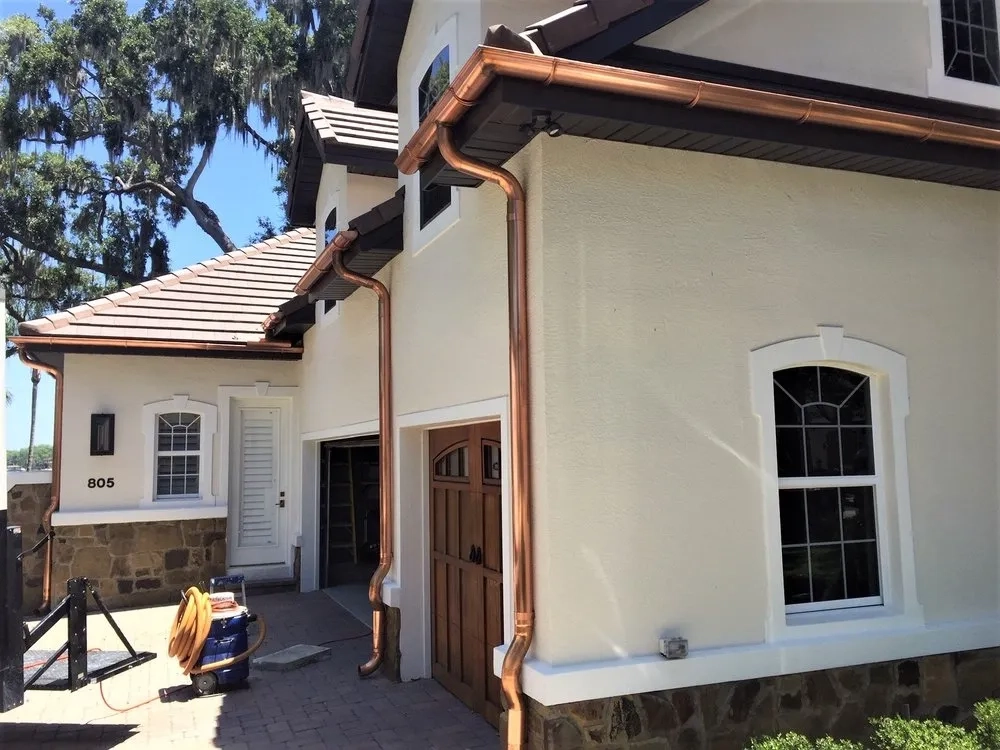
Winter Park is one of the few Central Florida markets where copper gutters are often an appropriate choice rather than a luxury upgrade. Historic Tudor Revival, Mediterranean Revival, and Colonial Georgian homes along Palmer Avenue, Interlachen Avenue, and the neighborhoods surrounding Rollins College frequently benefit from gutter profiles and materials that complement their original architecture. While standard K-style aluminum gutters provide excellent performance, copper offers a more historically appropriate appearance for many of these properties.
We install copper gutters in half-round and ogee profiles that match the architectural character of Winter Park’s historic homes. Over time, copper develops a natural patina that complements historic exteriors while providing exceptional durability and corrosion resistance. We present both copper and seamless aluminum options during the estimate, allowing homeowners to compare appearance, performance, maintenance, and cost before selecting the material that best fits their property.
Four Failure Patterns Most Common on Winter Park Property Assessments
Winter Park’s lake chain proximity, live oak canopy density, and historic housing stock create specific recurring failure conditions. These four account for the large majority of what we find on initial property assessments across the city.
Near-Lake Foundation Saturation
Lakefront and near-lake properties along Winter Park’s chain of lakes experience seasonal water table rises that slow drainage during the wet season. By August, runoff that drained quickly in May can remain near the foundation for an hour or more after each storm. Over time, this repeated moisture exposure can contribute to slab joint movement, foundation-edge saturation, and interior moisture problems.
Debris Blockage From Live Oak Canopy
Year-round live oak debris, including spring tassels, summer leaves, and fall acorn caps, can clog downspout inlets faster than a standard twice-yearly cleaning schedule can manage on heavily wooded properties. Missing a spring gutter cleaning often means the first major wet-season storms hit a partially blocked system. For homes with dense tree canopy, micro-mesh gutter guards or three cleanings per year are the most effective long-term solutions.
Fascia Deterioration Behind Historic Gutters
Original wood fascia on Palmer Avenue, Interlachen Avenue, and the historic Via neighborhoods has been exposed to Central Florida’s humidity for 80 to 110 years. A gutter pulling away at the hanger points is often only the visible sign of much deeper wood deterioration. Installing new gutters without repairing or replacing weakened fascia can lead to failure at the same location within one to two storm seasons.
Valley Overflow on Newer Winter Park Homes
Winter Park’s newer homes, including contemporary and transitional properties near Maitland and Casselberry, often experience the same valley overflow issues seen throughout the Orlando metro. Many feature hip roofs with valley convergence points where runoff from multiple roof planes exceeds the capacity of builder-installed 5-inch sectional gutters. As a result, overflow at roof valleys is one of the most common drainage problems reported within the first 5 to 10 years after construction.
Gutter and Drainage Services for Winter Park and Orange County
Each service below addresses conditions specific to Winter Park’s lake chain, live oak canopy, historic housing stock, or Park Avenue commercial character. We identify which apply during the free estimate.
Winter Park Neighborhoods and Communities We Serve
Lake proximity, canopy density, housing age, and architectural character vary significantly across Winter Park’s neighborhoods. Each shapes the gutter specification, cleaning schedule, material selection, and drainage planning approach.
Schedule a Winter Park Estimate
We serve all Winter Park neighborhoods and surrounding Orange County communities including Maitland, Casselberry, Eatonville, and the border areas with Orlando. Estimates include a lake proximity assessment, canopy density evaluation for cleaning interval recommendations, fascia condition review on older and historic properties, and discharge planning for near-lake lots.
Orlando Office:
4677 LB McLeod Rd, Ste. B, Orlando FL 32811
(407) 203-1144
How We Work in Winter Park
Lake Proximity, Canopy Density, Architectural Character — Before We Specify Anything
Winter Park requires a different approach than a typical Central Florida gutter installation. Lakefront properties along the chain of lakes, mature live oak canopy, and historic homes built between the 1910s and 1940s create drainage and installation challenges that vary from one neighborhood to the next.
For lakefront and near-lake homes, we evaluate how proximity to the lake, lot elevation, and seasonal water table changes affect drainage planning. For historic properties along Palmer Avenue, Interlachen Avenue, Orwin Manor, and the Via neighborhoods, we inspect fascia condition before recommending gutter sizing or materials and determine whether seamless aluminum or historically appropriate copper best suits the home. We also assess tree canopy and debris levels to recommend the right maintenance schedule and whether micro-mesh gutter guards are a worthwhile long-term investment.
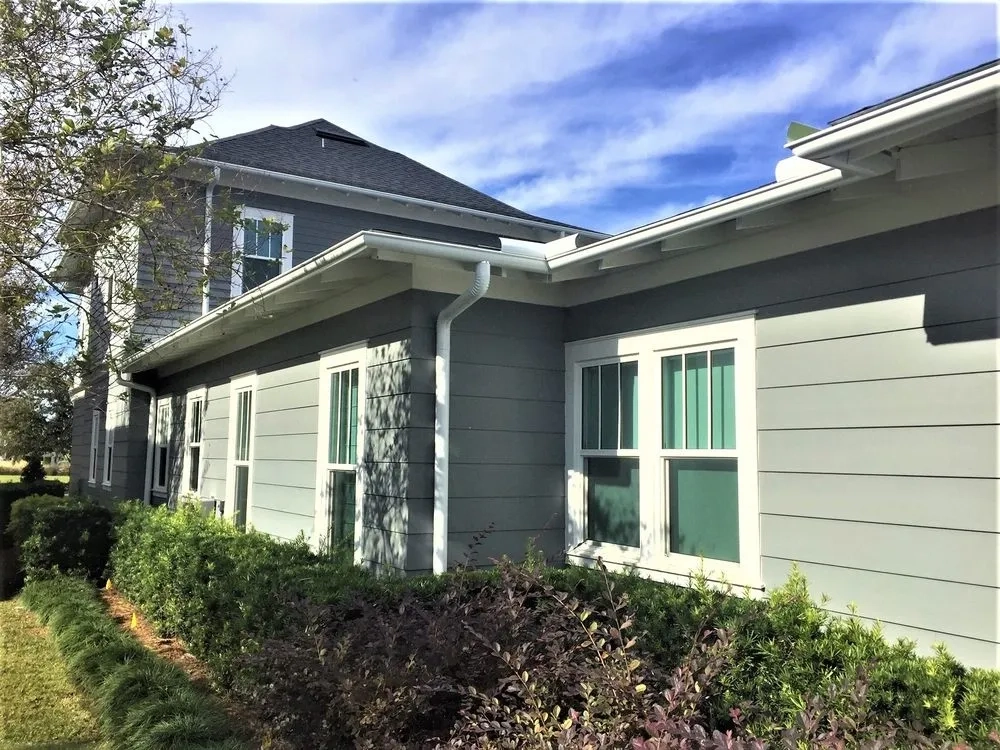
Every seamless gutter system is fabricated on-site from continuous aluminum or copper to match your roofline. We calculate the proper slope for each run, position outlets based on roof drainage patterns, and carry the findings from the estimate directly to the installation crew so every system is built specifically for your property.
How We Work
From Estimate to Installation
Five steps between your free estimate and a correctly specified, fabricated, and installed gutter system for your Winter Park property.
Property Assessment
Lake chain proximity and elevation, fascia condition on historic properties, canopy density, roofline configuration, and architectural character — evaluated before measurement begins.
Material & Profile Selection
Aluminum or copper determined by architectural period and homeowner priority. Profile — K-style, half-round, or ogee — determined by architectural context. Color selected to complement existing exterior treatment.
Sizing & Discharge Planning
Gutter profile (5″ or 6″), downspout sizing, outlet count, and discharge routing finalized — accounting for lake chain environmental constraints and wet-season water table at near-lake properties.
On-site Fabrication
Seamless gutters formed from continuous coil stock in aluminum or copper to exact roofline dimensions — no pre-cut section joints, in the specified material and color.
Install & Flow Test
Gutters hung at calculated pitch, downspouts connected to appropriate discharge points, flow tested before the crew leaves to confirm outlet performance at valley and concentration points.
Routing Downspout Water Correctly on Winter Park’s Regulated Lake Chain Properties
Winter Park lakefront properties face two unique drainage challenges. During the June to September wet season, rising lake levels elevate the surrounding water table, slowing the ability of soil to absorb downspout discharge. At the same time, the Winter Park chain of lakes is a protected, interconnected watershed, so concentrating roof runoff directly toward the shoreline can create stormwater management concerns.
Underground drainage systems help address both issues by carrying runoff through buried piping to a properly located pop-up emitter or approved stormwater connection. Depending on the property, discharge may be directed to the turf area, the street side of the lot, or another suitable outlet rather than near the foundation or lake edge. On narrow lakefront lots, we evaluate lot layout, elevation, and drainage patterns during the estimate to determine the most effective discharge strategy. See our underground drainage page and downspout installation page for system configuration detail.
Regulated Discharge Runs
Buried pipe from downspout outlet to a pop-up emitter at a regulated discharge point — away from both the foundation edge and the lake surface, positioned per local stormwater guidelines for the Winter Park lake chain.
Copper Downspouts
Copper downspouts on historic lakefront properties — period-appropriate profile and patina match that complements the architectural character of the Tudor, Mediterranean Revival, and Colonial estates fronting the lake chain.
Lake-Side Catch Basins
Surface collection points on lakefront lots where multiple downspouts near the lake side of the structure must have their discharge consolidated and routed to a single appropriate discharge point away from the shoreline.
Valley Outlet Addition
Additional outlets at hip-roof valley convergence points on newer Winter Park homes — the primary correction for builder-spec systems that overflow at valley locations during peak Central Florida wet-season events.
Residential, Historic Estate, and Commercial Gutter Systems in Winter Park
Residential
Standard residential homes across Winter Park’s neighborhoods — from newer northern residential blocks to established mid-century stock in Lakemont and Winter Park Pines.
Historic Properties
Palmer Avenue, Interlachen, Orwin Manor, Via’s, Hannibal Square, and the Rollins College neighborhood — architecturally significant properties from the 1910s through 1940s.
Commercial & Institutional
Park Avenue commercial buildings, Via’s district, Rollins College campus, Morse Museum, cultural institutions, and multifamily throughout Winter Park.
What Winter Park Customers Say
Professionalism
The first home repair team in a long time that did what they promised and on time. I would recommend Hank’s. We had a whole house gutter and downspout replacement after the March hail storm in 2023.

Highly Recommended!
Dealt with Precision Gutters on a complex custom project, fixing an issue caused by a bad contractor. They worked tirelessly with me and went over every detail to help me come up with the best solution.
Premium Quality
Very professional and on time installation highly recommend thank you for your service!
Knowledgeable
I contracted Precision Gutters LLC to do the drainage for the gutters. They are professional, punctual, great attitude, knowledgeable, respectful personally.
I highly recommend Precision Gutters LLC as a company & their skills workers. Every message I sent to the Sales Representative Marc Marchand was answered in a timely manner & to the point.
Gutter Installation, Cleaning, and Drainage in Winter Park
Frequently Asked Questions — Winter Park Gutter Services
How does the Winter Park chain of lakes affect drainage planning?
Winter Park’s chain of lakes, including Lakes Virginia, Osceola, Maitland, Killarney, and Berry, raises the surrounding water table during the June to October wet season. On lakefront and near-lake properties, downspout discharge that drains well in spring can remain near the foundation as groundwater rises through the summer. In some locations, the water table comes within 12 to 18 inches of the surface by August, leaving little capacity for natural drainage. Underground drainage systems are often the most effective solution for moving runoff away from the foundation. Because the lake chain is a protected watershed, discharge must also be directed away from the shoreline and routed to an appropriate outlet that complies with local stormwater management practices.
Why does Winter Park’s live oak canopy require more frequent gutter cleaning?
Winter Park has one of Florida’s most celebrated urban tree canopies, with mature live oaks lining Park Avenue, the Via neighborhoods, and many lakefront estates. Unlike trees that shed seasonally, live oaks drop tassels, small leaves, and acorn caps throughout the year, creating continuous gutter debris. Homes beneath dense canopy often benefit from three gutter cleanings annually, with the April or May service being the most important to prepare the system for the wet season. Properties in Winter Park’s northern neighborhoods with lighter tree coverage can often be maintained with a twice-yearly cleaning schedule.
What gutter material is appropriate for Winter Park’s historic estate homes?
Standard K-style aluminum gutters in historically compatible colors are an excellent choice for many Winter Park homes. For Tudor Revival, Mediterranean Revival, Colonial, and Craftsman properties along Palmer Avenue, Interlachen Avenue, and the Via neighborhoods, copper gutters in half-round or ogee profiles may provide a more historically appropriate appearance. Copper naturally develops a patina over time that complements historic architecture while offering exceptional durability. We provide specifications for both seamless aluminum and copper systems, allowing homeowners to compare performance, appearance, and cost before choosing the best option for their property.
Do Palmer Avenue and Interlachen historic homes need fascia assessment first?
Yes. The estate-scale homes along Palmer Avenue, Interlachen, and the surrounding lakefront streets are built from the 1910s through the 1940s with original wood rafter-tail framing and wood fascia boards that have been exposed to Central Florida’s humidity for 80 to 110 years. Even on well-maintained properties, the fascia boards behind existing gutters frequently show moisture deterioration not visible from the ground. We assess fascia condition as the first step of the estimate on any Winter Park property built before 1960. Where fascia replacement is needed, we coordinate the scope before specifying or fabricating new gutter hardware — not as a change order after the crew arrives.
Are micro-mesh leaf guards worth installing on high-canopy Winter Park properties?
For many Winter Park homes with mature live oak canopy, micro-mesh gutter guards are one of the most effective long-term maintenance upgrades. Unlike standard screen guards, which often allow fine live oak tassels and acorn caps to enter the gutter, high-quality micro-mesh systems are designed to block this smaller debris while maintaining water flow. On properties that currently require three gutter cleanings each year, micro-mesh guards can significantly reduce maintenance, often limiting service to an annual pre-wet-season inspection and surface clearing. Over time, the reduction in cleaning frequency can help offset the initial investment while improving year-round gutter performance.
What gutter considerations apply to commercial buildings along Park Avenue?
Park Avenue’s historic commercial buildings place drainage performance and appearance under equal scrutiny. Because these multi-story brick buildings are viewed up close, gutter profile and color should complement the property’s masonry and architectural style while providing reliable water management. We evaluate each building individually, considering roof catchment area, roofline configuration, and any architectural or preservation considerations before recommending the appropriate commercial gutter system.
How should lakefront discharge be planned on the regulated Winter Park lake chain?
Winter Park’s chain of lakes is a protected, interconnected watershed, making proper stormwater management especially important for lakefront homes. Downspout discharge should not be directed toward the shoreline, as concentrated runoff can create environmental concerns and may not align with local stormwater requirements. Instead, runoff is typically routed toward the street, a designed stormwater feature, or an underground drainage system with a properly placed pop-up emitter. On narrow lakefront lots, we also consider seasonal water table conditions and foundation drainage to ensure the system directs water safely based on the property’s layout and elevation.
Does Precision Gutters serve commercial and institutional properties in Winter Park?
Yes. We install commercial gutter systems for Park Avenue businesses, the Via neighborhood retail district, Rollins College buildings, the Morse Museum, the Albin Polasek Museum, multifamily developments, mixed-use properties, and other commercial and institutional buildings throughout Winter Park. For historic buildings and cultural institutions, we evaluate architectural compatibility alongside drainage performance, ensuring the gutter profile, material, and color complement the property’s character while providing long-term protection.
Stop Water Problems Before They Reach the Foundation
Winter Park’s interconnected lake chain, the densest live oak canopy in the Orlando metro, and historic estate-scale homes from the 1910s through the 1940s all require gutter systems specified for the actual conditions at each property — not the standard Central Florida template. Free estimates include lake proximity assessment, canopy density evaluation, fascia condition review on older properties, and discharge planning for near-lake and lakefront lots.
Other Florida Locations