
Gutter Company In Gainesville, FL
Gainesville’s live oak canopy, clay-soil drainage zones, and university rental housing stock create gutter conditions that demand more than a standard Florida residential spec. Dense tree coverage produces the highest sustained debris load of any inland market we serve. We size systems for Alachua County rainfall, calculate cleaning schedules by canopy density, and assess fascia condition on every property before mounting a single hanger.
Gainesville’s Live Oak Canopy Requires a Different Cleaning Schedule Than Most Florida Cities
Live oak sheds tassels, acorn caps, and small leaves year-round — not in a single seasonal drop. Properties in Duck Pond, Duckpond, Golfview, and the University Avenue corridor need three cleanings annually to maintain design flow capacity through wet season. Standard twice-annual scheduling leaves these gutters entering June with significant blockage accumulation.
What the University Market Does to Gutter Maintenance — and Why Deferred Service Compounds Faster Here
Gainesville’s identity as a university town shapes its housing market in ways that directly affect gutter system condition across a large portion of the city’s residential stock. The area within roughly two miles of the University of Florida campus — the Duckpond, Duck Pond Historic District, University Avenue corridor, SW 2nd Avenue zone, and the dense NW 13th Street rental belt — is dominated by single-family homes that have been converted to rental use, multifamily student housing, and investment properties cycling through tenants on 12-month leases.
In this market, proactive exterior maintenance is routinely deferred. Tenants report interior problems — a drip from the ceiling, a soft spot on the floor — but they do not notice that a gutter has begun pitching backward, that an oak tassel mat has blocked a downspout inlet, or that the fascia board behind a loosening hanger has begun accumulating moisture. The property owner, often managing the home remotely, addresses tenant complaints but rarely schedules a gutter inspection unless something is visibly failing. Over three to five tenant cycles, small maintenance deficits compound: the hanger that needed tightening in year two has pulled progressively further from the fascia by year five, and the moisture it admitted has rotted the wood over a span two feet wider than the visible separation point.
The result, when these properties finally receive a gutter assessment — often triggered by a sale, a re-roof, or a fascia that is visibly deflecting — is that repair is not the correct answer. The mounting substrate has deteriorated past the point where new hardware will hold, and fascia replacement is a prerequisite to any new installation. We see this condition more consistently in Gainesville’s near-campus rental zone than in any other market we serve in north-central Florida.
Why Drainage Planning Varies Across Gainesville’s Different Soil Zones
Gainesville sits on a transitional geological zone between the limestone karst platform of Marion County to the south — where solution cavities create unpredictably fast percolation — and the heavier flatwoods clay soils that characterize north-central and north Florida. This transition is not geographically uniform across the city, which means that the correct downspout discharge plan varies significantly by where a property sits within the Gainesville metro.
The northeast quadrant of Gainesville — Duck Pond, Tumblin Creek, and the higher-elevation neighborhoods near the UF campus and along NE 8th Avenue — sits on sandy loam soils with generally good percolation. Grade-level downspout discharge on most of these properties moves laterally away from the foundation quickly enough that extended elbows or underground systems are not typically necessary, though flat-lot conditions and dense plantings can create localized pooling that requires attention.
Southwest and west Gainesville — the Jonesville corridor, Newberry Road, and the newer subdivisions along SW 75th Street — sits on heavier clay-dominant flatwoods soils with substantially lower percolation rates. In this zone, standard grade-level discharge from a downspout elbow deposits water within 5 to 8 feet of the foundation edge, where it sits in contact with the slab perimeter during the hours following a peak wet-season event. Properties on these soils benefit from underground drainage components — catch basins, French drains, or pop-up emitters — that route water past the clay layer to a discharge point away from the structure. The correct answer depends on a site-specific evaluation of the soil conditions at each downspout location, not a county-wide percolation assumption.
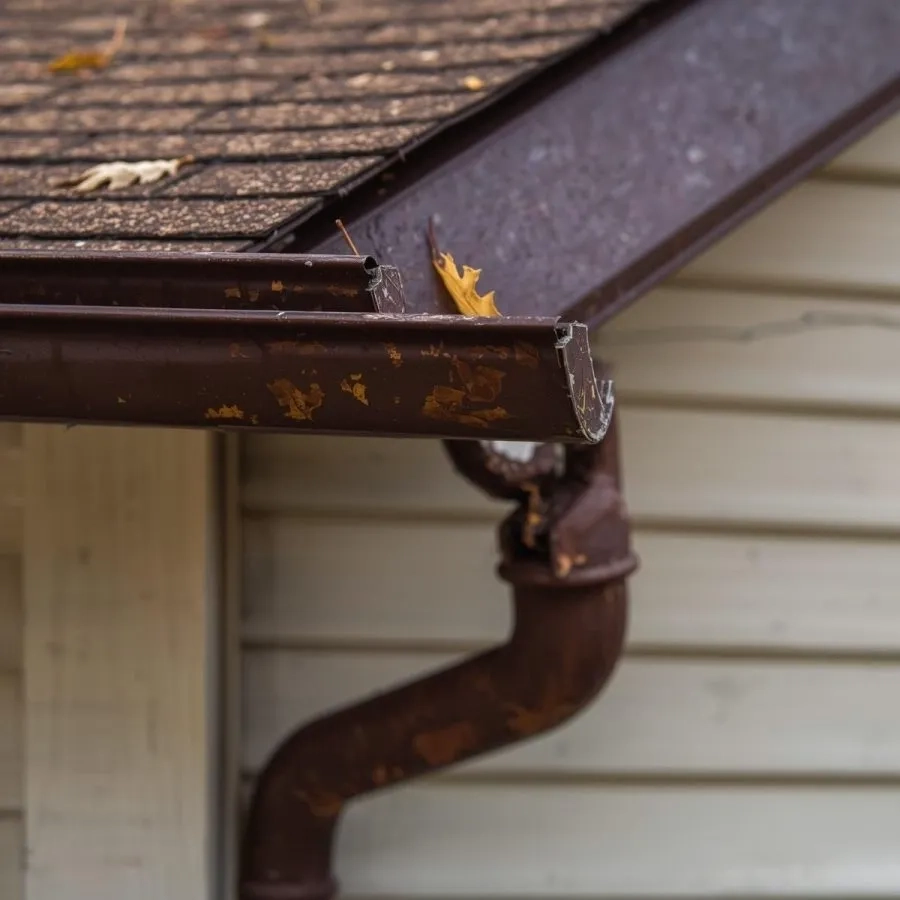
Why Gainesville’s Tree Cover Creates the Highest Sustained Debris Load in Our Inland Market
Gainesville’s live oak canopy is functionally different from the debris conditions in every other city in the Precision Gutters service network. Most Florida cities have deciduous tree species that produce a concentrated seasonal debris event — a fall leaf drop that accumulates in gutters over a few weeks and then largely ceases until the following year. Live oak in Gainesville does not behave this way.
Live oak is technically semi-evergreen: it sheds continuously rather than seasonally, producing fine tassels in a concentrated spring flush (March through May), smaller leaf and acorn cap debris through summer and early fall, and another accumulation period in late fall and winter. There is no month in a Gainesville calendar year when a property under live oak canopy is not adding debris volume to its gutters. The consequence is that cleaning intervals adequate for other Florida cities are insufficient for the highest-canopy Gainesville neighborhoods — properties that are serviced twice annually enter June, the first month of the high-intensity wet season, with three to four months of accumulated debris loading that has not been cleared since a fall cleaning in November or December.
Water oak, longleaf pine, and magnolia — all common in Gainesville’s established neighborhoods — compound the live oak debris pattern with different but equally problematic debris types. Water oak drops small, round leaves that mat densely at downspout inlets. Pine needles from longleaf and slash pine compress into plugs inside downspout transitions. Magnolia drops large, leathery leaves that bridge across gutter channels and trap smaller debris behind them. The combination of debris types common in a single Gainesville block produces blockage conditions that require more frequent clearing than any single debris type would create on its own.
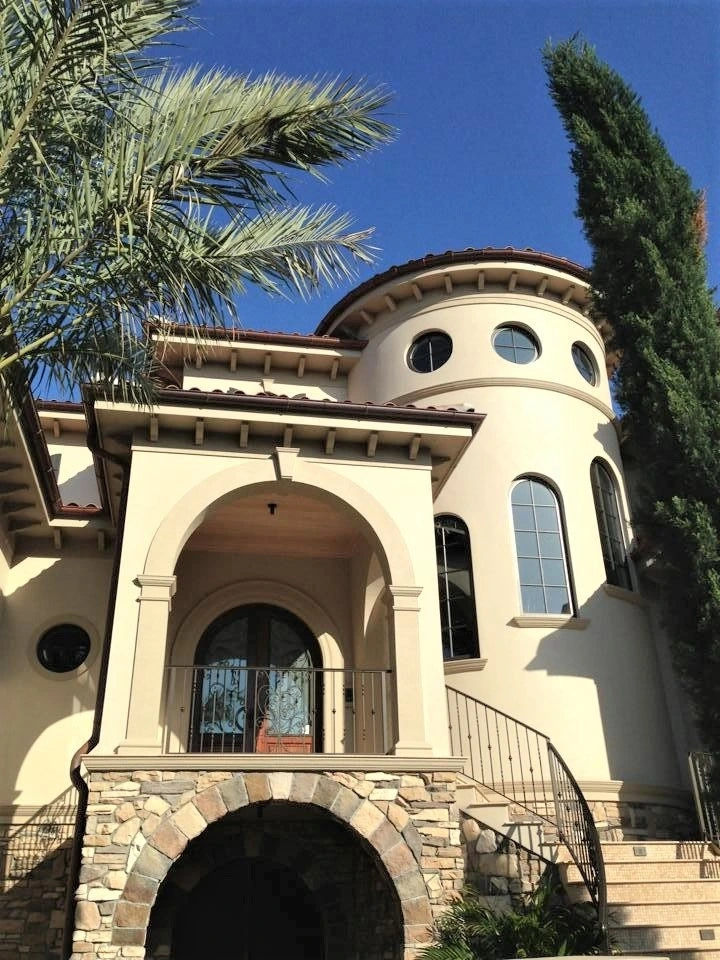
How North-Central Florida’s Storm Season Tests Gainesville Gutter Capacity
Gainesville receives approximately 54 inches of annual rainfall — distributed across a May–September wet season driven by convective afternoon thunderstorm cells that build over the Florida peninsula. The city sits far enough inland that it does not receive the direct coastal storm intensification of Daytona Beach or Tampa, but it is positioned squarely in the zone of maximum convective activity as Gulf of Mexico and Atlantic moisture converge over north-central Florida. Peak summer storm events routinely deliver 2 to 3 inches of rain per hour.
A gutter system that enters June with a partially blocked downspout inlet — the result of a missed pre-wet-season cleaning — faces its first peak-intensity storm of the season running at reduced capacity. If that storm delivers 2.5 inches per hour to a roofline with a 1,500-square-foot catchment area, the volume reaching the gutter is approximately 25 gallons per minute. A partially blocked 3×4 downspout can handle perhaps 35 to 40 percent of this volume before overflow begins. The overflow discharges against the fascia at the downspout inlet location — exactly where the wood substrate is already under the most moisture stress from the debris mat sitting in contact with it above the inlet.
Pre-wet-season cleaning in late April or May is the critical maintenance interval for Gainesville properties, more so than in any other city we serve except those with direct coastal debris exposure. Entering June with cleared gutters and functioning downspout inlets converts the first heavy storm of the season from a stress event into a routine drainage performance test.
Four Drainage Failure Patterns We Diagnose Most Often on Gainesville Properties
Gainesville’s combination of dense live oak canopy, university rental market maintenance deferral, aging historic housing stock, and clay-soil zones creates a specific set of recurring conditions. These four failure patterns account for the large majority of what we find on initial assessments.
Fascia Rot from Deferred Maintenance
Near-campus rental properties accumulate the classic deferred-maintenance failure: hangers loosen over multiple tenant cycles without tightening, the gutter pitches backward and ponds standing water against the fascia face, and wood fiber deteriorates over a span wider than the visible hanger separation point. By the time the gutter is visibly pulling away, fascia replacement is a prerequisite — not a repair, a replacement project. We assess fascia condition before recommending anything.
Downspout Blockage from Live Oak Debris
Live oak tassels and acorn caps compact at downspout inlets faster than any other debris type common in central Florida. A tassel mat that builds during the spring shedding period (March–May) reaches flow-restricting volume before pre-wet-season cleaning intervals, meaning the first major June storm loads through a restricted inlet. Micro-mesh leaf guards are the correct long-term solution; correct cleaning scheduling is the immediate one.
Builder-Spec Overflow on Newer Subdivision Homes
Haile Plantation, Tioga, Gainesville Place, and the Post Oak corridor have large-footprint homes with hip-roof configurations and valley convergence points where builder-installed 5-inch sectional systems overflow during peak wet-season events. The overflow occurs at valley points — where two roof planes combine their flow — and at any sectional joint that has opened through thermal cycling. Correct sizing at valley points is a 6-inch profile; correct joint treatment is seamless replacement.
Foundation Saturation in Southwest Gainesville Clay Zones
SW Gainesville’s flatwoods clay soils along the Newberry Road and SW 75th Street corridors do not percolate grade-level downspout discharge quickly enough to prevent foundation-edge saturation during sustained wet-season rainfall periods. Water that sits in contact with the slab perimeter for multiple hours per storm event, repeated across 20 to 30 events per wet season, creates hydrostatic pressure cycling that causes slab joint separation and soil movement around utility penetrations over several years.
Gutter and Drainage Services for Gainesville and Alachua County
Each service below addresses conditions specific to Gainesville’s canopy, housing stock, soil type, or university rental market context. We identify which services apply to your property during the free estimate.
Gainesville Neighborhoods and Communities We Serve
Canopy density, soil type, housing age, and ownership structure vary significantly across Gainesville’s neighborhoods. Each shapes the gutter specification, cleaning schedule, and drainage planning approach.
Schedule a Gainesville Estimate
We serve all Gainesville neighborhoods and Alachua County communities including Newberry, Alachua, High Springs, Micanopy, and Waldo. Estimates include a fascia condition assessment, a canopy density evaluation for cleaning schedule recommendations, and a soil drainage review at each downspout discharge location.
Orlando Office:
4677 LB McLeod Rd, Ste. B, Orlando FL 32811
(407) 203-1144
How We Work in Gainesville
Accounting for Canopy, Soil Zone, and Housing Age Before Specifying Anything
Gainesville’s gutter market does not respond well to a uniform specification. The difference between a 1920s Craftsman in Duck Pond with original wood fascia, maximum live oak canopy overhead, and sandy loam soil — and a 2005 Mediterranean-revival home in Haile Plantation with a hip-roof valley configuration and clay-soil drainage conditions — is larger than the difference between many cities in the states. Applying the same 5-inch aluminum spec and twice-annual cleaning recommendation to both properties produces an appropriate result on neither one.
Our estimate process for Gainesville properties covers four distinct assessments: roofline measurement and sizing calculation, fascia condition review before any hardware specification, canopy density evaluation to determine the appropriate cleaning interval recommendation, and soil drainage assessment at each downspout discharge location to determine whether grade-level discharge is adequate or whether underground drainage components are needed. These are not separate consultations — they happen during a single free estimate visit.
We fabricate gutters on-site from continuous coil stock using a truck-mounted seamless fabrication machine. Slope is calculated per run based on your actual fascia pitch and roofline dimensions — not a standard default applied uniformly. For properties where copper is the appropriate material — Duck Pond historic homes, Golfview, Duckpond — we specify and install copper on the same framework of roofline-specific measurement and on-site coordination.
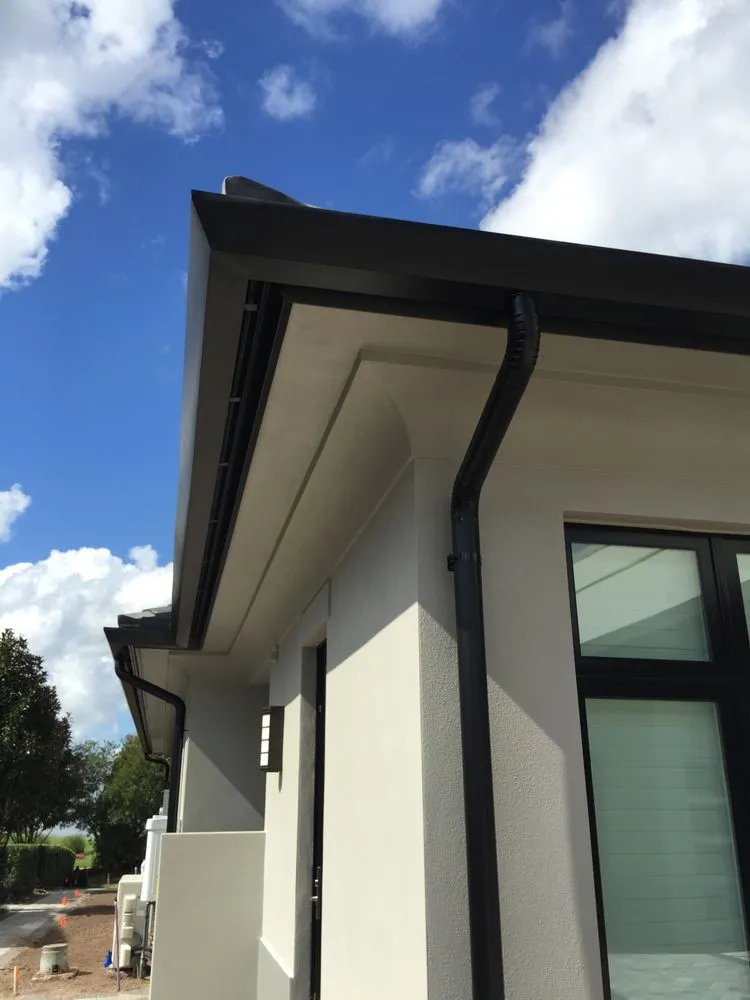
How We Work
From Estimate to Installation
Five steps between your free estimate and a correctly specified gutter system for your Gainesville or Alachua County property.
Property Assessment
Roofline measurement, fascia condition inspection, canopy density rating for cleaning interval recommendation, and soil assessment at downspout discharge locations.
Fascia Determination
Fascia condition evaluated before any specification is made. Deteriorated wood is replaced before installation — not discovered as a change order on installation day.
Sizing & Material Spec
Gutter profile (5″ or 6″), downspout sizing, and outlet spacing calculated for actual catchment area per run. Copper specified for qualifying historic properties.
On-site Fabrication
Seamless gutters formed from continuous coil stock to your exact roofline dimensions — no pre-cut section joints on long fascia runs.
Install & Flow Test
Gutters hung at calculated pitch with hidden hangers, downspouts connected to appropriate discharge points, and water flow tested before the crew leaves.
Why Downspout Discharge Location Differs Between Northeast and Southwest Gainesville
The correct discharge planning approach for a Gainesville property depends on which soil zone it sits in — and these zones correspond roughly (though not perfectly) to the city’s quadrants. Northeast Gainesville’s sandy loam soils allow grade-level discharge to percolate away from the foundation within an acceptable timeframe for most storm events. Southwest Gainesville’s clay-dominant flatwoods soils create the opposite condition: water deposited within 10 feet of the foundation may sit there for hours before infiltrating, maintaining hydrostatic contact with the slab edge throughout.
For SW and west Gainesville properties on clay soils, we typically recommend underground drainage components that route water from the downspout outlet to a pop-up emitter positioned at sufficient distance from the foundation to avoid this saturation pattern. For northeast Gainesville properties on sandy loam, grade-level discharge with appropriate elbow extensions is usually adequate — though flat lot conditions and dense foundation planting can create localized pooling that requires assessment. We evaluate the discharge area at each downspout location during the estimate rather than applying a zone-wide assumption. See our underground drainage page and downspout installation page for system configuration details.
French Drains
Perforated pipe systems that intercept and redirect subsurface water movement through SW Gainesville’s clay-dominant soils — routing it to discharge points away from the slab perimeter.
Catch Basins
Surface collection points for high-volume downspout discharge and sheet flow — particularly useful on Haile Plantation and Tioga properties where large roofline catchment areas produce peak discharge volumes that exceed what downspout elbows alone can route.
Pop-up Emitters
Pressure-activated outlets at the termination of underground drain runs — positioned 15 to 25 feet from the foundation to ensure water discharges past the zone of slab-edge influence.
Downspout Extensions
Surface elbows that increase discharge distance from 2 to 6–8 feet — the minimum intervention for properties where soil percolation is adequate but existing downspouts terminate too close to the foundation edge.
Residential, Rental, and Commercial Gutter Systems in Gainesville
Owner-Occupied Residential
Owner-occupied homes throughout Gainesville and Alachua County — from Duck Pond historic properties to newer Haile Plantation and Tioga homes. Specification determined by roofline, canopy, soil zone, and fascia condition.
Investment & Rental Properties
Near-campus and university-area investment properties where deferred maintenance creates compounded gutter and fascia failure. We assess total scope including fascia condition before providing any estimate.
Commercial & Multifamily
Retail and office along Archer Road, NW 13th, Newberry Road, and Tower Road; apartment buildings and student housing near campus; UF-adjacent mixed-use properties.
What Gainesville and Alachua County Customers Say
Professionalism
The first home repair team in a long time that did what they promised and on time. I would recommend Hank’s. We had a whole house gutter and downspout replacement after the March hail storm in 2023.

Highly Recommended!
Dealt with Precision Gutters on a complex custom project, fixing an issue caused by a bad contractor. They worked tirelessly with me and went over every detail to help me come up with the best solution.
Premium Quality
Very professional and on time installation highly recommend thank you for your service!
Knowledgeable
I contracted Precision Gutters LLC to do the drainage for the gutters. They are professional, punctual, great attitude, knowledgeable, respectful personally.
I highly recommend Precision Gutters LLC as a company & their skills workers. Every message I sent to the Sales Representative Marc Marchand was answered in a timely manner & to the point.
Gutter Installation, Repair, Cleaning, and Drainage in Gainesville
Frequently Asked Questions — Gainesville Gutter Services
Why do rental properties near UF so often need replacement rather than repair?
The university rental market in Gainesville creates a specific maintenance deferral pattern that accumulates across multiple tenant cycles. Landlords typically respond to tenant-reported problems but rarely schedule proactive gutter inspections between occupancy cycles. Over five to ten years of deferred cleaning and ignored hanger failures, the fascia board behind the gutter absorbs moisture from a backward-pitching gutter, and wood rot progresses well past the visible failure point before anyone inspects it. By the time a gutter is obviously pulling away from the fascia, the wood substrate has deteriorated over a span several feet wider than the visible separation. Installing new gutters on a rotted fascia board without replacing the wood first produces a new installation that fails at the same point within one to two storm seasons.
How does Gainesville’s live oak canopy affect cleaning frequency?
Gainesville carries one of the densest sustained live oak canopy loads of any city in north-central Florida. Neighborhoods like Duck Pond, Duckpond, Golfview, Tumblin Creek, and the University Avenue corridor have mature live oak and water oak with canopy that overhangs rooflines nearly continuously. Live oak sheds small leaves, tassels, and acorn caps throughout the year, with peak debris load in spring (March–May) and again in October–November. Properties in these neighborhoods typically need three gutter cleanings annually to maintain design flow capacity. Properties in newer southwestern Gainesville subdivisions with less established canopy can typically maintain a twice-annual schedule.
Do Duck Pond Historic District homes need special fascia assessment?
Yes — fascia assessment is especially critical on Duck Pond, Duckpond, and Golfview historic homes because the original construction used wood rafter-tail framing with wood fascia boards exposed to Gainesville’s humidity and rainfall for 80 to 130 years. Even when a historic home’s exterior appears well-maintained, the fascia boards behind existing gutters frequently show advanced moisture deterioration not visible from the ground. Gutters on these homes typically separate from the fascia gradually as original spike-and-ferrule hangers pull out of softened wood fiber. We assess fascia condition as a prerequisite before any installation recommendation on properties of this age. Where fascia replacement is required, we coordinate the scope and sequencing before new gutter hardware is specified.
How does Alachua County’s clay soil affect downspout discharge planning?
Gainesville sits on a transitional zone between the limestone karst platform of Marion County to the south and heavier flatwoods clay soils of north-central Florida. Southwest Gainesville along the Newberry Road corridor, the Jonesville area, and the SW 75th Street subdivision ring sit on more clay-dominant soils with limited percolation capacity. For properties in these areas, standard grade-level downspout discharge concentrates runoff within 5 to 8 feet of the slab edge without moving laterally — underground drainage components that route water past the clay layer to a pop-up emitter are the correct solution, not extended downspout elbows that still discharge into clay. Northeast Gainesville has better-draining sandy-loam soils where grade-level discharge typically percolates adequately.
Are leaf guards worth it for Gainesville homes with heavy live oak canopy?
Micro-mesh leaf guards significantly reduce maintenance burden on Gainesville properties with live oak canopy. The key is mesh opening size: live oak produces fine tassels, small acorn caps, and leaf fragments that penetrate standard aluminum screen guards easily. Micro-mesh systems with openings of 50 microns or finer exclude most live oak debris effectively. For properties in Duck Pond, Duckpond, Golfview, and the University Avenue corridor where annual cleaning frequency without guards is three times per year, a quality micro-mesh system typically reduces this to one cleaning annually. The multi-year service cost savings relative to the guard installation cost typically produce a positive return within three to four years on properties with heavy oak canopy.
Do newer homes in Haile Plantation or Tioga need gutter upgrades?
Builder-installed gutter systems in Haile Plantation, Tioga, Gainesville Place, and the Post Oak subdivision ring are almost uniformly 5-inch sectional aluminum installed to minimum code specification. These communities contain homes with larger footprints — typically 2,200 to 4,500 square feet — with hip-roof configurations and multiple valley convergence points where two roof planes combine their flow. The combined flow at a valley convergence point significantly exceeds what the 5-inch profile was sized to handle for a single roof plane, producing overflow at the location where moisture intrusion risk is highest. We assess valley point sizing, sectional joint condition, and downspout outlet spacing on these homes before recommending whether targeted valley-section replacement or full system replacement is appropriate.
What maintenance schedule works for investment properties near UF campus?
Investment properties in the near-campus rental zones — NW 13th Street, University Avenue corridor, SW 2nd Avenue, and the Duckpond area — should be on a three-annual cleaning schedule if they have live oak or water oak canopy overhead, which most do. The highest-priority cleaning is pre-wet-season in late April or May: properties that enter the June–September wet season with accumulated tassel and debris loading are running their drainage system at reduced capacity through the highest-intensity rainfall period. Post-wet-season cleaning (October–November) addresses fall debris accumulation. Mid-season cleaning (July–August) is the third interval for the highest-canopy properties. Leaf guard installation reduces this schedule materially for properties where recurring service cost is a management burden.
Does Precision Gutters serve commercial and multifamily buildings in Gainesville?
Yes. We install commercial gutter systems on retail and office properties throughout Gainesville’s commercial corridors — Archer Road, NW 13th Street, Newberry Road, and the Tower Road zone — as well as on apartment buildings, student housing complexes, and mixed-use properties near the UF campus. Large student housing and multifamily buildings present commercial-scale drainage loads on structures that are often managed as residential properties and serviced to residential standards — an undersizing mismatch that produces accelerated overflow and fascia failure across long roofline runs. We assess each commercial installation for catchment area, roof pitch, and drainage capacity rather than applying residential gutter spec to commercial-scale buildings.
Stop Water Problems Before They Reach the Foundation
Gainesville’s live oak canopy, university rental maintenance deferral, clay-soil drainage zones, and range of housing ages from 1890s historic to 2010s subdivision all require gutter systems specified for the actual property — not a standard Florida residential spec applied uniformly. Free estimates include a fascia condition assessment, a canopy cleaning interval recommendation, and a discharge location soil evaluation.
Other Florida Locations