
Gutter Company in Jacksonville, FL
Jacksonville spans 874 square miles — the largest city by land area in the contiguous United States. From the Atlantic Beaches barrier island to the St. Johns River historic corridor to the outer growth communities of Nocatee and St. Johns County, the correct gutter specification varies significantly by where a property sits within the metro. We assess zone, roofline, and drainage conditions before specifying anything.
874 Square Miles, Four Drainage Zones — One Specification Does Not Fit All
Jacksonville’s consolidation with Duval County in 1968 created the largest municipality by land area in the contiguous United States. That size means the city encompasses property types and drainage environments that, in most states, would span multiple cities, counties, or climate zones. Applying a uniform gutter specification across all Jacksonville addresses — the approach taken by providers who don’t distinguish by sub-market — produces correct installations in some zones and materially incorrect ones in others.
The Atlantic Beaches zone east of the Intracoastal Waterway — Atlantic Beach, Neptune Beach, Jacksonville Beach, and the barrier island portions of Ponte Vedra Beach — sits in direct Atlantic salt-air exposure equivalent to Daytona Beach’s beachside zone. Standard aluminum oxidizes measurably faster in this environment than it does a mile west of the Intracoastal, and Galvalume or copper is the correct material specification. The St. Johns River historic corridor — Riverside, Avondale, Ortega, Murray Hill, and San Marco — has no salt-air concern but presents a different challenge: tidal water table fluctuation that affects discharge planning, historic wood fascia on 80-to-110-year-old properties, and dense live oak canopy that demands more frequent cleaning than standard residential maintenance schedules. The inner suburban ring and the outer growth corridors present standard aluminum specs but with sizing and valley-overflow assessment requirements on the large newer homes that dominate those communities.
Our estimate process begins by identifying which zone a Jacksonville property sits in — that determination drives material selection, cleaning interval recommendation, discharge planning approach, and whether the fascia requires assessment before any hardware is specified.
Why the Tidal River Changes Discharge Planning for Riverside, Avondale, and Ortega
The St. Johns River is one of the few rivers in North America that flows northward — from its headwaters in Brevard County to its mouth at Mayport on the Atlantic Ocean. At Jacksonville, the river is fully tidal: it rises during Atlantic high tide and falls during low tide regardless of rainfall, responding to ocean tidal cycles with a lag of roughly one to three hours depending on location along the river.
The drainage consequence for riverside neighborhoods is specific and underappreciated. During heavy wet-season rainfall coinciding with high tide — a combination that occurs regularly during the June–October storm season — the river’s capacity to accept drainage discharge from adjacent neighborhoods is temporarily reduced. The water table in low-elevation portions of Riverside, Avondale, Ortega, Murray Hill, and San Marco rises closer to the surface as the river backs up against incoming tidal volume. In this condition, grade-level downspout discharge on riverside lots percolates more slowly than it does during low-tide dry periods, increasing the time that water sits in contact with the foundation perimeter after each storm event.
This is not an insurmountable drainage problem — it is a calculable one. Underground drainage systems that route downspout discharge through buried pipe to a controlled discharge point handle combined tidal and rainfall events more reliably than grade-level elbows that depend on percolation conditions varying with the tide. Properties in the lowest-elevation portions of the St. Johns corridor benefit from this specification during the peak of wet season when tidal and rainfall maximums coincide most frequently.
Why Jacksonville’s Most Architecturally Significant Neighborhoods Have the Most Demanding Gutter Conditions
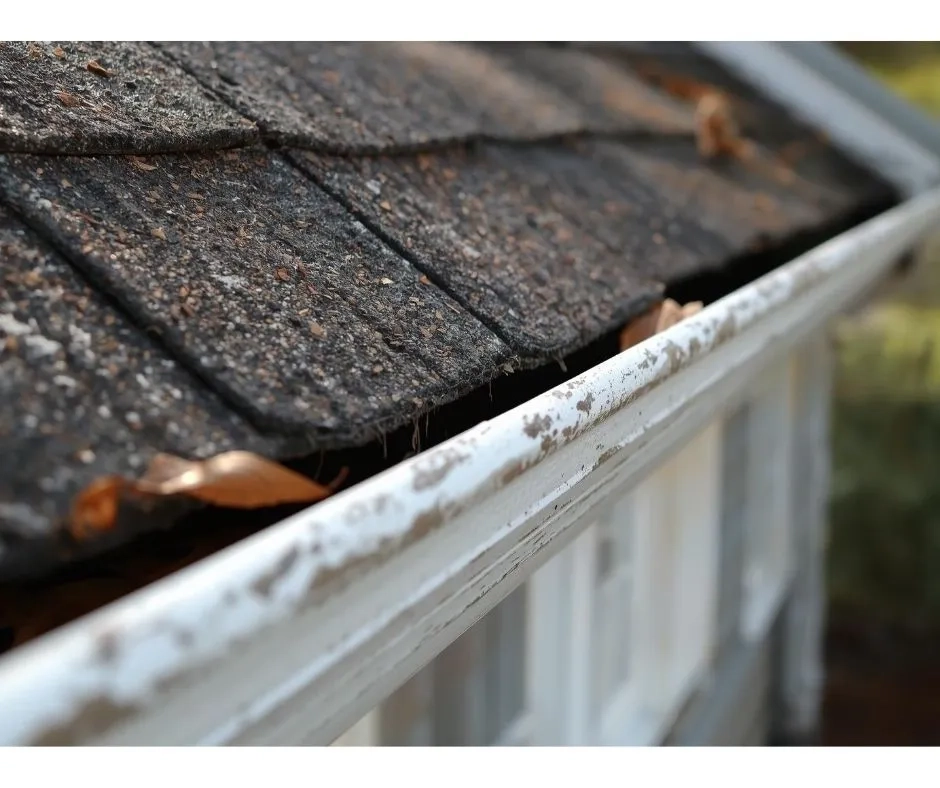
Riverside and Avondale together constitute one of the largest intact historic residential districts in the American Southeast — over 3,000 homes built primarily between 1910 and 1945 in Craftsman bungalow, Colonial Revival, Mediterranean Revival, and Tudor styles, most on lots with mature live oak, magnolia, and sabal palm canopy that predates the structures themselves. These neighborhoods present the highest concentration of original wood fascia construction, the densest canopy loading, and the most architecturally constrained gutter specification requirements in the Jacksonville market.
Live oak canopy in Riverside and Avondale provides year-round continuous debris loading — the same sustained shedding pattern that drives three-annual cleaning schedules in Gainesville’s Duck Pond district. The tidal water table influence from the St. Johns River adds a discharge planning complexity that flat suburban properties to the south and west don’t face. And the architectural character of the housing stock — particularly for Riverside properties under historic preservation guidelines — creates gutter profile constraints: K-style aluminum profile is appropriate for the large majority of the housing stock, but Craftsman bungalows and early Colonial Revivals with period-appropriate exterior details may warrant half-round profiles in copper or painted aluminum to maintain architectural consistency.
How Atlantic Exposure Changes Material Specification East of the Intracoastal
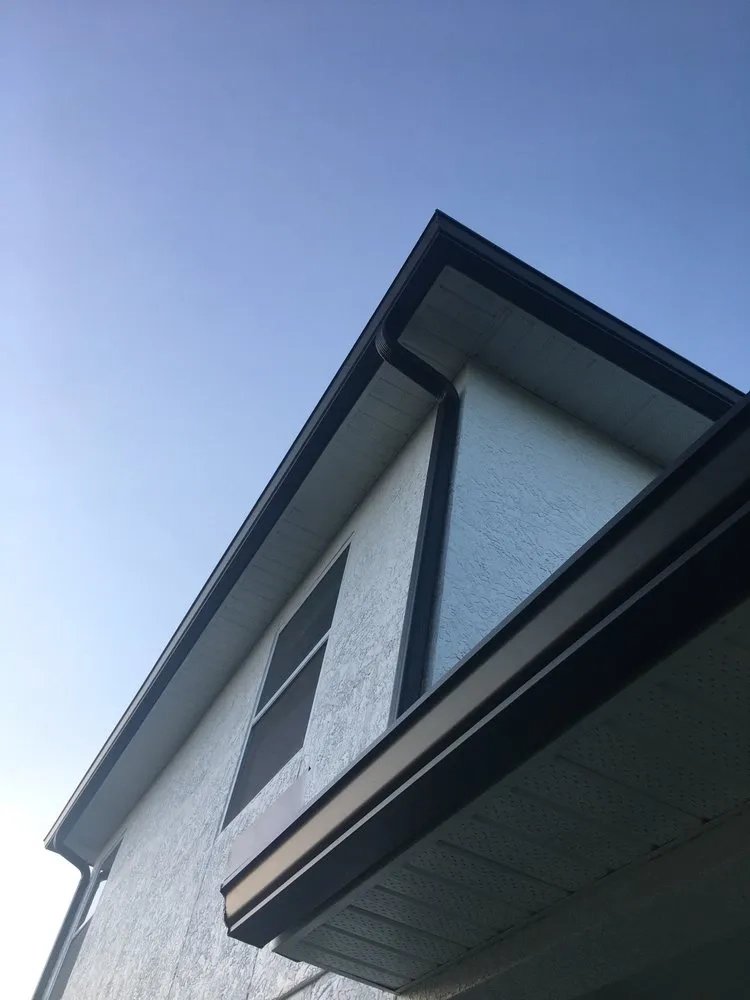
The barrier island communities east of the Intracoastal Waterway — Atlantic Beach, Neptune Beach, Jacksonville Beach, and the oceanfront portions of Ponte Vedra Beach — sit in the same Atlantic salt-air exposure category as Daytona Beach’s beachside zone. Prevailing Atlantic easterlies carry aerosol chloride from the surf zone inland year-round, not only during storm events, attacking aluminum gutter surfaces at joint points, sealant-compromised seams, and any location where paint adhesion has been reduced by UV exposure or installation damage.
Sand is the additional variable specific to the barrier island zone. Windblown Atlantic sand enters open gutter channels continuously, accumulating at downspout inlets where it combines with palm frond and organic debris to form a dense, abrasive plug. Sand acts as an abrasive accelerant on aluminum surface wear wherever water moves it against the gutter face — particularly at the inlet collar, the gutter floor at the outlet point, and any low-flow zone where a wet sand-and-organic mat rests in prolonged contact with the metal surface. For barrier island properties, Galvalume provides measurably better chloride resistance than standard aluminum without the premium cost of copper. For direct-oceanfront properties where long-term material performance is the primary consideration, copper is the appropriate specification.
Four Zone-Specific Failure Patterns That Appear Most Often on Jacksonville Property Assessments
Jacksonville’s geographic range means gutter failure presents differently by zone. These four patterns account for the large majority of what we find on initial assessments across the metro — each tied to a specific zone’s conditions.
Corrosion and Sand Wear — Beaches Zone
Standard aluminum east of the Intracoastal develops joint oxidation and sealant failure significantly ahead of the expected service life. Sand abrasion accelerates surface wear at inlet collars and gutter floors. The visible failure sequence — chalking at seams, staining on fascia below joints, progressive joint separation — unfolds faster on the barrier island than anywhere else in the Jacksonville market.
Tidal-Enhanced Foundation Saturation — River Corridor
Grade-level downspout discharge on low-elevation Riverside, Avondale, and Ortega lots percolates slowly during high-tide periods when the St. Johns River raises the local water table. Repeated foundation-edge saturation from discharge that sits rather than drains during combined high-tide and rainfall events drives soil movement against slab edges and moisture intrusion at the foundation base over multiple storm seasons.
Fascia Rot on Historic Wood Construction — River Corridor
Riverside and Avondale properties with original wood rafter-tail fascia accumulate moisture deterioration behind gutters that loosen progressively over decades. By the time a hanger visibly pulls from the fascia, the wood behind it has typically softened over a span several feet wider than the separation point. New hardware mounted into deteriorated wood produces installations that fail at the same location within one to two storm seasons.
Valley Overflow on Large Hip-Roof Homes — Growth Corridors
Nocatee, Oakleaf, Argyle Forest, and St. Johns County suburban homes have large Mediterranean-revival and contemporary plans with hip-roof configurations. Builder-installed 5-inch sectional systems overflow at valley convergence points during peak June–October storm events because the combined flow from two roof planes at each valley exceeds the single-plane capacity the system was sized to handle. Sectional joint separation compounds the problem as joints open through thermal cycling.
Gutter and Drainage Services Across the Jacksonville Metro
Material selection, sizing, and discharge planning vary by zone. We assess which services apply to your property — and which zone it sits in — before making any recommendation.
Jacksonville Neighborhoods and Communities We Serve
Organized by zone — material spec, cleaning interval, and drainage approach vary by location within the metro. Each neighborhood note indicates the primary conditions that shape the correct installation approach.
Schedule a Jacksonville Estimate
We serve all Jacksonville neighborhoods across Duval County, St. Johns County communities including Nocatee and Ponte Vedra, Clay County communities including Orange Park and Fleming Island, and Nassau County. Every estimate includes a zone assessment, a fascia condition review where applicable, and a discharge location evaluation.
Orlando Office:
4677 LB McLeod Rd, Ste. B, Orlando FL 32811
(407) 203-1144
How We Work Across the Jacksonville Metro
Zone Assessment Before Specification — Across 874 Square Miles
The Jacksonville market is unique in the Precision Gutters network because no single specification is correct across the metro. A Galvalume system appropriate for an Atlantic Beach barrier island home is an over-spec on a Mandarin property 15 miles to the southwest. A standard aluminum system appropriate for a Nocatee hip-roof home requires valley-point sizing assessment that wouldn’t apply to a flat-plane ranch home in Baymeadows. A copper half-round profile appropriate for a 1925 Riverside Craftsman bungalow would be architecturally inappropriate for a 2015 Mediterranean Revival in the Southside.
Our estimate process for Jacksonville properties starts with zone identification — beaches, river corridor, inner suburban, or outer growth — because zone determines material selection before roofline measurement begins. Within zone, roofline configuration, fascia condition, canopy type, and discharge location determine the remaining specification. We fabricate seamless gutters on-site from continuous coil stock — aluminum, Galvalume, or copper — to the exact dimensions of the roofline on the day of installation. Slope is calculated per run; outlet placement is determined by flow concentration on the roofline, not by default spacing. The crew performing the installation works from the same assessment conducted during the estimate, not a generic work order.
How We Work
From Estimate to Installation
Five steps between your free estimate and a correctly specified, fabricated, and installed system for your Jacksonville property.
Zone Assessment
Property location within the four-zone Jacksonville framework determines material starting point — Galvalume/copper for beaches, aluminum for river corridor, suburban, and growth zones.
Roofline & Fascia
Catchment area measurement per run, valley convergence identification, fascia condition inspection — critical on Riverside, Avondale, and other historic properties.
Sizing & Material Spec
Gutter profile (5″ or 6″), downspout sizing, outlet placement, and final material selection finalized based on zone and roofline assessment data.
On-site Fabrication
Seamless gutters formed from continuous coil stock on the truck-mounted machine to your exact roofline dimensions — aluminum, Galvalume, or copper as specified.
Install & Flow Test
Gutters hung at calculated pitch with hidden or reinforced hangers, downspouts connected to discharge points, flow tested before the crew leaves the property.
Why Downspout Discharge Decisions Differ Across the Four Jacksonville Zones
Discharge planning is not uniform across Jacksonville’s zones. In the beaches zone, discharge location is relatively straightforward on well-drained barrier island sand — though proximity to the structure matters for erosion prevention. In the St. Johns River corridor, the key variable is the tidal water table: on low-elevation lots near the river, grade-level discharge during combined high-tide and rainfall events percolates more slowly than during dry low-tide conditions, making underground discharge runs the more reliable option during the worst-case scenarios that occur regularly during peak wet season. In the outer growth corridors — Nocatee, Oakleaf, and Argyle Forest — flat terrain on sandy-dominant soils means grade-level discharge is usually adequate, but proximity to retention ponds and drainage easements can create localized high-water-table conditions requiring assessment.
We evaluate the discharge area at each downspout location during the estimate across all four zones. The decision to recommend grade-level elbows, downspout extensions, or underground drainage is based on the specific conditions at each outlet location — not a zone-wide assumption or a standard package. More detail on system configurations is on our underground drainage page and downspout installation page.
Tidal-Cycle Discharge Runs
Underground pipe from downspout outlet to pop-up emitter — specified for St. Johns River corridor properties where tidal water table rise during high tide reduces grade-level percolation during peak storm events.
Valley Outlet Addition
Additional downspout outlets at hip-roof valley convergence points on Nocatee and St. Johns County homes — addressing overflow at the combined-flow location that builder outlet spacing misses.
Reinforced Beach Hangers
Hidden hanger hardware rated for Atlantic wind-uplift — critical on barrier island properties where Atlantic easterlies and tropical system winds load gutter systems at rates higher than inland residential spec accounts for.
Catch Basins
Surface collection points for high-volume discharge on large roofline homes in growth corridors — routing water from multiple downspout outlets to a single buried discharge run rather than discharging against multiple foundation locations.
Residential, Historic, and Commercial Gutter Systems Across the Jacksonville Metro
Residential — All Zones
Single-family homes across all four Jacksonville zones — material, sizing, and discharge determined by zone, roofline configuration, fascia condition, and canopy density.
Historic Properties
Riverside, Avondale, Ortega, and Murray Hill homes under historic preservation guidelines — copper half-round or painted aluminum profiles appropriate to the construction period.
Commercial & Multifamily
Beach Boulevard, Southside, Riverside commercial, multifamily throughout Duval County, and military housing adjacent to NAS Jax and Mayport.
What Jacksonville and First Coast Customers Say
Professionalism
The first home repair team in a long time that did what they promised and on time. I would recommend Hank’s. We had a whole house gutter and downspout replacement after the March hail storm in 2023.

Highly Recommended!
Dealt with Precision Gutters on a complex custom project, fixing an issue caused by a bad contractor. They worked tirelessly with me and went over every detail to help me come up with the best solution.
Premium Quality
Very professional and on time installation highly recommend thank you for your service!
Knowledgeable
I contracted Precision Gutters LLC to do the drainage for the gutters. They are professional, punctual, great attitude, knowledgeable, respectful personally.
I highly recommend Precision Gutters LLC as a company & their skills workers. Every message I sent to the Sales Representative Marc Marchand was answered in a timely manner & to the point.
Gutter Installation, Repair, Cleaning, and Drainage in Jacksonville
Frequently Asked Questions — Jacksonville Gutter Services
How does Jacksonville’s size affect gutter specification across the city?
Jacksonville is the largest city by land area in the contiguous United States, spanning 874 square miles from Atlantic oceanfront to inland rural west Jacksonville. This range means the correct gutter specification varies significantly by location within the city. Atlantic Beach, Neptune Beach, and Jacksonville Beach barrier island properties require Galvalume or copper due to direct Atlantic salt-air exposure. Riverside, Avondale, Ortega, and San Marco properties use standard aluminum with attention to tidal water table conditions affecting discharge planning. Outer growth corridor properties — Nocatee, Oakleaf, Argyle Forest — use standard aluminum with sizing assessment for large-footprint hip-roof homes. Applying a uniform specification across all Jacksonville addresses produces correct installations in some zones and inadequate ones in others.
How does the St. Johns River affect drainage for Riverside and Avondale?
The St. Johns River is a tidal river that flows northward, responding to Atlantic tidal cycles at Jacksonville. During heavy wet-season rainfall coinciding with high tide, the river’s capacity to accept drainage discharge from adjacent neighborhoods is temporarily reduced, causing water tables in Riverside, Avondale, Ortega, Murray Hill, and San Marco to rise closer to the surface. In this condition, grade-level downspout discharge on low-elevation lots near the river percolates more slowly than during dry low-tide conditions. Underground drainage systems that route water away from the foundation perimeter perform more reliably during combined tidal and rainfall events than standard grade-level discharge elbows on these properties.
Do Riverside and Avondale historic homes need replacement or repair?
Riverside and Avondale contain Northeast Florida’s most architecturally significant residential stock — 1910s through 1940s Craftsman bungalows, Colonial Revival, and Mediterranean Revival homes with original wood rafter-tail fascia. By the time a gutter is visibly separating from the fascia on a property of this age, the fascia wood beneath has typically deteriorated over a span several feet wider than the visible failure. We assess fascia condition before making any recommendation. Where fascia replacement is needed first, we coordinate the scope before any new gutter hardware is specified. On qualifying Riverside and Avondale properties, copper gutters with half-round profile are appropriate to the architectural period.
What gutter material is correct for Jacksonville Beaches barrier island homes?
Properties in Atlantic Beach, Neptune Beach, Jacksonville Beach, and barrier island Ponte Vedra Beach are in the highest Atlantic salt-air exposure zone in the Jacksonville market. Prevailing Atlantic easterlies carry aerosol chloride from the surf zone continuously, accelerating oxidation on standard aluminum at joint points and sealant locations. For barrier island homes within approximately one to two miles of the Atlantic shoreline, we specify Galvalume gutters as the primary material — or copper for direct-oceanfront properties. Standard aluminum is appropriate for properties west of the Intracoastal Waterway where salt-air concentration is lower.
How often should Jacksonville homes with live oak canopy be cleaned?
Most Jacksonville properties with significant live oak or magnolia canopy need gutter cleaning at least twice annually — once pre-wet-season in April or May and once post-fall in November or December. Properties in Riverside, Avondale, Ortega, and San Marco where mature live oak canopy overhangs rooflines continuously typically need three cleanings per year. Live oak produces fine tassels, small leaves, and acorn caps year-round rather than in a single seasonal drop. In the Beaches zone, windblown sand compounds organic debris at downspout inlets, also requiring three-annual cleaning even without heavy canopy overhead.
Do Nocatee and St. Johns County homes need gutter system assessments?
Builder-installed gutter systems in Nocatee, Oakleaf Plantation, Argyle Forest, and St. Johns County suburban communities are almost universally 5-inch sectional aluminum at minimum code specification. These communities contain homes in the 2,500 to 5,000 square foot range with hip-roof configurations and multiple valley convergence points where two roof planes combine their flow. At a valley convergence point, the combined flow from two planes exceeds what the 5-inch profile was sized to handle for a single plane, producing overflow at the highest moisture-intrusion-risk location on the roofline. Sectional joint separation through thermal cycling is the second most frequent issue on these homes within 5 to 10 years of installation.
What drainage considerations apply to Southside and Baymeadows neighborhoods?
The Southside and Baymeadows neighborhoods sit on low-elevation flat terrain with sandy soils that generally percolate better than clay-dominant markets — but the wet-season water table rises close to the surface during sustained June through October rainfall periods. In this condition, the percolation advantage of sandy soil is reduced. Properties on lower-elevation lots near drainage features, retention ponds, or stormwater easements in these neighborhoods benefit from downspout discharge routed away from the foundation perimeter during peak wet-season periods. Grade-level elbows are typically adequate on these properties, but lot-specific assessment at each downspout location confirms the correct approach.
Does Precision Gutters serve commercial properties in Jacksonville?
Yes. We install commercial gutter systems on retail and office properties throughout Jacksonville’s commercial corridors — Beach Boulevard, Southside Boulevard, Phillips Highway, the Regency area, and the Riverside commercial district — as well as on multifamily apartment buildings, military housing adjacent to NAS Jacksonville and Mayport Naval Station, and industrial properties in the Westside and North Jacksonville industrial zones. Oceanfront commercial buildings in the A1A and Atlantic Beach corridors require Galvalume or copper specification; inland commercial properties use standard commercial aluminum profiles sized for the specific catchment area and roof drainage plan.
Stop Water Problems Before They Reach the Foundation
Jacksonville’s four drainage zones — Atlantic Beaches, St. Johns River corridor, inner suburban, and outer growth — each require different material selection, sizing approaches, and discharge planning. A single specification applied uniformly across 874 square miles produces correct installations in some locations and inadequate ones in others. Free estimates include zone assessment, fascia condition review, and discharge location evaluation — not just a linear-foot quote.
Other Florida Locations