
Gutter Company in Clermont, FL
Clermont sits atop the Florida Ridge — the highest continuous terrain on the Florida peninsula, reaching over 300 feet above sea level. Every gutter system here must account for slope: runoff velocity on a Florida Ridge hillside, erosion risk on fine quartz sand, and discharge dissipation before water hits the grade face. The chain of lakes at the base of the ridge adds environmental discharge constraints for lakefront lots. We design for all three before fabricating anything.
Hilltop Properties (250–300 ft)
Fast-draining ridge sand — no foundation saturation concern. Primary issue: concentrated downspout discharge picks up sand particles at high velocity. Splash pad or underground discharge dissipation required to prevent erosion gullying.
Hillside Properties (slope face)
Highest-risk zone. Gutter overflow at the downhill end of the run, slope-accelerated runoff, and gullying all concentrate here. Outlet placement at flow concentration points, pitch per run calculated for actual fascia slope, downhill discharge dissipation essential.
Lake Base Properties (chain of lakes)
Slope velocity arrives from uphill. Near-lake wet-season water table elevation reduces percolation from below. Environmental discharge constraints from the protected lake chain. Dual constraint: velocity dissipation AND lake-compliant discharge routing.
Why Clermont Is the Only City in the Orlando Metro Where Slope Is the Primary Gutter Design Variable
Clermont sits atop the Florida Ridge — the highest continuous upland terrain on the Florida peninsula, rising to over 300 feet above sea level in Lake County. This elevation makes Clermont the highest major city in Central Florida by a significant margin; the surrounding flat Orlando metro sits at 80 to 100 feet. The Citrus Tower, a local landmark, was built as a tourist attraction because Clermont’s elevation offered panoramic views across the entire Central Florida landscape — at 226 feet above sea level, it stood above virtually everything else for miles in every direction when built.
For gutter installation, this elevation has a direct and significant engineering consequence that does not appear anywhere else in the Orlando metro market. On a flat Orlando lot, water leaving the roofline enters the gutter, moves to the downspout, and exits at grade level where it percolates relatively quickly into the sandy Central Florida soil. The drainage challenge on a flat lot is about volume — whether the gutter profile is large enough and the downspout outlets numerous enough to handle the catchment area during peak Central Florida storm intensity.
On a Clermont Florida Ridge hillside property, volume still matters — but velocity matters equally or more. Water moving off a steep Clermont roofline reaches the downhill end of the gutter run faster and with more kinetic energy than on a flat equivalent. A 5-inch gutter profile that handles a flat Orlando roofline of identical catchment area may overflow at the downhill end of the same run on a Clermont hillside because slope-velocity delivers water to the downhill gutter inlet faster than the outlet can discharge it. Beyond the roofline, discharge from a downspout on a hillside lot hits grade and immediately picks up slope-velocity, generating concentrated surface flow that carries fine ridge sand particles — creating erosion channels that deepen with every storm event.
Why Hilltop, Hillside, and Lake-Base Properties Each Require Different Gutter and Discharge Approaches
Clermont’s rolling terrain creates three distinct drainage environments, each requiring a different gutter and discharge strategy. Hilltop properties at elevations of 250 to 300 feet have fast-draining quartz sand soils where foundation moisture is rarely the primary concern. Instead, concentrated runoff can erode sandy slopes, making splash blocks or level spreaders important for dispersing water before it reaches the ground.
Hillside homes require more precise gutter design because roof runoff gains speed as it moves downhill. Proper outlet placement and discharge routing are essential to prevent concentrated flow from cutting channels through sandy slopes and causing erosion. Lakefront properties at the base of the ridge face the most demanding conditions. They must manage runoff from higher elevations while also accounting for seasonal water table rises near Clermont’s chain of lakes and directing discharge away from the shoreline. These sites often require customized drainage planning that balances slope control, foundation protection, and responsible stormwater management.
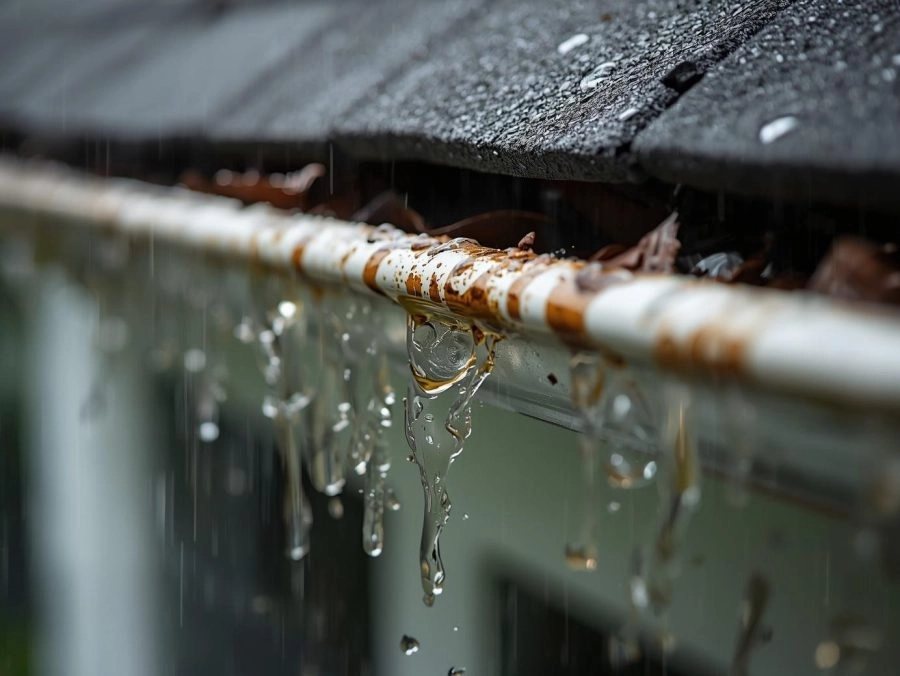
Environmental Discharge Constraints and Near-Lake Drainage for Properties on the Lake Chain
The Clermont chain of lakes — Lakes Minneola, Minnehaha, Susan, Louisa, and their connected waterways — sits at the base of the Florida Ridge in a chain that extends through the Clermont and Minneola areas. The chain is ecologically significant and environmentally protected under Lake County stormwater management regulations. Properties fronting or adjacent to the chain face a discharge constraint analogous to Winter Park’s lake chain and Lake Apopka’s restoration watershed: concentrated stormwater discharge directed toward the lake surface can conflict with stormwater guidelines designed to protect the chain’s water quality and ecological integrity. Hillside runoff carrying fine ridge sand directly into the lakes is a particular concern — suspended sediment from slope erosion is a primary contributor to turbidity in the Clermont chain.
For lake-chain properties in the flat zone at the ridge base, correct discharge planning routes water away from both the foundation edge and the lake surface to an appropriate regulated discharge point. On these properties, the discharge challenge involves velocity dissipation from any uphill runoff arriving on the property, foundation-edge drainage during wet season when the near-lake water table reduces percolation, and environmental compliance for discharge routing. Underground systems that capture downspout water and route it to a pop-up emitter at an appropriate location — or to a level spreader that disperses velocity before it reaches the lake edge — address all three simultaneously.
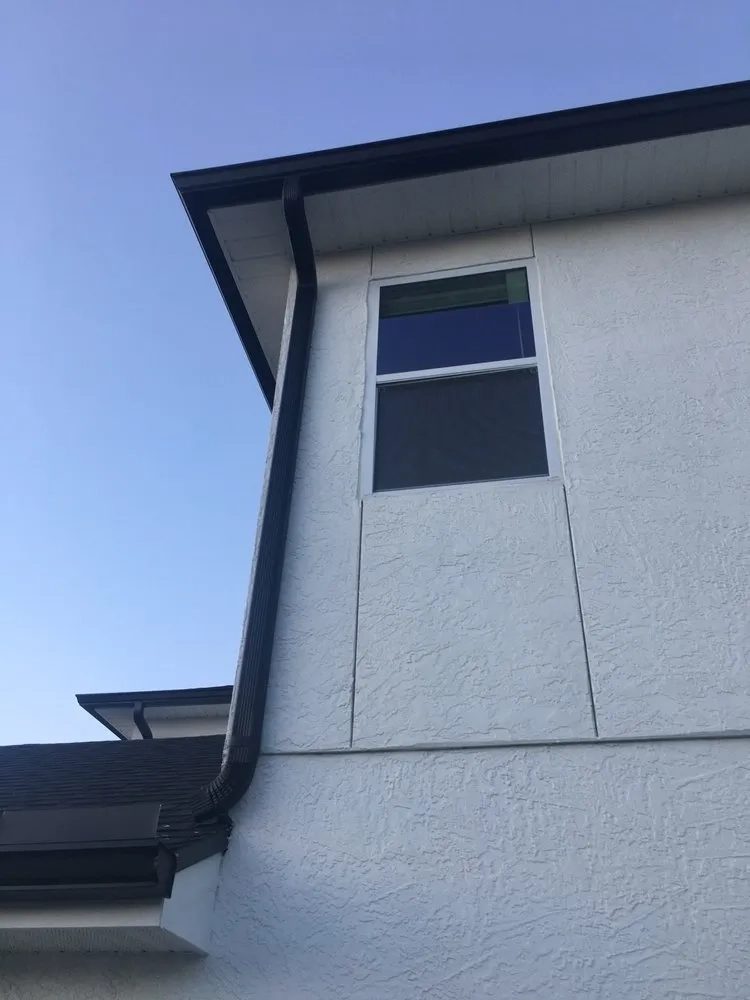
Large Hip-Roof Homes on Sloped Lots — the Most Complex New Construction Gutter Condition in the Network
Clermont and Minneola’s rapid growth communities — Wellness Way, Sunrise Lakes, Magnolia Park, and the SR-27 corridor developments — have added tens of thousands of homes to South Lake County over the past decade, many on lots that are not flat. Mediterranean-revival and contemporary homes in these communities range from 2,500 to 5,500 square feet with hip-roof configurations, multiple valley convergence points, and extended overhangs — all on lots where the grade may change 10 to 30 feet across the property.
Builder-installed 5-inch sectional gutter systems on these homes were designed for flat-terrain roofline calculations. On sloped Clermont lots, the downhill end of each gutter run receives combined slope-velocity and catchment area flow — exceeding what the single-plane 5-inch calculation assumed even before the valley convergence point adds combined flow from two planes. The result is overflow at the downhill end of gutter runs and at valley convergence points simultaneously, generating the highest-volume and highest-velocity discharge of any residential gutter failure pattern in the network. We assess slope position, roofline valley configuration, and discharge dissipation requirements on growth community properties before recommending any correction.
Four Failure Patterns Most Common on Clermont and Lake County Property Assessments
The Florida Ridge’s slope, the chain of lakes’ environmental constraints, and the growth corridor’s large-roofline construction each produce specific failure conditions. These four account for the large majority of what we diagnose on Clermont property assessments.
Downhill-End Overflow on Ridge Hillside Runs
On steep-pitch Clermont rooflines, slope-velocity delivers water to the downhill end of each gutter run before the outlet can discharge it — producing overflow at the downhill end even when the gutter is not filled to capacity by volume alone. The overflow discharges against the fascia at the gutter’s lowest point, initiating fascia rot at exactly the location where two roof planes may also converge and where moisture intrusion risk is highest. Correct outlet placement at the downhill flow concentration point prevents this.
Sand Erosion Gullying Below Downspout Outlets
Standard downspout elbows that discharge at grade on Clermont hillside properties concentrate the full catchment area’s flow at a single point on the slope face. Fine quartz ridge sand begins moving within seconds of concentrated flow contact — creating erosion channels that deepen and widen with each storm event. A 1-inch-deep erosion channel after the first season becomes 3 inches after the second. Splash pad discharge dissipation and underground outlet runs prevent this entirely when installed correctly before erosion begins.
Growth Corridor Valley and Slope Combined Overflow
Wellness Way, Sunrise Lakes, and SR-27 corridor homes on sloped lots experience valley overflow at hip-roof convergence points compounded by slope-velocity flow at the downhill end of each gutter run simultaneously. The combined failure — valley overflow at the uphill roofline section and downhill end overflow on the same storm event — generates the highest-volume discharge of any residential gutter failure pattern in this market. Targeted 6-inch valley replacement and downhill outlet addition address both failure points.
Lake-Base Dual-Constraint Discharge
Properties at the base of the Florida Ridge fronting the Clermont chain of lakes receive slope-velocity runoff arriving from uphill, experience near-lake wet-season water table elevation that reduces percolation, and face environmental constraints on direct lake discharge. Three conditions that must be resolved simultaneously in the discharge plan — velocity dissipation, foundation-edge drainage, and lake-chain compliant routing to a regulated discharge point — produce the most complex single-property drainage problem in the Orlando metro.
Gutter and Drainage Services for Clermont and Lake County
Each service below addresses conditions specific to Clermont’s Florida Ridge slope positions, chain of lakes environmental constraints, growth corridor large-roofline construction, or hillside erosion mechanics. We assess which apply during the free estimate — slope position is evaluated on every visit.
Clermont Neighborhoods and South Lake County Communities We Serve
Slope position — hilltop, hillside, or lake-base — is the organizing variable for Clermont property assessments. Each community note indicates the dominant drainage condition for that area.
Schedule an Clermont Estimate
We serve all Clermont neighborhoods and South Lake County communities including Minneola, Groveland, Mascotte, and the broader SR-27 and SR-429 corridor. Every estimate begins with slope position identification — hilltop, hillside, or lake base — because the drainage approach differs significantly between positions. Slope assessment is included in the free estimate at no additional charge.
Orlando Office:
4677 LB McLeod Rd, Ste. B, Orlando FL 32811
(407) 203-1144
How We Work in Clermont and Lake County
Slope Position First — Hilltop, Hillside, or Lake Base — Before Any Specification
Clermont is unique in Central Florida because slope position drives every gutter and drainage recommendation. Before measuring the roof or specifying gutter size, we determine whether the property sits on the ridge crest, hillside, or lake base. Each location presents different drainage challenges: erosion on the ridge, high-velocity runoff on hillsides, and combined water table and environmental constraints near the lakes. That assessment guides every recommendation that follows.
We fabricate seamless gutters on-site from continuous aluminum coil stock to match each roofline. Gutter slope is calculated for the home’s actual fascia pitch, which often differs between the uphill and downhill sides of sloped properties. Downspouts are positioned where roof runoff naturally concentrates, not at standard intervals, and discharge is managed with the appropriate combination of splash blocks, level spreaders, or underground drainage to slow water before it reaches the ground and protect the property from long-term erosion.
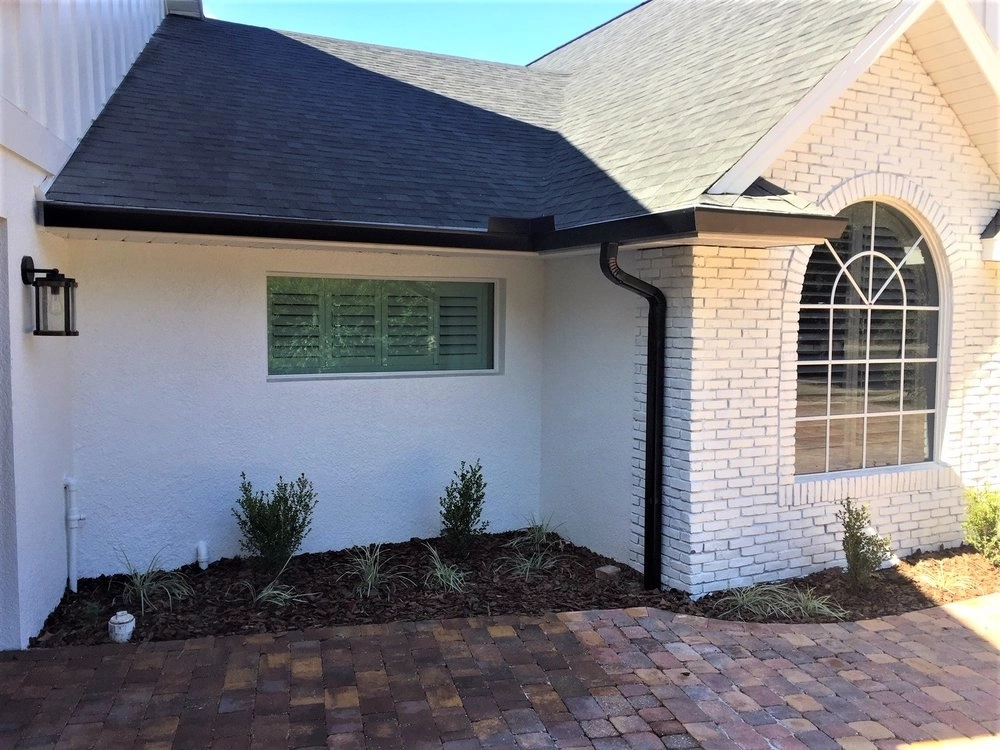
How We Work
From Estimate to Installation
Five steps between your free estimate and a correctly specified gutter system for your Clermont or Lake County property.
Slope Position Assessment
Hilltop, hillside, or lake base — determines primary drainage concern, velocity dissipation requirement, and whether environmental lake-chain discharge constraints apply.
Roofline & Valley Analysis
Catchment area per run, fascia pitch on sloped Clermont rooflines (which may differ between uphill and downhill sides), hip-roof valley convergence identification, fascia condition review.
Sizing & Discharge Spec
Gutter profile (5″ or 6″), per-run slope calculation accounting for actual fascia pitch, outlet placement at flow concentration points, and velocity-appropriate discharge routing at grade.
On-site Fabrication
Seamless gutters formed from continuous aluminum coil stock to exact roofline dimensions — no pre-cut section joints, in the calculated profile and gauge for the slope position.
Install & Flow Test
Gutters hung at calculated per-run pitch, downspouts connected to dissipation or underground discharge as specified by slope position, flow tested before the crew leaves.
Why Standard Downspout Elbows Are Insufficient for Clermont Hillside Properties
On most flat Central Florida properties, a standard downspout extension is enough to move water away from the foundation. Clermont hillside homes are different. On Florida Ridge slopes, runoff leaving a downspout quickly gains speed, concentrates into narrow flow paths, and begins eroding the fine quartz sand. Even after a single wet season, visible erosion channels can develop below the outlet, eventually exposing roots and foundation soil if left uncorrected.
The solution is to slow the water before it reaches the slope. Depending on the property’s grade, we may recommend splash blocks to spread runoff across a wider area, level spreaders to distribute flow evenly along the hillside, or underground drainage systems with pop-up emitters that carry water safely to the base of the slope. During every Clermont estimate, we evaluate the property’s slope, soil conditions, and runoff patterns to determine the most effective erosion-control strategy. See our underground drainage page for system configuration detail.
Splash Pads
Broad stone or concrete pads below downspout outlets that break concentrated flow into wide sheet flow — distributing velocity across a wider contact area and reducing erosion below the threshold for fine ridge sand.
Level Spreaders
Shallow drainage stone-filled trenches that accept point-source discharge and distribute it as broad linear sheet flow — appropriate for longer hillside slope runs where splash pads cannot achieve sufficient velocity reduction width.
Underground Slope Runs
Buried pipe from downspout outlet to a pop-up emitter at the slope base or flat grade — bypassing the entire hillside face and delivering water to a discharge point where slope velocity is absent.
Lake-Chain Compliant Routing
Discharge planning for chain of lakes-adjacent lots that routes water away from both the foundation edge and the lake surface to a regulated discharge point — per Lake County stormwater guidelines for the protected lake chain.
Residential, Growth Community, and Commercial Gutter Systems in Clermont and Lake County
Established Residential
Historic Clermont hilltop homes, established hillside properties, Kings Ridge, Heritage Hills, and lake-base lots on the Clermont chain — slope position assessed on every estimate.
Growth Community — SR-27 / Wellness Way
Wellness Way, Sunrise Lakes, Magnolia Park, Greater Hills, and the SR-429/27 corridor — large hip-roof homes on lots with variable grade from hilltop to lake-base transition.
Commercial
US-27 and SR-27 retail, hospitality, and office properties — commercial buildings on sloped Clermont lots combine large-catchment drainage loads with slope-velocity grade-level discharge.
What Clermont and Lake County Customers Say
Professionalism
The first home repair team in a long time that did what they promised and on time. I would recommend Hank’s. We had a whole house gutter and downspout replacement after the March hail storm in 2023.

Highly Recommended!
Dealt with Precision Gutters on a complex custom project, fixing an issue caused by a bad contractor. They worked tirelessly with me and went over every detail to help me come up with the best solution.
Premium Quality
Very professional and on time installation highly recommend thank you for your service!
Knowledgeable
I contracted Precision Gutters LLC to do the drainage for the gutters. They are professional, punctual, great attitude, knowledgeable, respectful personally.
I highly recommend Precision Gutters LLC as a company & their skills workers. Every message I sent to the Sales Representative Marc Marchand was answered in a timely manner & to the point.
Gutter Installation, Velocity Dissipation, Cleaning, and Lake Chain Drainage in Clermont
Frequently Asked Questions — Clermont Gutter Services
How does the Florida Ridge change gutter design requirements for Clermont?
Clermont sits atop the Florida Ridge — the highest continuous terrain on the Florida peninsula, reaching over 300 feet above sea level in Lake County. This elevation is the only genuinely hilly terrain in the Central Florida market and introduces slope-related gutter design variables that don’t exist in flat Orlando metro markets. On sloped Clermont rooflines, water reaches the gutter with higher velocity than on flat equivalents — the downhill end of each run receives flow first at the greatest kinetic energy. A 5-inch gutter adequate for a flat roofline of identical catchment area may overflow at the downhill end on a steep Clermont hillside. Beyond the roofline, grade-level discharge on a sloped lot generates slope-velocity runoff that carries fine ridge sand and creates erosion gullies. Correct discharge planning routes water to a velocity-dissipating outlet before it hits the grade face.
What causes erosion on Clermont hillside properties, and how does gutter installation prevent it?
Clermont’s Florida Ridge soils are predominantly fine quartz sand — rapidly draining but highly susceptible to erosion when concentrated flow hits the surface at speed. A standard downspout elbow that discharges concentrated roofline runoff at a single point on a sloped lot creates a velocity-concentration problem: the full catchment area’s drainage exits at one point, immediately picks up sand particles as it begins moving downhill, and generates an erosion channel that deepens with each storm event. Correct gutter installation on Clermont hillside properties incorporates discharge dissipation — splash pads, level spreaders, or underground outlet runs — that break concentrated flow before it contacts the sandy grade face. Incorrect downspout placement and absence of velocity dissipation are the two most common gutter installation failures we find on Clermont hillside properties.
How does the Clermont chain of lakes affect discharge planning?
The Clermont chain of lakes — Lakes Minneola, Minnehaha, Susan, Louisa, and their connecting waterways — is environmentally protected under Lake County stormwater management regulations. Properties fronting or adjacent to the chain face a discharge constraint: concentrated stormwater discharge directed toward the lake surface can conflict with guidelines designed to protect the chain’s water quality. Hillside runoff carrying fine ridge sand directly into the lakes is a particular concern — suspended sediment from slope erosion is a primary contributor to turbidity in the Clermont chain. For lake-chain properties, correct discharge planning routes water away from both the foundation edge and the lake surface to an appropriate regulated discharge point.
Do new homes in Wellness Way or Sunrise Lakes need gutter assessments?
Builder-installed gutter systems in Wellness Way, Sunrise Lakes, Magnolia Park, and the SR-27 corridor communities are sized for flat-terrain roofline calculations. On sloped Clermont lots, the downhill end of each gutter run receives combined slope-velocity and catchment area flow — exceeding what the single-plane 5-inch calculation assumed before the valley convergence point adds combined flow from two planes. The result is overflow at the downhill end of runs and at valley convergence points simultaneously — the highest-volume and highest-velocity discharge failure pattern in this market. Targeted 6-inch valley replacement and downhill outlet addition address both failure points. Slope position of the specific lot also affects the discharge specification.
How does the slope calculation work for gutter pitch on a Clermont hillside property?
Gutter pitch — the slope designed into the gutter run to move water toward the downspout — must be calculated separately from the lot slope on a Clermont hillside property. On a flat lot, gutter pitch is simply the designed ¼-inch-per-10-feet fall toward the downspout. On a sloped lot, the roofline pitch may already be steeper than on a flat-terrain home, and the lot grade below creates additional velocity for any water that overflows or exits the downspout. Correct slope calculation on a Clermont hillside gutter run accounts for the actual fascia pitch — which may vary between the uphill and downhill sides of the same structure — rather than applying a standard default pitch uniformly. We calculate slope per run based on actual fascia configuration during the estimate.
What drainage approach works on hilltop Clermont properties with rapidly draining ridge sand?
Hilltop properties on the Florida Ridge crest have fine quartz sand soils that percolate so rapidly that foundation-edge saturation from downspout discharge is rarely a concern. The drainage concern shifts from percolation to erosion: concentrated downspout discharge that hits the bare ridge sand at grade level picks up particles immediately and creates erosion channels even when percolation is fast. The correct approach is discharge dissipation — routing water from the downspout to a splash pad or level spreader that breaks the concentrated flow into broad sheet flow before it contacts the sandy ridge soil. This distributes the energy across a wider area, reducing velocity below the erosion threshold. Underground discharge runs to a pop-up emitter lower on the slope are the alternative where slope geometry makes surface dissipation inadequate.
How often should Clermont homes be cleaned, and are guards worth it?
Most Clermont properties benefit from gutter cleaning at least twice annually — pre-wet-season in April or May and post-fall in November. Pre-wet-season cleaning is particularly critical on sloped hillside properties: a partially blocked downspout inlet concentrates the full catchment area’s flow at a single restricted point during peak wet-season storms, generating the highest-velocity overflow condition at the downhill end. Micro-mesh guards are worth considering on Clermont hillside properties not only for the maintenance cost reduction but also for the safety benefit — accessing gutters on steep-pitch hillside rooflines is physically more demanding than on flat-terrain homes. Guards that reduce cleaning frequency from twice to once annually meaningfully reduce the number of required steep-roof access visits.
Does Precision Gutters serve commercial properties along US-27 and SR-27?
Yes. We install commercial gutter systems on retail, hospitality, and office properties throughout Clermont’s US-27 and SR-27 commercial corridors, as well as on the growing retail and commercial development in the Wellness Way and SR-50 areas. Commercial buildings on sloped Clermont lots present the combined slope-velocity and large catchment area challenge — requiring both commercial-profile gutter sizing for the roof drainage load and slope-appropriate discharge dissipation for the grade-level runoff management. We assess each commercial property individually for roof area, slope position, drainage plan, and discharge requirements — the same slope-first assessment approach used for residential properties.
Stop Water Problems Before They Reach the Foundation — and the Hillside
Clermont’s Florida Ridge creates the most slope-intensive gutter design conditions in the Central Florida market. Whether your property is on the ridge crest where concentrated discharge velocity erodes fine quartz sand, on the hillside slope where downhill-end overflow and grade-level velocity combine, or at the chain of lakes base where environmental discharge constraints and water table conditions create a dual requirement — free estimates include slope position assessment, velocity dissipation planning, and lake-chain discharge routing where applicable.
Other Florida Locations