
Gutter Company In Oviedo, FL
Oviedo’s east-west character split matters for gutter and drainage planning. Western Oviedo along Alafaya Trail has 1990s–2000s suburban housing stock at the valley overflow stage of builder-spec gutter failure. Eastern Oviedo along the Econlockhatchee River corridor has larger lots, heavy longleaf pine canopy, and near-river water table conditions that require different discharge planning. We address both before specifying anything.
Western Oviedo — 1990s–2000s Suburban Valley Overflow Zone
Communities along Alafaya Trail, Mitchell Hammock Road, and the UCF corridor have builder-installed gutter systems at or approaching the valley overflow stage. 1990s homes show loosened hangers and undersized downspouts. 2000s homes show sectional joint separation and hip-roof valley overflow during peak wet-season events.
Eastern Oviedo — Econ Corridor Semi-Rural with Near-River Drainage
Twin Rivers, Riverside Drive, and eastern properties adjacent to the Econlockhatchee River have larger lots, heavy longleaf pine and live oak canopy, and seasonal water table elevation from the Econ during wet season. Different primary drainage concern from western Oviedo’s suburban pattern.
Why Oviedo’s 1990s–2000s Housing Stock Is at Two Different Stages of the Same Failure Progression
Oviedo’s primary residential development era ran from the mid-1980s through approximately 2005, when Seminole County’s easternmost suburban expansion pushed housing into the area between Casselberry, Winter Springs, and the Econlockhatchee River corridor. The concrete block and frame homes built across communities like Twin Lakes, Alafaya Woods, Stonehurst, Countryside at Bear Lake, and the neighborhoods along Alafaya Trail and Mitchell Hammock Road represent the dominant housing stock — and they split into two distinct gutter condition profiles depending on whether they were built in the 1990s or the early 2000s.
Homes from the 1990s construction wave — now 25 to 35 years old — are approaching the same aging condition that Altamonte Springs’ 1975–1995 stock has already reached. Original spike-and-ferrule hanger installations have been cycling through Florida’s heat environment for three decades, loosening their grip on the fascia and allowing gutters to pitch backward. Original 2×3 downspout sizing is undersized for current rainfall intensity standards applied to these homes’ actual catchment areas. Sectional joints have accumulated separations. These three conditions don’t yet appear together as dramatically as they do in Altamonte Springs’ older stock, but they are developing — and homes built in 1988 or 1992 are approaching the point where full system assessment rather than isolated repair becomes the more cost-effective answer.
Homes from the early 2000s construction wave — 20 to 25 years old — have reached the valley overflow stage. The hanger system and downspout sizing may still be functional, but builder-installed 5-inch sectional gutters at hip-roof valley convergence points overflow during peak Central Florida wet-season storm events. The single-plane 5-inch profile was sized for permit approval, not for the combined flow from two roof planes during a 2.5-inch-per-hour storm cell. Targeted 6-inch valley section replacement at convergence points and additional outlet placement address this condition without requiring full system replacement.
How the Econlockhatchee River Creates a Different Drainage Environment for Eastern Oviedo Properties
Eastern Oviedo and nearby Chuluota differ from the city’s denser western neighborhoods. Communities along Riverside Drive, Twin Rivers, East Lake Road, and the semi-rural corridor toward the Econlockhatchee River feature larger one to five-acre lots with mature longleaf pine and live oak canopy. The Econlockhatchee River and Little Econlockhatchee River create seasonal water table conditions similar to those found along the Little Wekiva River in Altamonte Springs and the St. Johns River in Sanford.
During the June through October wet season, rising river levels slow drainage on low-lying properties near the Econ corridor. Downspout discharge that drains well during the dry season can remain near the foundation after heavy summer rains, making underground drainage with pop-up emitters a more effective solution for many river-adjacent homes. Larger lots also tend to have heavier longleaf pine debris. Pine needles quickly mat at gutter outlets and restrict water flow, making micro-mesh gutter guards especially beneficial for properties with mature pine canopy.
Why Oviedo’s Mature Tree Coverage Creates a More Demanding Cleaning Requirement Than Newer Suburbs
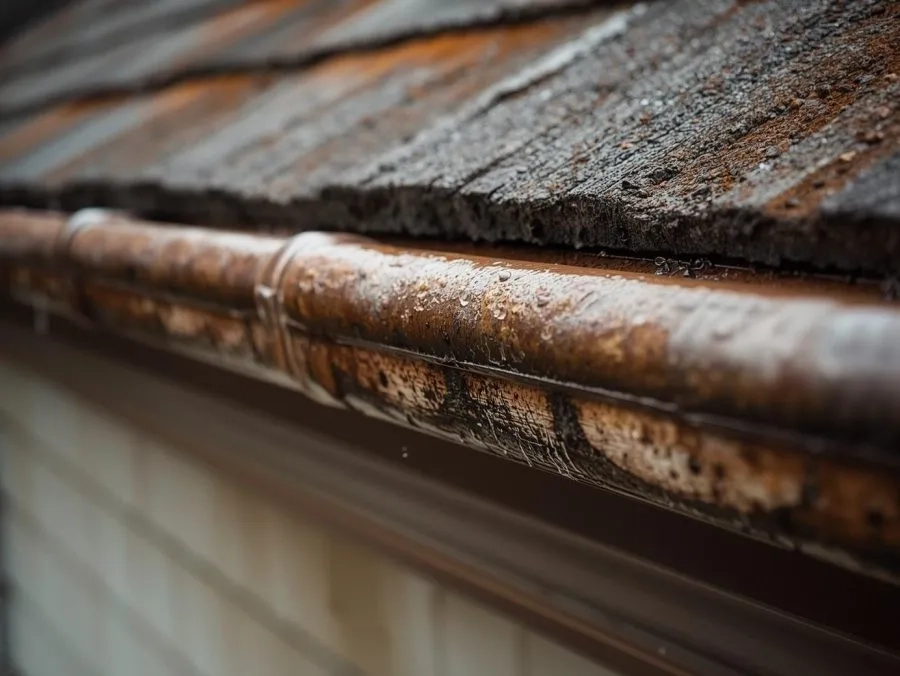
Oviedo’s established residential neighborhoods — Twin Rivers, Twin Lakes, the Mitchell Hammock Road corridor, and Riverside Drive — have mature live oak and water oak canopy that accumulated over the 20 to 35 years since these neighborhoods were developed. The canopy density is less than Winter Park’s famous urban forest, but more than most comparable-age Seminole County suburbs, partly because Oviedo’s development era coincided with a period of stronger tree preservation requirements in local planning.
Live oak sheds fine tassels and acorn caps year-round in a continuous loading pattern — not a single seasonal drop. Water oak produces a concentrated leaf drop in late fall and early winter. The combination creates two debris accumulation peaks per year rather than one, and means the gutter never has a “clear” month between cleaning visits. Pre-wet-season cleaning in April or May is the most critical single maintenance interval: properties entering June with debris at downspout inlets test their drainage system at reduced capacity through every significant storm in the following four months. Post-wet-season cleaning in November addresses both the water oak fall drop and the organic accumulation from wet-season storm debris. Properties in the eastern neighborhoods with significant longleaf pine canopy may need a mid-summer inspection given the pine needle compression rate.
Commercial, Multifamily, and Newer Residential Along Oviedo’s Western Edge
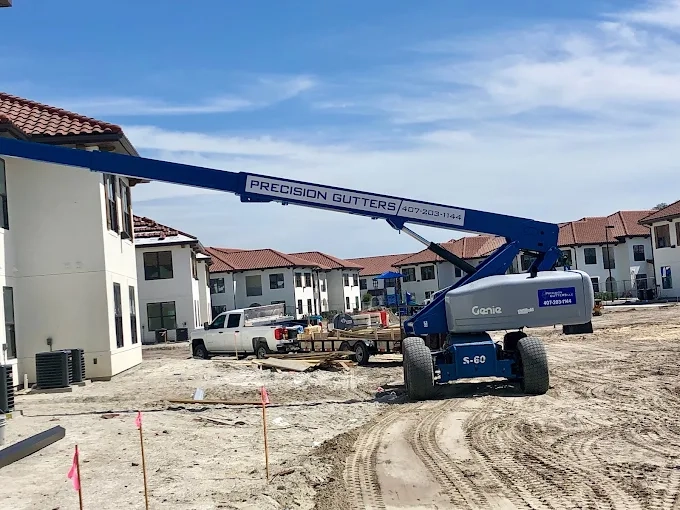
Oviedo’s western boundary with Orange County along Alafaya Trail and the UCF Research Park corridor includes a mix of property types that differ from the established residential character of central and eastern Oviedo. Research park commercial buildings, apartment communities serving the UCF student and faculty market, retail and restaurant properties along Alafaya Trail, and the newer residential phases adjacent to the UCF corridor have been added over the past 15 to 20 years as development responded to UCF’s growth.
Commercial and multifamily buildings in this corridor have roof catchment areas substantially larger than adjacent residential properties and require commercial-profile gutter assessment rather than residential spec at scale. Apartment communities in particular — with long multi-unit rooflines and multiple outlet points that must collectively manage large per-building catchment areas — benefit from individual assessment rather than assuming the installed system is sized correctly. In many cases, builder-installed apartment community gutter systems use residential profiles on buildings where the cumulative roofline length and catchment area require commercial-profile specifications.
Four Failure Patterns Most Common on Oviedo and East Seminole County Property Assessments
Oviedo’s east-west market split, aging suburban housing stock, Econ corridor near-river conditions, and mature live oak and pine canopy produce specific recurring failure conditions. These four account for the large majority of what we find on initial property assessments across the city.
Hip-Roof Valley Overflow — 2000s Construction
Homes in Twin Lakes, Stonehurst, Alafaya Woods, and the early 2000s Oviedo subdivisions have builder-installed 5-inch sectional systems that overflow at hip-roof valley convergence points during peak wet-season events. Combined flow from two roof planes at each valley point substantially exceeds the single-plane capacity the system was sized for. Overflow at valley locations occurs during every significant summer storm event — not as a malfunction but as a consequence of original undersizing at these flow concentration points.
Aging Hanger and Downspout Pattern — 1990s Homes
Oviedo homes from the late 1980s and 1990s — in the older Twin Rivers sections, Mitchell Hammock Road corridor neighborhoods, and early Alafaya Trail subdivisions — are approaching the same aging failure progression seen more fully in Altamonte Springs. Loosened spike-and-ferrule hangers allow gutters to pitch backward and pond against fascia. Original 2×3 downspouts are undersized by current standards. These conditions benefit from full system assessment to determine whether targeted repair or seamless replacement is the more cost-effective path over a 10-year horizon.
Near-Econ Water Table Saturation
Properties in the Twin Rivers community, along Riverside Drive, and in the eastern Oviedo neighborhoods within two to three blocks of the Econlockhatchee River experience seasonal water table elevation during the June through October wet season. Grade-level downspout discharge that percolates quickly in the dry season sits in contact with foundation perimeters for extended periods during peak wet season — accumulating foundation-edge saturation across 20 to 30 storm events per season. Underground drainage routing is the appropriate solution for the lowest-elevation Econ-adjacent lots.
Pine Needle Compression at Downspout Inlets
Eastern Oviedo properties with mature longleaf or slash pine canopy develop a specific downspout inlet restriction pattern distinct from live oak debris. Long pine needles mat and compress at inlet transitions — creating dense plugs that resist being cleared by water flow alone. A pine needle mat at a downspout inlet can reduce effective outlet diameter by 50 to 80 percent before it is visible from the ground. Pre-wet-season cleaning that specifically addresses downspout inlet condition is essential on eastern Oviedo pine-canopy properties.
Gutter and Drainage Services for Oviedo and East Seminole County
Each service addresses conditions specific to Oviedo’s 1990s–2000s housing stock, Econ corridor near-river drainage, live oak and pine canopy, or UCF corridor commercial properties. Property location within Oviedo’s east-west character split shapes which services are most relevant.
Oviedo Neighborhoods and East Seminole County Communities We Serve
Oviedo’s east-west character split means the dominant gutter concern varies significantly by location. Each neighborhood note indicates the primary drainage condition for that area.
Schedule an Oviedo Estimate
We serve all Oviedo neighborhoods and East Seminole County communities including Chuluota, Winter Springs, Geneva, and the UCF Research Park corridor. Every estimate identifies which side of Oviedo’s east-west character split the property is on — different primary drainage concerns by location.
Orlando Office:
4677 LB McLeod Rd, Ste. B, Orlando FL 32811
(407) 203-1144
How We Work in Oviedo and East Seminole County
East or West, 1990s or 2000s Construction, Econ-Adjacent or Inland — the Assessment Starts with Location
Oviedo requires a location-first estimate approach. Is the property in western Oviedo’s established suburban grid or eastern Oviedo’s semi-rural Econ corridor? What decade was the home built — and therefore what stage of the suburban gutter failure progression is it at? Is there significant live oak, water oak, or longleaf pine canopy creating debris loading above standard cleaning intervals? Is the lot within the Econ River’s seasonal influence zone where wet-season water table elevation changes the discharge planning equation?
These questions are answered during the free estimate visit — not as separate consultations. For a 1992 home in the Mitchell Hammock Road corridor, we’re assessing hanger condition, downspout sizing adequacy, joint separation extent, and fascia integrity to determine whether targeted repair or seamless replacement is the right answer. For a 2003 home in Twin Lakes with hip-roof valley overflow, we’re placing additional outlets at the convergence points that builder spacing missed. For an eastern Twin Rivers property adjacent to the Econ, we’re assessing whether the lowest-elevation downspout outlets need underground drainage components to handle the reduced wet-season percolation near the river corridor.
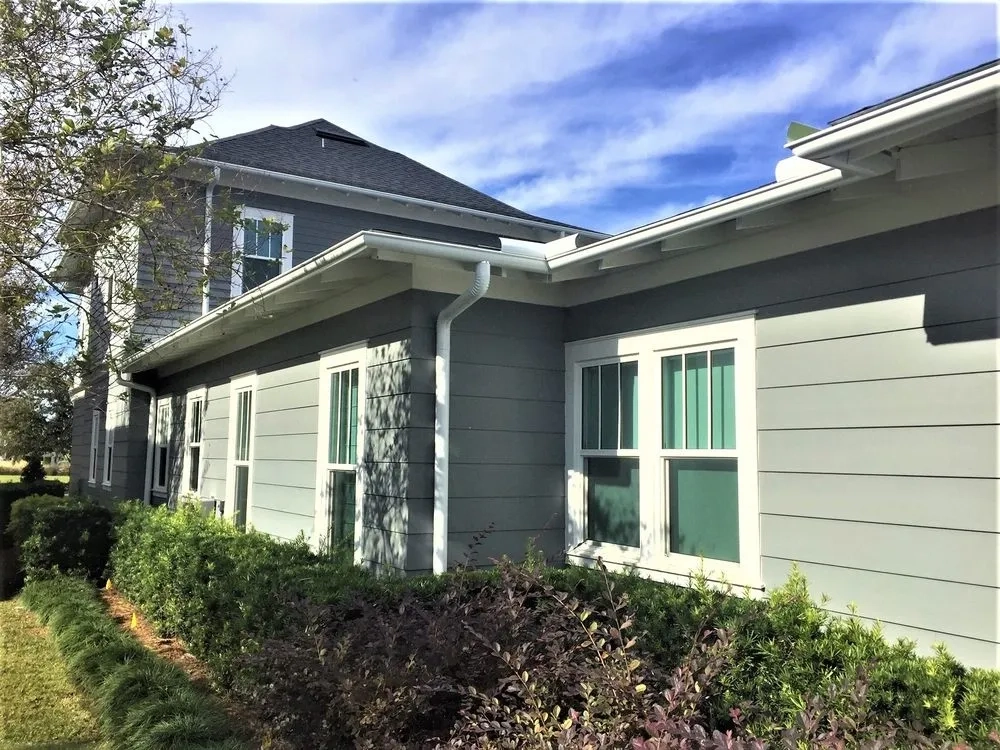
We fabricate seamless gutters on-site from continuous aluminum coil — no pre-cut section joints. The assessment from the estimate travels to the installation crew without loss.
How We Work
From Estimate to Installation
Five steps between your free estimate and a correctly specified gutter system for your Oviedo or East Seminole County property.
Location & Character Assessment
Western suburban or eastern Econ corridor? Construction decade? Canopy type and density? Econ River proximity? These determine the dominant drainage concern before measurement begins.
System Condition Review
Hanger condition, joint separation, valley convergence overflow pattern, downspout sizing, and fascia integrity — assessed in context of the construction decade to distinguish the aging vs. valley overflow failure stage.
Sizing & Discharge Spec
Profile (5″ or 6″), valley outlet placement at convergence points, downspout sizing correction where needed, and underground drainage components for Econ-adjacent properties with seasonal water table constraints.
On-site Fabrication
Seamless gutters formed from continuous aluminum coil stock to exact roofline dimensions — no pre-cut section joints to separate through thermal cycling.
Install & Flow Test
Gutters hung at calculated pitch, downspouts connected to grade-level or underground discharge as specified, flow tested before the crew leaves the property.
Why Seasonal Water Table From the Econlockhatchee Changes Discharge Recommendations for Eastern Oviedo
For most of Oviedo’s western suburban neighborhoods on flat terrain with standard sandy Seminole County soils, grade-level downspout elbows that direct water away from the foundation perform adequately year-round. Percolation is fast enough that standard elbows are the correct discharge approach — underground drainage is the exception, specified only when specific lot conditions create localized pooling issues.
In the eastern Econ corridor, the seasonal dynamic changes the answer for the lowest-elevation river-adjacent properties. The Econlockhatchee River’s wet-season flow increase elevates the local water table progressively through June, July, August, and September — narrowing the soil column available for percolation on low-elevation Econ-adjacent lots.
By peak wet season, the same discharge that percolated in 15 minutes in April may sit against the foundation for 60 to 90 minutes during a significant August storm event. Underground drainage systems — pop-up emitters in the turf zone, positioned away from the foundation perimeter — route water past the seasonally restricted percolation zone to discharge at a rate the elevated water table can accommodate. See our underground drainage page for system configuration detail.
Econ-Adjacent Emitter Runs
Underground pipe from downspout outlet to a pop-up emitter in the turf zone — for Twin Rivers, Riverside Drive, and eastern Oviedo lots where Econ seasonal water table elevation reduces grade-level percolation during August and September wet-season peak.
Valley Outlet Addition
Additional downspout outlets placed specifically at hip-roof valley convergence points on 2000s-era Oviedo homes — the primary correction for builder-spec systems where standard outlet spacing produces overflow at combined-flow valley locations during peak wet-season storms.
Downspout Upsizing
Replacing original 2×3 downspout outlets with 3×4 sizing on 1990s-era Oviedo homes where original sizing is inadequate for current rainfall intensity standards applied to the actual roofline catchment area.
Seamless Replacement
Full seamless aluminum system to replace sectional systems where the combination of aging hangers, undersized downspouts, and open joints makes targeted repair less cost-effective than complete replacement — based on actual condition assessment, not a default recommendation.
Residential, Semi-Rural, and Commercial Gutter Systems in Oviedo and East Seminole County
Western Suburban Residential
Established 1990s–2000s neighborhoods along Alafaya Trail, Mitchell Hammock Road, and the central Oviedo suburban grid — construction decade determines primary failure pattern.
Eastern Semi-Rural & Econ Corridor
Twin Rivers, Riverside Drive, Chuluota, and eastern Oviedo large-lot properties adjacent to the Econlockhatchee River and conservation corridor.
Commercial & Multifamily
Alafaya Trail retail and office, UCF Research Park corridor commercial, apartment communities, and Oviedo on the Park mixed-use properties.
What Oviedo and East Seminole County Customers Say
Professionalism
The first home repair team in a long time that did what they promised and on time. I would recommend Hank’s. We had a whole house gutter and downspout replacement after the March hail storm in 2023.

Highly Recommended!
Dealt with Precision Gutters on a complex custom project, fixing an issue caused by a bad contractor. They worked tirelessly with me and went over every detail to help me come up with the best solution.
Premium Quality
Very professional and on time installation highly recommend thank you for your service!
Knowledgeable
I contracted Precision Gutters LLC to do the drainage for the gutters. They are professional, punctual, great attitude, knowledgeable, respectful personally.
I highly recommend Precision Gutters LLC as a company & their skills workers. Every message I sent to the Sales Representative Marc Marchand was answered in a timely manner & to the point.
Gutter Installation, Valley Correction, Cleaning, and Drainage in Oviedo
Frequently Asked Questions — Oviedo Gutter Services
How does the Econlockhatchee River affect drainage in eastern Oviedo?
The Econlockhatchee River and the Little Econlockhatchee run through and adjacent to Oviedo’s eastern corridor, forming one of Seminole County’s most significant natural conservation corridors. Properties in Twin Rivers, along Riverside Drive, and in the eastern Oviedo residential areas within approximately two to three blocks of the Econ system experience seasonal water table elevation during the June through October wet season. As the Econ’s flow increases with wet-season rainfall, the water table in adjacent low-elevation properties rises progressively. By August and September, grade-level downspout discharge on low-elevation Econ-adjacent lots percolates more slowly — making underground drainage the more appropriate discharge solution for the lowest-elevation river-adjacent lots.
What gutter conditions are typical on Oviedo homes built in the 1990s vs. early 2000s?
Oviedo’s two dominant construction eras produce different gutter condition profiles. 1990s-era homes are approaching 25 to 35 years old: original spike-and-ferrule hangers have been cycling through Florida heat for three decades and may be loosening; original 2×3 downspouts are undersized by current rainfall intensity standards; sectional joints have accumulated separations. These conditions benefit from full system assessment to determine whether targeted repair or seamless replacement is the more cost-effective path. 2000s-era homes have functioning hanger and downspout systems, but builder-installed 5-inch sectional gutters overflow at hip-roof valley convergence points during peak wet-season events because the single-plane 5-inch profile cannot handle combined flow from two roof planes. Targeted 6-inch valley section replacement addresses this condition without requiring full system replacement.
Why does Oviedo’s live oak and longleaf pine canopy require more frequent cleaning?
Oviedo’s established residential neighborhoods have mature live oak, water oak, and longleaf pine canopy accumulated over 20 to 35 years. Live oak sheds fine tassels and acorn caps year-round in a continuous loading pattern. Water oak produces a concentrated fall leaf drop. Longleaf pine drops long needles that mat and compress at downspout inlets — creating dense plugs that can restrict effective outlet diameter by 50 to 80 percent before the restriction is visible from the ground. The combination creates two annual debris peaks and a specific downspout inlet compression problem. Pre-wet-season cleaning in April or May is the most critical interval; eastern Oviedo properties with heavy pine canopy may also need mid-summer downspout inlet inspection.
Do new homes in the UCF corridor or Alafaya Trail area need gutter assessments?
Builder-installed gutter systems in the UCF Research Park corridor communities and newer Alafaya Trail phases follow the same minimum-code-specification pattern seen throughout the Orlando metro’s new construction market — 5-inch sectional aluminum adequate for permit inspection, not necessarily sized for the roofline’s actual catchment area. Hip-roof configurations with valley convergence points are standard on homes in this size range, and the combined flow from two planes at each valley point during peak wet-season storm events exceeds what the single-plane 5-inch sectional profile handles. We assess valley sizing, sectional joint condition, and downspout spacing on these properties before recommending targeted valley correction or full seamless replacement.
How do eastern Oviedo’s larger semi-rural lots differ from western Oviedo for drainage?
Eastern Oviedo — toward the Econ corridor, the Chuluota area, and the rural transition zone along East Lake Road — has significantly larger lots with mature longleaf pine and live oak canopy, occasional agricultural outbuildings, and in some cases well and septic systems. The larger eastern lots produce larger catchment areas from single structures, heavier longleaf pine needle debris loading, and in Econ-adjacent cases the near-river water table conditions. Western Oviedo — along Alafaya Trail, near the UCF Research Park, and in the denser subdivisions adjacent to Casselberry — is classic Seminole County suburban with quarter-acre to half-acre lots, standard residential gutter systems, and the 1990s–2000s aging and valley overflow failure patterns. The correct gutter specification, cleaning interval, and discharge planning approach differs between these two zones more than the east-west distance suggests.
Are micro-mesh guards worth installing for Oviedo homes with heavy canopy?
For established Oviedo neighborhoods with significant live oak and longleaf pine canopy — Twin Rivers, Twin Lakes, the Mitchell Hammock Road corridor, and Riverside Drive-area properties — micro-mesh leaf guards are the most cost-effective long-term maintenance investment relative to ongoing cleaning costs. Standard screen guards allow fine live oak tassels and acorn caps to pass through regardless. Micro-mesh systems with fine enough openings to exclude these debris types effectively reduce cleaning frequency from twice to once annually on high-canopy properties. For eastern Oviedo properties with large longleaf pine stands, guards that keep pine needles out of the gutter channel entirely provide particularly strong maintenance cost reduction given the volume of needle accumulation these trees produce.
Does Precision Gutters serve commercial properties in Oviedo?
Yes. We install commercial gutter systems on retail and office properties along Oviedo’s Alafaya Trail, Mitchell Hammock Road, and SR-426 commercial corridors, on apartment and multifamily communities serving the UCF market on Oviedo’s western edge, and on institutional and civic buildings throughout the city. Apartment communities in particular — with long multi-unit rooflines and large per-building catchment areas — require commercial-profile assessment rather than residential spec at scale. We also serve the Oviedo on the Park mixed-use development properties and assess each commercial building individually for catchment area, drainage plan, and discharge requirements.
How often should Oviedo homes be cleaned?
Most Oviedo residential properties benefit from gutter cleaning at least twice annually — pre-wet-season in April or May and post-fall in November. Western Oviedo properties in lower-canopy newer subdivisions may need only twice-annual cleaning. Eastern Oviedo properties with heavy live oak and longleaf pine canopy may need a mid-summer downspout inlet inspection given the pine needle compression rate. Pre-wet-season cleaning is the most critical interval for all Oviedo properties — entering June with debris loading at downspout inlets means the first significant storm tests the system at reduced capacity through the highest-intensity storm period of the year.
Stop Water Problems Before They Reach the Foundation
Oviedo’s 1990s–2000s housing stock is at two distinct stages of the suburban gutter failure progression — the aging hanger pattern in 1990s homes and the valley overflow pattern in 2000s homes. The Econlockhatchee River corridor creates near-river water table conditions for eastern properties. Heavy live oak and longleaf pine canopy creates year-round debris loading across established neighborhoods. Free estimates identify which conditions apply to your specific property and address them before the next wet season.
Other Florida Locations