
Gutter Company in St. Cloud, FL
St. Cloud’s gutter conditions split along two lines: proximity to East Lake Tohopekaliga, which raises the local water table during wet season for the historic downtown core, and construction era, which determines whether a property has aging 1900s-era hardware or a builder-spec valley overflow problem tied to hip-roof new construction along the Narcoossee corridor. We identify both before recommending anything.
Historic Downtown Core — East Lake Tohopekaliga Proximity
St. Cloud’s original 1909 townsite sits close enough to East Lake Tohopekaliga that seasonal lake level rise elevates the local water table, slowing grade-level percolation. Original hanger and downspout specifications also predate current rainfall-intensity standards.
Narcoossee Growth Corridor — Post-2010 Construction
Hanover Lakes, Weslyn Park, and the broader Narcoossee corridor toward Lake Nona were built to current code with hip-roof floor plans that create valley convergence points builder-grade gutters weren’t sized for.
Why St. Cloud’s Downtown Core Drains Differently During Wet Season
St. Cloud’s historic core sits close enough to East Lake Tohopekaliga that seasonal lake level changes measurably affect how fast a property’s grade-level drainage can clear water. During Central Florida’s wet season, the lake’s level rises, which raises the water table in adjacent low-lying properties — a mechanism distinct from surface flooding, since it affects percolation capacity even on lots that show no visible standing water.
That elevated water table slows how quickly grade-level percolation can absorb gutter discharge. Over a wet season’s worth of storm events — typically 20 to 30 — this shows up as water sitting at the foundation edge longer than it should after each rain, the pattern that eventually produces slab joint separation or interior moisture near exterior walls.
Underground Drainage as the Correction for Elevated Water Table Conditions
Because the water table itself is elevated during wet season — not just the surface — grade-level splash blocks have limited effect on downtown-core properties near the lake. The ground surrounding the foundation is already close to saturated near the surface, so adding a splash block doesn’t change the underlying percolation constraint.
Underground drainage with pop-up emitters addresses this directly by routing discharge 10 to 15 feet past the foundation to a point where percolation isn’t dependent on how saturated the immediate area around the house has become. Properties further from the lake — including most of the Narcoossee corridor — don’t experience this effect and are typically well served by standard grade-level discharge instead.
Why Hip-Roof Homes in Hanover Lakes and Weslyn Park Overflow at One Point
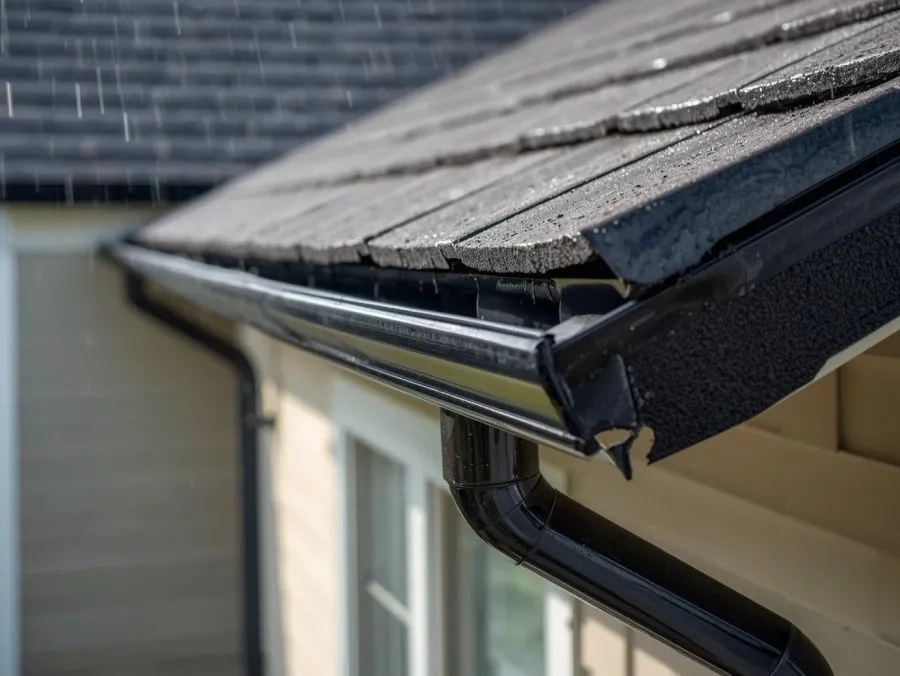
Hip-roof construction common in Hanover Lakes, Weslyn Park, and other Narcoossee corridor subdivisions creates convergence points where two roof planes meet, and builder-grade gutters are sized for a single plane’s runoff — not the combined volume a valley point receives. During peak-intensity Central Florida storms, that combined flow exceeds a standard 5-inch section’s capacity, producing overflow localized to that specific point rather than along the full run.
The correction is to upsize the gutter section at the valley to 6 inches and install a dedicated outlet directly below the convergence point, rather than routing combined flow through downstream sections already carrying single-plane volume. Because this is a localized fix, the straight runs elsewhere on the same roofline are typically left as-is unless they show separate signs of hanger or slope failure.
What 1900s-Era Construction Means for Gutter Hardware Today
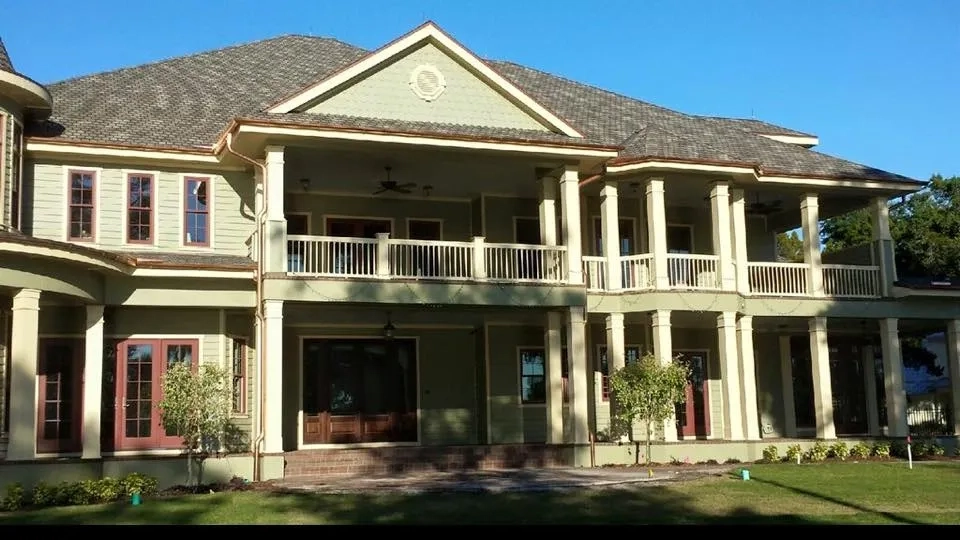
St. Cloud’s original townsite, developed as a colony for Grand Army of the Republic veterans starting in 1909, contains the city’s oldest residential and commercial gutter installations. Hardware from this era — and from the subsequent decades of infill construction through the mid-20th century — was specified under rainfall assumptions and stormwater standards that predate current code by a wide margin.
On these properties, original hanger spacing has typically loosened after decades of thermal cycling, allowing backward pitch and fascia-edge ponding. Original downspouts, sized to older rainfall data, run at or near capacity during storms that current intensity data shows exceed what the systems were built for. We assess hardware condition and hanger spacing on historic-core properties before recommending repair versus full seamless replacement.
Four Failure Patterns Most Common on St. Cloud Property Assessments
East Lake Tohopekaliga’s seasonal water table effect, the historic downtown core’s aging hardware, and Narcoossee corridor new-construction valley geometry each produce specific and identifiable drainage conditions. These four account for the large majority of what we find on initial property assessments across the city.
Overflow at One Section Only
Localized overflow at a single roofline point in Hanover Lakes, Weslyn Park, and other Narcoossee corridor homes — the diagnostic marker of a valley convergence issue rather than a full-system failure.
Slow-Draining Foundation Edge Near the Lake
Historic core properties near East Lake Tohopekaliga experiencing elevated water table conditions during wet season, which slows grade-level percolation and accumulates foundation-edge moisture.
Aging Downtown-Core Hardware
1900s through mid-century construction in the historic core showing loosened original hanger spacing and undersized original downspouts after decades of thermal cycling and evolving rainfall data.
Undersized New-Construction Downspouts
Narcoossee corridor downspouts sized to average roof planes rather than the combined flow generated at hip-roof valley convergence points during peak storm events.
Gutter and Drainage Services for St. Cloud and Osceola County
Each service addresses conditions specific to St. Cloud’s lake-proximity historic core, Narcoossee corridor growth communities, or commercial and US-192 corridor properties. We identify which apply to your property during the free estimate.
St. Cloud Neighborhoods and Osceola County Communities We Serve
Lake proximity, construction era, and roofline geometry vary across St. Cloud. Knowing which zone a property sits in is the first step of every estimate visit.
Schedule a St. Cloud Estimate
We serve all St. Cloud neighborhoods and Osceola County communities. Every estimate begins with lake-proximity and construction-era identification, because the correct hardware and discharge recommendation differs meaningfully between a downtown-core property near East Lake Tohopekaliga and a Narcoossee corridor new-construction home. This assessment is included in the free estimate at no additional charge.
Orlando Office:
4677 LB McLeod Rd, Ste. B, Orlando FL 32811
(407) 203-1144
How We Work in St. Cloud and Osceola County
Lake Proximity First — Water Table or Standard Percolation — Before Any Other Specification
St. Cloud is a city where distance to East Lake Tohopekaliga materially changes the correct drainage recommendation. A downtown-core property near the lake typically has both an aging-hardware condition and a seasonal water-table constraint that grade-level fixes can’t fully address. A Narcoossee corridor property in Hanover Lakes or Weslyn Park typically has a roofline-geometry problem — hip-roof valleys converging combined flow into a section sized for a single plane. These require different diagnostic approaches, and treating one condition like the other leads to the wrong recommendation.
After lake-proximity and construction-era identification, we assess roofline configuration for valley convergence points on Narcoossee corridor homes, and hardware condition for historic-core properties where original hanger spacing and downspout sizing may be decades out of date. For commercial and US-192 corridor buildings, we calculate catchment area individually rather than applying residential spec at scale.
We fabricate seamless gutters on-site from continuous aluminum coil stock — no pre-cut section joints. Slope calculated per run. The lake-proximity and construction-era reasoning from the estimate travels directly to the installation crew.
How We Work
From Estimate to Installation
Five steps between your free estimate and a correctly specified gutter system for your St. Cloud property.
Lake Proximity & Era Assessment
Downtown core near East Lake Toho or Narcoossee corridor new construction? This determination shapes everything that follows.
Roofline & Valley Analysis
Catchment area per run, hip-roof valley convergence point identification on Narcoossee corridor homes, fascia condition review.
Sizing & Discharge Spec
Gutter profile, downspout sizing, valley outlet additions, and discharge routing based on lake proximity and construction era.
On-site Fabrication
Seamless gutters formed from continuous aluminum coil stock to your exact roofline dimensions — no pre-cut section joints.
Install & Flow Test
Gutters hung at calculated pitch, downspouts connected to grade-level or underground discharge as specified, flow tested before the crew leaves.
Why the Correct Discharge Approach Near East Lake Tohopekaliga Differs From the Narcoossee Corridor
On a property well removed from East Lake Tohopekaliga — most of the Narcoossee corridor, including Hanover Lakes and Weslyn Park — downspout discharge deposited at grade percolates away from the foundation efficiently, even during the June through September wet season peak. Installing underground drainage on these properties adds cost without adding meaningful protection.
On a property in the historic downtown core near the lake, wet-season water level rise elevates the local water table, and the surrounding soil is already close to saturated near the surface during these periods. Grade-level splash blocks have limited effect under that condition. Underground drainage with pop-up emitters, carrying discharge 10 to 15 feet past the foundation, routes water to a point where percolation isn’t dependent on how saturated the immediate area has become — the correction that actually addresses the constraint.
This is why we assess lake proximity during every St. Cloud estimate rather than assuming based on subdivision. See our underground drainage page for system configuration detail.
Lake-Proximity Emitter Runs
Pop-up emitter systems for downtown-core St. Cloud properties near East Lake Tohopekaliga — routing discharge past the water-table-affected zone to a point beyond the foundation perimeter.
Historic Core Hanger Replacement
Full hanger replacement at correct modern spacing for downtown St. Cloud properties where original early-1900s hardware has loosened and allowed backward pitch.
Valley Outlet Additions
Additional downspout outlets at hip-roof valley convergence points on Narcoossee corridor homes — the primary correction for builder-spec systems where standard outlet spacing produces overflow.
Downspout Upsizing
Downspout resizing for historic-core properties where original specifications were calculated against rainfall data that current intensity figures have since exceeded.
Historic, Growth Community, and Commercial Gutter Systems in St. Cloud
Historic Downtown Core
1909-era townsite properties near East Lake Tohopekaliga — assessed for aging hardware and water-table-affected drainage before any specification.
Narcoossee Growth Community
Hanover Lakes, Weslyn Park, and the broader Narcoossee corridor — hip-roof homes with builder-spec valley overflow conditions.
Commercial & US-192 Corridor
US-192 and Narcoossee corridor commercial buildings, plus retail and multifamily throughout Osceola County.
What St. Cloud and Osceola County Customers Say
Professionalism
The first home repair team in a long time that did what they promised and on time. I would recommend Hank’s. We had a whole house gutter and downspout replacement after the March hail storm in 2023.

Highly Recommended!
Dealt with Precision Gutters on a complex custom project, fixing an issue caused by a bad contractor. They worked tirelessly with me and went over every detail to help me come up with the best solution.
Premium Quality
Very professional and on time installation highly recommend thank you for your service!
Knowledgeable
I contracted Precision Gutters LLC to do the drainage for the gutters. They are professional, punctual, great attitude, knowledgeable, respectful personally.
I highly recommend Precision Gutters LLC as a company & their skills workers. Every message I sent to the Sales Representative Marc Marchand was answered in a timely manner & to the point.
Gutter Installation, Repair, Cleaning, and Drainage in St. Cloud
Frequently Asked Questions — St. Cloud Gutter Services
Does East Lake Tohopekaliga affect gutter drainage for nearby St. Cloud properties?
Yes, for properties in the historic downtown core close to the lake. During wet season, the lake’s water level rises, which elevates the water table in adjacent low-lying properties and slows grade-level percolation. Underground drainage with pop-up emitters is typically the appropriate correction. Properties well removed from the lake, including most of the Narcoossee corridor, don’t experience this effect.
Why does my gutter only overflow at one point on the roofline?
That’s the diagnostic signature of a valley convergence problem, common in the hip-roof floor plans throughout Hanover Lakes, Weslyn Park, and the broader Narcoossee corridor. A standard 5-inch gutter section is sized for a single roof plane, and a valley receives combined flow from two planes — exceeding capacity during peak-intensity storms. The correction is upsizing that section to 6 inches and adding a dedicated outlet.
How does the historic downtown core differ from Narcoossee corridor new construction?
The historic core, platted in 1909 near East Lake Tohopekaliga, has aging hardware sized to specifications that predate current stormwater codes, plus seasonal water-table effects from lake proximity. The Narcoossee corridor was built to modern code but with hip-roof valleys builder-grade gutters weren’t sized for. One zone has an aging-hardware and water-table problem; the other has a roofline-geometry problem.
Do I need underground drainage for my St. Cloud property?
It depends on proximity to East Lake Tohopekaliga, not subdivision. Downtown-core properties near the lake typically benefit from underground drainage with pop-up emitters. Properties in the Narcoossee corridor and elsewhere away from the lake are usually well served by standard grade-level discharge. We assess proximity during the estimate.
Are builder-installed gutters in Hanover Lakes or Weslyn Park adequate?
They meet minimum code but are calculated for an average roof plane, not hip-roof valley convergence points common in these communities’ floor plans. Overflow typically shows up specifically at valley points — a targeted, correctable geometry issue rather than defective materials.
What’s the difference between gutter repair and full replacement?
Repair addresses isolated issues on an otherwise sound system. Replacement is typically more cost-effective when multiple failure points appear concurrently, which is common on St. Cloud’s historic downtown core properties where original hardware tends to degrade in several places around the same time.
Do you serve commercial properties along US-192 and the Narcoossee corridor?
Yes. Commercial buildings along US-192 and the Narcoossee corridor are assessed individually for roof catchment area rather than scaled up from a residential specification.
How often should St. Cloud gutters be cleaned?
Most St. Cloud properties benefit from cleaning twice annually — pre-wet-season in April or May and post-fall in November. The pre-wet-season cleaning is the most critical interval, particularly for historic-core properties already contending with elevated water table conditions during that same period.
Other Cities We Serve Near St. Cloud
Precision Gutters serves communities throughout Osceola County and the broader Central Florida region. Each has distinct terrain, lake proximity, and housing stock conditions that shape the correct gutter specification.
Stop Water Problems Before They Reach the Foundation
St. Cloud’s historic downtown core and Narcoossee growth corridor require different diagnostic approaches — sometimes for properties a few miles apart within the same city. Downtown-core homes near East Lake Tohopekaliga have aging hardware compounded by seasonal water table rise. Narcoossee corridor homes have builder-spec valley overflow at hip-roof convergence points.
Free estimates include lake-proximity assessment, construction-era identification, and valley analysis appropriate to each property’s actual conditions.
Other Florida Locations