
Gutter Company In Tallahassee, FL
Tallahassee is the only genuinely hilly city in Florida — and slope changes gutter design in ways that flat-terrain specifications don’t account for. With 58 inches of annual rainfall, red clay soils that resist percolation, and longleaf pine canopy that concentrates debris on downhill roof runs, every gutter system in Leon County requires calculations specific to the property’s grade, roofline, and drainage path.
Tallahassee’s Slope Changes Gutter Sizing, Outlet Placement, and Discharge Planning — Not Just Aesthetics
On a sloped lot, runoff velocity is higher, debris concentrates at the downhill end of each gutter run, and discharge from multiple downspouts combines at the low side of the property. Correct gutter design on a Betton Hills or Meyers Park hillside lot is a different calculation than on a flat Southwood subdivision pad — even with the same roofline configuration.
The Only Florida City Where Lot Slope Is a Primary Variable in Gutter Design
Every other city in the Precision Gutters service network sits on terrain that ranges from flat to gently rolling — the Florida peninsula’s characteristic low-relief topography. Tallahassee is the exception. The Tallahassee Hills physiographic region produces genuine elevation changes across Leon County, with the northeastern corridor reaching over 200 feet above sea level while the Lake Jackson basin and the St. Marks corridor near Wakulla County approach sea level. Within the city, individual lots in Betton Hills, Meyers Park, Indianhead Acres, and the Ox Bottom Road area can have grade changes of 10 to 30 feet across the property — more than the entire elevation range of many south Florida cities.
This topography changes gutter system design in three specific ways that flat-terrain Florida specifications don’t address. First, runoff velocity on a steep-pitch Tallahassee roofline is higher than on a flat-terrain equivalent — water reaches the gutter with more kinetic energy per unit time, and a 5-inch profile that handles a similar catchment area on a flat Orlando lot may overflow at the downhill end of the run on a steep Betton Hills roofline. Second, debris travel on a sloped roof is directional rather than uniform — longleaf pine needles and live oak debris concentrate at the downhill end of each roof plane, compacting at the downspout inlet location that also receives the highest flow volume. Third, at grade level on a sloped lot, the downhill side of the property receives combined discharge from multiple downspouts, which can exceed what a standard discharge plan anticipates.
None of these variables are addressed by applying the standard residential gutter specification designed for flat Florida terrain. They require lot-specific slope assessment as part of the estimate process.
From Historic Hills Homes to Capital-Area Subdivisions and University Rental Properties
Tallahassee’s housing stock is more diverse than most Florida markets its size. The historic neighborhoods on the hills — Betton Hills, Meyers Park, Midtown, the Market District, and the original Frenchtown and Smokey Hollow areas — contain genuine 1920s through 1960s residential construction on sloped lots with original wood fascia, mature longleaf pine and live oak canopy, and gutter systems that have accumulated decades of deferred maintenance under the same patterns seen in Gainesville’s near-campus rental zone.
The mid-city residential band — Waverly Hills, Hartsfield, Ox Bottom — represents 1970s through 1990s construction on moderate-slope lots where aging spike-and-ferrule hanger installations have loosened and original downspout sizing (2×3 outlets on many homes) is inadequate for current rainfall intensity standards applied to actual catchment areas. The outer ring — Killearn Estates, Killearn Lakes, Southwood, Buck Lake Road — is newer master-planned construction with larger rooflines on lots ranging from flat (Southwood) to moderately sloped (Killearn), where builder-spec 5-inch sectional systems are frequently undersized at hip-roof valley convergence points.
Florida State University and Florida A&M University together create a near-campus rental market along Stadium Drive, Gaines Street, Tennessee Street, and the College Town corridor with the same deferred-maintenance compounding pattern seen in Gainesville — investment properties cycling through tenant occupancy without proactive gutter maintenance, accumulating fascia deterioration across multiple lease cycles until the problem reaches structural scale.
Why Leon County’s Red Clay Creates a Different Discharge Problem Than Any Other Florida Market
Tallahassee’s red Tifton and Orangeburg clay-loam soils are among the lowest-permeability soils in the Precision Gutters service network. Across most of Florida, the concern with downspout discharge is that grade-level water pools near the foundation and slowly infiltrates into sandy or sandy-loam soils — a saturation problem that underground drainage resolves by routing water further from the structure. In Tallahassee, the red clay creates an additional dynamic that does not appear in flat-terrain markets: lateral surface channeling on sloped lots.
On a sloped Leon County lot, water deposited at grade level from a downspout elbow does not simply pool and slowly percolate. The clay surface’s low permeability means the water moves laterally downhill along the surface before it infiltrates — channeling through planting beds, along driveways, and around the low side of the foundation where it accumulates in concentrated volume against the stem wall or slab edge. The longer the slope run between the downspout discharge point and the low edge of the lot, the more volume this lateral channel collects. Underground drainage systems that capture downspout discharge and route it through buried pipe to a pop-up emitter positioned at a controlled location are the correct solution — not surface elbows that relocate the problem a few feet further downhill on the same clay surface.
This is the most consequential drainage planning difference between Tallahassee and every other inland Florida market in the network — including Gainesville, where clay soil is present in the southwest quadrant but does not dominate the city’s drainage character the way it does in Leon County.
58 Inches of Annual Rainfall — The Highest in the Network — and Why Gulf-Track Storms Compound It
Tallahassee receives approximately 58 to 65 inches of annual rainfall depending on location within Leon County — the highest total of any city in the Precision Gutters service network, exceeding Tampa (47″), Gainesville (54″), Daytona Beach (54″), and Fort Lauderdale (62″). The bulk arrives during the June through October wet season through two mechanisms: the afternoon convective thunderstorm cycle that affects all of north Florida, and Gulf of Mexico tropical systems that track northeastward from the Gulf of Mexico and make or near-make landfall in the Big Bend region west of Tallahassee.
Gulf-track tropical systems deliver sustained high-intensity rainfall over periods of 12 to 36 hours rather than the 30-to-90-minute convective cell events typical of the summer thunderstorm pattern. A gutter system adequate for a 2-inch-per-hour peak convective event may remain at or near capacity for the full duration of a tropical system passage — which means that any partial blockage from pine needle accumulation, any backward-pitched section that restricts flow, or any downspout outlet undersized for the roofline catchment area will be in overflow condition for an extended period rather than briefly during the peak of a passing cell.
Four Drainage Failure Patterns Specific to Tallahassee’s Slope, Clay, and Canopy Conditions
Leon County’s topography, soil type, and tree canopy produce failure patterns that are structurally different from what we see in flat-terrain Florida markets. These four conditions account for the large majority of diagnoses on initial Tallahassee property assessments.
Downhill-End Overflow on Sloped Rooflines
On steep-pitch rooflines in Betton Hills, Meyers Park, and Indianhead Acres, water velocity at the gutter entry point is higher than on equivalent flat-terrain rooflines. The downhill end of each gutter run receives this flow first and at the greatest velocity. If the gutter profile is undersized for the catchment area, or if the slope calculation pitches the gutter downward too steeply, the downhill end overflows before water reaches the downspout — discharging concentrated volume against the fascia at the gutter’s low point rather than into the downspout inlet.
Lateral Clay-Surface Channeling at the Foundation
Downspout discharge that lands on red clay soil on a sloped Tallahassee lot moves downhill along the surface rather than percolating. On longer slope runs, this lateral flow picks up velocity and volume before depositing against the low-side foundation edge. The result — hairline slab joint separation, moisture intrusion at the foundation base, and soil movement around utility penetrations — is identical in appearance to salt-slab movement in coastal markets but has a completely different cause and a completely different solution.
Pine Needle Concentration at Downhill Inlets
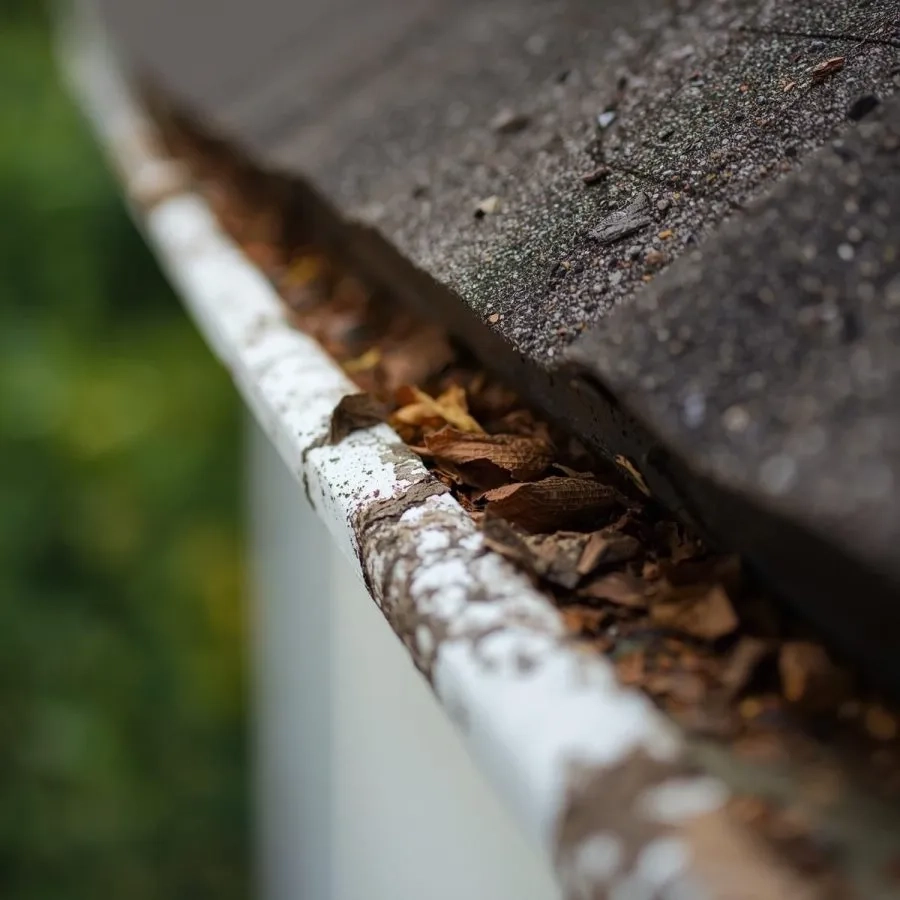
On sloped rooflines with longleaf pine canopy overhead, needles travel with slope-accelerated runoff toward the eave and collect at the downhill end of each roof plane — exactly where the highest flow volume must enter the downspout. A needle mat at the downhill inlet on a Betton Hills or Ox Bottom property during a Gulf-track tropical system creates a sustained overflow condition at the most structurally vulnerable fascia location. The slope-debris concentration pattern means that downspout inlets on the downhill side of the roof require more frequent clearing than those on the uphill side.
Fascia Rot on Near-Campus Rental Properties
FSU and FAMU rental properties along Stadium Drive, Tennessee Street, and the College Town corridor accumulate the same deferred-maintenance fascia deterioration pattern seen in Gainesville’s near-campus rental zone — but compounded by Tallahassee’s higher annual rainfall and the sloped-lot conditions common in Midtown and adjacent rental neighborhoods. By the time the gutter is visibly separating, the fascia has typically absorbed moisture over a span wider than the visible failure. Fascia assessment is a prerequisite to any repair or replacement recommendation on these properties.
Gutter and Drainage Services for Tallahassee and Leon County
Each service below addresses conditions specific to Tallahassee’s sloped terrain, red clay soil, longleaf pine canopy, or historic housing stock. We assess which apply to your property during the free estimate — slope and soil conditions are evaluated on every visit.
Leon County Neighborhoods and Communities We Serve
Slope gradient, soil condition, housing age, and canopy type vary significantly across Tallahassee’s neighborhoods. The gutter specification, cleaning interval, and drainage approach differ accordingly.
Schedule a Tallahassee Estimate
We serve all Tallahassee neighborhoods and Leon County communities including Woodville, Havana, Quincy, Crawfordville, and Wakulla County. Every estimate includes a slope assessment, a fascia condition review, and a discharge location evaluation — not just a linear-foot gutter quote.
Orlando Office:
4677 LB McLeod Rd, Ste. B, Orlando FL 32811
(407) 203-1144
How We Work in Leon County
Slope Assessment, Soil Evaluation, and Fascia Condition — Before Any Specification
Tallahassee requires a pre-specification assessment process that no other Florida city in our network demands to the same degree. Before we recommend a gutter profile, downspout count, or outlet placement on a Leon County property, we need to know the lot slope gradient, the soil condition at the discharge locations, the roofline’s catchment area per run, and the fascia condition behind the existing system. Skipping any of these steps produces a specification that is correct for a different property than the one we’re installing on.
On sloped lots, slope calculation for each gutter run accounts for the combined effect of roofline pitch and lot grade rather than treating them as independent variables. Outlet placement is determined by where flow concentrates on the sloped roofline — typically the downhill end — rather than by uniform spacing. Downspout discharge location is routed away from the lateral clay-surface channeling path downhill to the foundation edge, using underground components where the slope and soil combination require it.
We fabricate seamless gutters on-site from continuous coil stock on a truck-mounted machine — aluminum for the large majority of Tallahassee properties, copper for qualifying historic homes in Betton Hills and Meyers Park. The fabrication and installation crew receives the slope and discharge analysis from the estimate directly, without translation through a generic work order that loses the property-specific reasoning.
How We Work
From Estimate to Installation
Five steps between your free estimate and a correctly designed, fabricated, and installed gutter system for your Tallahassee property.
Slope & Property Assessment
Lot grade evaluation, roofline measurement, fascia condition inspection, canopy type and density, and soil percolation assessment at downspout discharge locations.
Fascia Determination
Fascia condition confirmed before specification. Deteriorated boards — common on Betton Hills and near-campus rental stock — are replaced before installation begins.
Sizing, Pitch & Outlet Spec
Gutter profile (5″ or 6″), run-specific pitch calculation accounting for lot slope, outlet placement at flow concentration points, downspout sizing for Tallahassee’s 58″ annual rainfall.
On-site Fabrication
Seamless gutters formed from continuous aluminum or copper coil stock on the truck-mounted machine — to your exact roofline dimensions, no pre-cut section joints.
Install & Discharge Test
Gutters hung at calculated pitch, downspouts connected to discharge points, underground components installed where specified, and water flow tested before the crew leaves.
Why Underground Drainage Is More Often the Correct Solution in Tallahassee Than in Any Other Inland Florida Market
In flat-terrain Florida markets, underground drainage is specified selectively — for clay-soil zones, for lots where terrain prevents grade-level discharge from moving away from the foundation, for properties near drainage features with high wet-season water tables. In Tallahassee, the combination of lot slope and red clay soil makes underground drainage the appropriate recommendation on the large majority of sloped residential lots — not as an upsell, but as the technically correct answer to a problem that surface discharge elbows cannot solve.
A downspout elbow that discharges at grade level on a sloped Leon County lot solves the vertical drainage problem (water leaves the roofline and reaches the ground) but creates a lateral drainage problem (water moves downhill along the clay surface to wherever the slope directs it, which is often directly to the low-side foundation edge). A buried pipe run that captures the downspout discharge and routes it to a pop-up emitter positioned at the property boundary or a designated drainage area eliminates both the vertical and the lateral problem simultaneously. French drains along the uphill side of the foundation intercept water that would otherwise move laterally through the clay layer and emerge at the foundation base. More detail on system configurations is on our underground drainage page and downspout installation page.
Pop-up Emitter Runs
Buried pipe from downspout outlet to a pressure-activated emitter at the property boundary or a drainage area — eliminating the lateral surface-channeling problem that grade-level discharge creates on sloped clay lots.
Catch Basins
Surface collection points for concentrated multi-downspout discharge that accumulates at the low side of a sloped lot — capturing it before it reaches the downhill foundation edge and routing it to a controlled discharge point.
Uphill French Drains
Perforated pipe along the uphill side of the foundation that intercepts lateral water movement through the clay layer — preventing it from emerging at the foundation base on the downhill side of the house.
Valley Outlet Addition
Additional downspout outlets at hip-roof valley convergence points where sloped-lot velocity compounds the flow concentration — addressing the overflow that occurs when a standard outlet spacing spec is applied to a slope-affected roofline.
Residential, Rental, Commercial, and Government Gutter Systems in Tallahassee
Owner-Occupied Residential
Historic Betton Hills and Meyers Park homes through newer Killearn and Southwood construction. Slope assessment and red clay discharge planning on every estimate.
Investment & University Rental
Near-FSU and FAMU rental properties with deferred maintenance — fascia condition fully assessed before any specification or cost estimate is provided.
Commercial & Government
State office buildings, FSU and FAMU campus structures, Capitol-area commercial, retail along Apalachee Parkway and North Monroe, and Leon County multi-family properties.
What Tallahassee and Leon County Customers Say
Professionalism
The first home repair team in a long time that did what they promised and on time. I would recommend Hank’s. We had a whole house gutter and downspout replacement after the March hail storm in 2023.

Highly Recommended!
Dealt with Precision Gutters on a complex custom project, fixing an issue caused by a bad contractor. They worked tirelessly with me and went over every detail to help me come up with the best solution.
Premium Quality
Very professional and on time installation highly recommend thank you for your service!
Knowledgeable
I contracted Precision Gutters LLC to do the drainage for the gutters. They are professional, punctual, great attitude, knowledgeable, respectful personally.
I highly recommend Precision Gutters LLC as a company & their skills workers. Every message I sent to the Sales Representative Marc Marchand was answered in a timely manner & to the point.
Gutter Installation, Repair, Cleaning, and Drainage in Tallahassee
Frequently Asked Questions — Tallahassee Gutter Services
How does Tallahassee’s hilly terrain change gutter sizing and downspout placement?
Tallahassee is the only genuinely hilly city in Florida with elevations ranging from near sea level near Lake Jackson to over 200 feet in the northeast corridor. Slope changes gutter design in two specific ways that flat-terrain Florida spec doesn’t address. First, runoff velocity on a sloped roof plane is higher — water reaches the gutter faster and a standard 5-inch profile may overflow at the downhill end on a steep-pitch Betton Hills roofline. Second, the downhill side of a sloped lot concentrates discharge from multiple downspouts into the same ground area. Correct outlet placement routes water to the sides of the structure rather than concentrating discharge at the lowest downhill point directly against the foundation.
Why does Leon County’s red clay require different discharge planning?
Leon County’s red Tallahassee Hills clay soil has a percolation rate far lower than the sandy or sandy-loam soils that characterize most of Florida’s gutter markets to the south. On Tallahassee’s sloped lots, water that doesn’t percolate into clay moves laterally downhill along the soil surface, channeling through planting beds and along driveways before depositing concentrated flow against the foundation at the low side of the lot. Underground drainage systems that capture downspout discharge and route it through buried pipe to a pop-up emitter at a controlled discharge point are the correct solution — not downspout extensions that simply redirect the surface flow problem a few feet downhill on the same clay surface.
How does longleaf pine debris on sloped rooflines affect cleaning schedules?
Longleaf pine on sloped rooflines creates debris accumulation patterns that differ from flat-terrain markets. Pine needles travel with slope-accelerated runoff toward the eave and concentrate at the downhill end of each gutter run, where they compact against the downspout inlet at exactly the point where the highest flow volume must exit. A needle mat at the downhill inlet converts the gutter to an overflow trough at the location of highest flow during a peak storm. Properties in Betton Hills, Indianhead Acres, and northeast Tallahassee with significant longleaf pine canopy should plan for three gutter cleanings annually — pre-wet-season in April, mid-season in July or August, and post-fall in November.
Do Betton Hills or Meyers Park homes need repair or replacement?
Betton Hills and Meyers Park contain some of Tallahassee’s most architecturally significant residential properties — 1940s through 1960s construction on hilly lots with mature longleaf pine and live oak canopy. The original gutter installations on these homes used spike-and-ferrule hangers mounted into wood fascia boards that have cycled through 60 to 80 years of north Florida humidity and temperature variation. By this age, the combination of loosened hangers, backward-pitched gutter runs, and moisture-damaged fascia is common even when exterior paint looks intact. We assess fascia condition before making any recommendation. On properties of this age, full replacement with properly gauged aluminum on new fascia is often more cost-effective over a 10-year horizon than repairing into deteriorated mounting substrate.
Are gutter guards effective for Tallahassee’s longleaf pine canopy?
Micro-mesh guards reduce pine needle loading on Tallahassee properties significantly. Long longleaf pine needles — 8 to 12 inches — typically bridge across guard openings rather than passing through them, reducing interior accumulation while concentrating debris on the guard surface where it can be cleared with less effort. The benefit is most pronounced at downspout inlets on sloped rooflines where needle accumulation concentrates due to slope-driven debris travel. Guards do not eliminate the cleaning requirement on high-canopy properties, but they typically reduce the interval from three visits annually to two. Properties with both longleaf pine and live oak overhead may still require three visits because live oak tassels and acorn caps can penetrate lower-grade mesh openings.
What gutter sizing is correct for Tallahassee’s 58-inch annual rainfall?
Tallahassee receives approximately 58 to 65 inches of annual rainfall — the highest of any city in the Precision Gutters service network. For most Tallahassee residential rooflines, 5-inch K-style gutters with 3×4 downspouts at intervals no wider than 30 feet represent the minimum appropriate specification. Sloped-lot homes with steep-pitch roof planes, large catchment areas, or valley convergence points require 6-inch profiles and additional outlet spacing to handle the combined velocity and volume effects of slope-accelerated flow. Builder-installed 5-inch sectional systems on newer Killearn and Southwood homes are frequently undersized at valley convergence points where hip-roof planes combine their flow.
Do Killearn or Southwood homes need gutter system assessments?
Builder-installed gutter systems in Killearn Estates, Killearn Lakes, Southwood, and similar Leon County master-planned communities are typically 5-inch sectional aluminum at minimum code specification. These communities contain homes with Mediterranean-revival and traditional plans ranging from 2,000 to 5,000 square feet on lots with moderate slope — enough to increase runoff velocity meaningfully above what a flat-terrain equivalent roofline would generate. The combination of larger footprints, hip-roof valley convergence points, and slope-accelerated flow frequently means that the builder-spec system overflows at valley locations during peak wet-season events. We assess valley sizing, sectional joint condition, and ground-level discharge location on these properties as part of the free estimate.
Does Precision Gutters serve commercial and government buildings in Tallahassee?
Yes. As Florida’s state capital, Tallahassee has a significant concentration of government office buildings, state agency campuses, and the Capitol complex, as well as Florida State University and Florida A&M University institutional buildings. We install commercial gutter systems on office buildings, retail properties along Apalachee Parkway, North Monroe Street, and the Capital Circle corridors, and on multifamily buildings throughout Leon County. Government and institutional buildings often have large roof drainage loads, internal scupper systems requiring external gutter tie-ins, and drainage documentation requirements — we assess each commercial project individually for catchment area, roof drainage plan, and discharge requirements rather than applying residential spec at commercial scale.
Stop Water Problems Before They Reach the Foundation
Tallahassee’s hilly terrain, red clay soil, 58-inch annual rainfall, and longleaf pine canopy require gutter systems designed for the specific conditions at each property — not a standard Florida residential spec applied uniformly across a city where every sloped lot has a different runoff velocity, debris concentration pattern, and discharge challenge. Free estimates include slope assessment, fascia condition review, and discharge planning — not just a linear-foot quote.
Other Florida Locations